
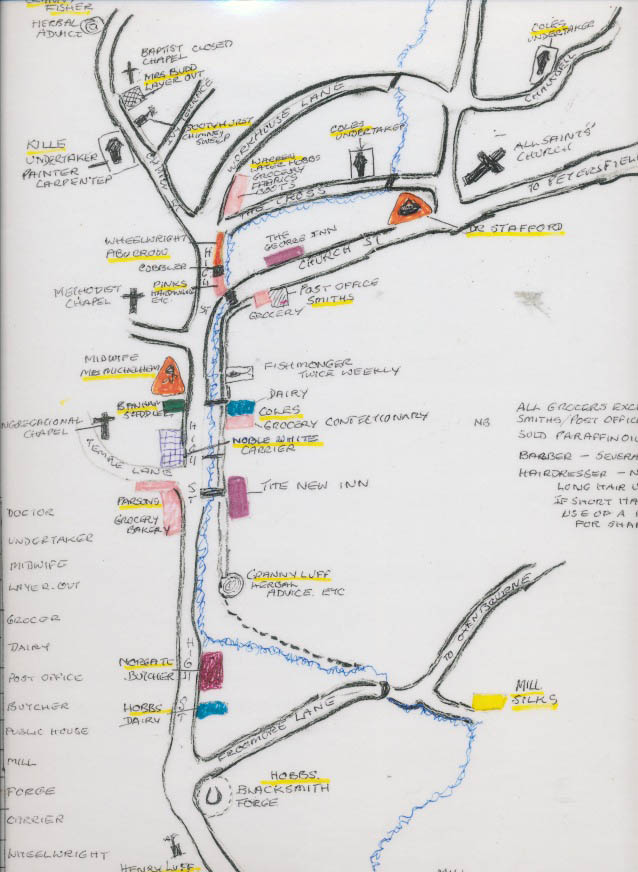
East Meon – the Self-Sufficient Village – in the early 1920’s
These notes were written by Denys Ryder to accompany the map of East Meon in the 1920s drawn by Margery Lambert, above.
You could buy anything, except a Wedding Ring!
1 Church and 3 Chapels – All Saints Church (C of E) is still there after 900 years. The Congregational Chapel in Temple Lane, is now a house as is The Methodist Chapel. The Baptist Chapel, not in use in the 1920’s, has since been demolished to make way for the Primary School
2 Undertakers Pinky Kille the Undertaker, as he was known, and with an unfortunate name for such a profession, was also the village painter and carpenter. Henry Coles was also an undertaker, and had his coffin making workshop up at Chalk dell. He laid out the bodies in part of the house known as Cross Keys, down in The Cross, and Margery and her young friends would often peep through the cracks in the shutters to see them lying there. Henry Coles was reported to make visits to the sick when they were ill.
4 Grocers, one also the Baker, 2 Dairies and 1 Butcher (Norgett) supplied all the culinary needs for The community. All Groceries, excepting Smiths at the Post Office, opposite the George Inn, sold Paraffin Oil, a most important requisite for the cottagers who had no electricity.
Margery Lambert reported that Warrens, where the Tudor House now is, was the Haberdashery and apart from selling groceries and household goods, sold fabrics, boots and shoes, as well as locust beans and figs out of sacks on the floor.
Wet & Dry Fish was available twice weekly from a hut beside the river Meon as marked on her map.
2 Corn Mills and a Sawmill at Drayton – provided feed for cattle on the farms and wood for building. .
2 Chimney Sweeps, (Henry Luff & Sooty Hurst), kept chimney’s clean, thus avoiding thatch fires around the Village 1 Blacksmith , 1 Hardware Store (Pinks) supplied the village with hardware.
1 Carrier (Noble White) , who lived opposite the New Inn in The White House, took farm and garden produce, as well as passengers, down to Portsmouth and brought back supplies on a twice a week basis. He left before dawn and arrive back after dark, having driven over 30 miles in the day.
1 Midwife, Mrs Micklen, brought children into the world, and Mrs Budd, as the village ‘Layer Out’ together with the help of Pinky Kille or Henry Coles, took care of one at the other end of life.
Whilst in between – Granny Fisher at the Coombe end of the village and Granny Luff, in the High Street, kept the Community well oiled and ‘potioned’ with Herbal Advice. Dr Stafford, the village doctor, dwelt in the house opposite the Church. The village was thus well supplied with medical advice of one type or another. Even till recently, Herbalist Tina Stapley occupied Granny Luff’s house, Brook Cottage, with her family and provided ‘alternative medical’ advice for those requiring it.
At one time East Meon had 4 pubs, The George, The Angel, The Bell and The New Inn. In 1920 there were only 2 remaining, the George and the New Inn, and what is now known as The Isaac Walton.