
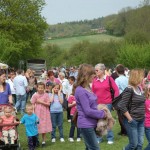
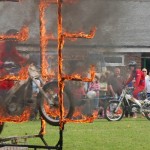

For a larger gallery of photographs of East Meon Country Fair, click here
History relates that there have been Fairs of all kinds and sizes in East Meon for centuries. A Parliamentary Survey of the Manor of East Meon records: “There is belonging to this Mannor one fayer every year which is kept at South Farme, in a field called Fayer Feilde or Chappell Close in the parrish of East Meon. This fayer is kept on the Ladyday in Harvest. The profits belonginge to the lord are £1. 10s 0d. (the Lord of the Manor being the Bishop of Winchester). The field at South Farm is called Fairfield to this day.
Many other fairs and locations followed. In the early 1990s, the Village Hall had been holding a small ‘May Fair’ in the car park (and, when wet, in the Hall); the then Committee was chaired by John Simpson, with Susan Davenport as vice chair. In 1992 Susan suggested that she establish a working party to consider broadening the scope and the size of the next event – to be held on the second May Bank Holiday of 1993
Her first step was to invite Sallie Atkinson who, with the help of her husband Matt, immediately introduced an agricultural element to the fair – Sheep Shearing, Vintage Tractors, along with a farrier (Richard Lovejoy) showing how horses are shoed. Pigs, calves and a goat were displayed in pens, with a competition to guess the weight of the pig. Even bee-keeping would be demonstrated, by Peter Street.
Keith Kitcher arranged for an appearance by ‘the Wasps’, described in the programme as ‘amazing teeny-bikers, aged 7 – 17’, who staged a display of formation motor bike riding. Lettice Ross brought with her the core of the traditional produce stalls and teas. Keiths Rockett and Kitcher, together with Susan Bremner, would run the barbecue; Great Tubbs and Julie Cannings laid on teas. Denys Ryder provided fencing to block off the Right of Way from the bottom of Duncombe Rd and the car park end of Workhouse Lane, and roped in the two show rings. The vicar, Peter Wadsworth, would arrange a fancy-dress procession of children from Glenthorne to the Green, to start the proceedings.
Tugs-of-war had been regular features of earlier fairs, but had fallen into abeyance following an outbreak of fisticuffs after a keenly contested competition between teams from the Izaak and the George. Nobby Whittear still had the cup, and the new fair reintroduced the contest, this time between a team representing the farmers and the rest of the village. Dave Baker arranged for a crime prevention bus and dog handler, together with his police car (whose siren did disturb the horses being shod …) Any connection between the tug-of-war and the police presence was purely coincidental.
To highlight the new emphasis on rural activities, the event was re-christened as a ‘Country Fair’. By this time, it was obvious both that the increased number of attractions would need to occupy the whole of what is now the Green (bigger than at present, because the new estate had not been built). There would be two arenas, a large one for the mini-bike display and the vintage tractors, a smaller one for Dog Agility competition.
It was now apparent that an event of this scale would be impossible without laying out substantial funds in advance, including a deposit on the bikers’ show, St John’s Ambulance and publicity. This was a huge gamble, and Susan only reassured the Hall Committee by persuading ten villagers to underwrite the event to the tune of £100 each. More concern was raised when the Country Fair committee recommended that the entry fee should be £1 a head (50p for OAPs and children aged 12 – 16). This was vastly greater than had even been charged for admission to a village event!
I was corralled under the misapprehension that I knew something about marketing. (As an ITV broadcaster, I did know a bit about segmenting audiences.) We decided, correctly as it turned out, that there were many potential visitors living in the towns and villages between East Meon and the sea. After a bit of research, I recommended that the most economic means of reaching large numbers would be leaflets drop, which Portsmouth News arranged to be distributed with its newspapers in the areas we had selected. History shows that the vast majority of the visitors to the Fair still come from these places.
And the numbers came rolling in. Only one thing had been overlooked – no-one had thought that so many would come by car, and parking had not been arranged. As Susan recollects ‘it was horrendous – had an emergency vehicle tried to get through, it would not have been possible’. The food at the barbecue soon ran out, and the coconut-shy managed by George and Clare Bartlett fell short of coconuts.
The TV satirist Rory Bremner then live in the village, and the village tug-of-war team was beefed up considerably when some of his friends joined in – they were Scottish rugby internationals.
The first Country Fair attracted 1500 people; the numbers grew over subsequent years to the point where today’s Fairs attract 5,000 or more. The Village Hall profited in that first year by an amazing £3,000 and subsequent Fairs have continued to contribute hugely to the running costs of this important village institution. Since Clanfield also held a Fair on that Bank Holiday, the East Meon event was moved to the first May holiday – despite the increased risk of bad weather. Susan Davenport, pregnant at the time she ran the first Country Fair, handed over the reins to Johnny Culley, who in turn handed over to Pam Thorne. The Fair decamped to its original location at South Farm whilst construction was taking place on The Green, but has only failed to take place twice in the twenty years since the Country Fair started.
For source materials on the Country Fair, in the online archive, click here.