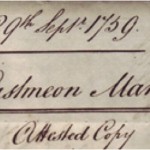
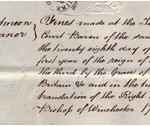
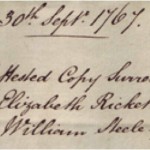
Tessa Barton, who lives in Norfolk, contacted www.eastmeonhistory.net to inform us of a package of documents which she had bought from a bookseller/antique dealer acquaintance. She understood that they had been acquired through clearance sales of a private house. Subsequently, she has kindly sent us the bundle and we have conducted some preliminary investigations.
The documents date from 1725 to 1826, in beautiful copperplate handwriting. Almost all are headed ‘Eastmeon Manor’ and many are copies of conveyances of copyhold land (or bondland) in the manor of Eastmeon (sic). We have placed them in the care of Hampshire Records Office where they can be examined by anyone who wants to take a closer look.
Copyhold land and the manor court
In the Middle Ages the basic categories of land tenure were freehold and copyhold. In each case the land was held by the freeholder or copyholder of (ie from) the lord of the manor. The freeholder’s interest was protected by the King’s courts. Copyhold, the holding of an unfree tenant (or bondman), had as its basis the custom of the particular manor – rather than the common law of England. So it was the court of the lord of the manor (otherwise referred to as the court baron) that had jurisdiction. Conveyances of such land were carried out in the court by surrender (to the lord by the outgoing tenant) and admission (of the new tenant). With the ending of feudalism the lord ceased to have control over his unfree tenants, but land which was copyhold land remained as such, and conveyances continued to be carried out through the manor court. This conveyancing role was effectively the last surviving function of the court. It continued into the 20th century until copyhold was abolished by the Law of Property Act 1925.
The manor
East Meon was a manor of the Bishops of Winchester in Saxon times and, apart from short periods immediately after the Norman conquest and during the Commonwealth in the 17th century, the bishops continued to hold the lordship of the manor up to the middle of the 19th century, when it vested in the Ecclesiastical Commissioners. From the 11th century it in fact consisted of two manors, East Meon, which extended to about 20,000 acres (from Coombe in the south to Oakshott in the north, and from Peak in the west to Stroud in the east), and East Meon Church, of about 750 acres, entirely surrounded by the larger manor. In addition certain sub-manors (including Bereleigh and Langrish) existed. Substantial parts of the manor were held by the lord for his own use.
East Meon in the 18th Century
By the 18th century the large areas of land that the lord had held for his own use were leased out by the diocese. They included Court Farm (including the manor house, The Court House), Church Farm and South Farm. The grant of a tenancy of the manor lands, of course, did not transfer the lordship, which was a separate incorporeal interest extending to the whole of the manor and carrying with it the function of holding the manor court. The manor of East Meon in the 18th century thus consisted of large tenanted farms, areas of freehold land and copyhold land like the holdings that were the subject of the conveyances in the recently discovered documents.
Notable people in East Meon
‘A History of East Meon’, by Freddie Standfield, tells us a little of the hierarchy of East Meon at this time. One Richard Eyles was ‘rated as the occupier of Court Farm’ in the 1750s; he also occupied ‘Beerly Farm’ in the 1760s. Click here to read about Glenthorne House, where the Eyles family lived for forty years, from 1783.
The book also has a note about another holding, Langrish Farm, that “it was tenanted …. of” 4 Manors, viz Meon Manor and Meon Church, belonging to the Church … (then Langrish and he doesn’t list the other two, one of which was presumably Bereleigh). For more about Richard Eyles and his family, see the House History of Glenthorne House, which he owned.Click here
These documents are from a period when parts of the manor, including Court Farm, were held under life tenancies from the Bishop by the Sharrock family of Gately in Norfolk. There are monuments to the both the Sharrocks and the Eyleses in the Lady Chapel of All Saints Church. Whether Richard Eyles held leases of the bishop or were sub-tenants of the Sharrock family is not clear – he may have been tenant of Bereleigh & sub-tenant, through Sharrock, of Court Farm.
The following enquiry was emailed to the website by Francis Williams, the owner of Froize End Vineyard :
“I undertook a drive through recently and thought the village was lovely and interesting. My particular interest was in Vineyard Hole. I believe it was a roman vineyard, but cannot find any more information regarding it and was wondeirng if you could help? What is its history in terms of vine growing and wine making?
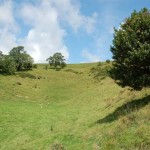
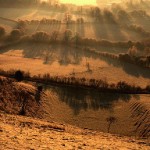
Vineyard Hole, the reputed site of a mediaeval vineyard.
Stunning photograph of Vineyard Hole, taken by East Meon photographer Chris Warren.
“Are there any wild vines growing from its past there? A friend in the village told me about it and because I have a fond interest in growing vines was just wondering about it and who might own it? Any plans to rejuvenate it back to former glories?”
‘A History of East Meon’ was written by villager Freddie Standfield. On page 19 he refers to a pipe roll recorded in 1207/8 which describes the accounts kept by the reeves of Menes Manor (run by the monks who lived in what is now The Court House). It lists the produce of the Manor Farm which includes, among all the corn, wool, milk and nuts … “an even more unusual product, four tuns of wine (£4.2s.0d).
“A tun of wine represented 252 gallons,, so over 1,000 gallons – equivalent to 6,000 bottles – were sold, representing by today’s standards, the average output of a two-acres vineyard. Could this represent a link with today’s landscape feature, the huge hollow indented into the side of Park Hill, a furlong east of the Court Hall called ‘Vineyard Hole”. Gouged by nature out of the steep, chalky hillside, facing due south and completely protected from northerly wind, its name must be derived from past use, though no one knows when it ceased.”
In 2006, George and Clare Bartlett established a new vineyard near Vineyard Hole, in the Berry Garden of The Court House. Click here for George’s accounts of the project.
William Stephens Tregear, Headmaster, East Meon National School, 1876 – 1902
From the Tregear family history
William Stephens Tregear trained as a teacher at St Mark’s Training College, graduating about December 1857. After his marriage to Mary Taylor on 23rd May 1681 he taught for 9 years at Aveston Gifford, a little village 8 miles east of Pewsey, Wilts. Life there was difficult – country tradition at that time was that the schoolmaster was servant of the vicar. There were clashes between a quiet but independent man and a domineering parson.
The culmination came in 1876 when William applied for the post of master at East Meon. His private correspondence was intercepted and opened by the vicar, who did all he could to foil his plans.
The terms of his appointment as Headmaster of East Meon village school are stated in a letter from William Tregear to W. Brodie (7.9.1876). “I understand my engagement to be for wife to take needlework, two daughters to teach and satisfy as PT the Government requirement – the salary to be from £120 – 130 with the house and that assistance to be given in Sunday School.” HE expressed misgivings for his family of 6 children, doubts which proved to have real foundatin since the school house was ‘two up, two down – a parlour (16’ x10’3”) over which was a bedroom divided by a partition into two rooms, a kitchen (12’ x 12’) with a room over. It is said that Mary sat down and wept when she arrived and saw the house, but she soon perked up. Luckily, it was holiday time and beds were put up in the schoolroom, to the delight of the elder children. Later, the two elder boys, William and John, were boarded out happily in the village. In spite of its smallness, this was to be their hospitable and happy home for the next 25 years.
On their arrival, they were visited by the village blacksmith, whose family had been blacksmiths there for over 200 years. He brought a large basket of cakes and tea for these new villagers and an offer of help. “None else had thought of such a thing and my family never forgot.” (EMT) This had its social repercussions. “Many years later I learned that our continued friendship with this family delayed our acceptance into the ranks of the gentry, or near-gentry, i.e. the Lady of the Manor, parson, doctor, the famers and millers, who still had large comfortable houses with maids and went to the hunt, but whose fortunes were fading in those – for them – difficult days of cheaper bread due to the repeal of the Corn Laws. One member said to my sister once: ‘Your friendship with the village blacksmith’s family kept us from knowing you for some time.”
These were the early days of compulsory elementary education under the Act of 1870. Opposition to education, especially in the country, was very strong, and even stronger was the opposition to paying it. People paid 1d, 2d or 6d a week, according to their social standing. “One tradesman paid 6d for his eldest child and then the price went down for the second and third. I remember when a man who had a small oil and colour business – a rag and bone man – was assessed as a tradesman, objected, but had to pay the 6d. So he sent the sixpence in farthings, but my sister (Katie) decided that at least he should learn to count by them. He soon learned to count, and prevailed on his father to use more acceptable coinage.
The former headmaster had been a kindly and gentle soul. Any discipline that there had been was maintained by his wife, who was of sterner stuff. It was said of her – probably apocryphally – that she suspended an unruly boy in a bucket over the well to bring him to heel. Many of the parents were poor and ignorant and their children hostile and sometimes violent. William Tregear, though tougher than his predecessor, was also a quiet man and it it clear that he had a hard life so far as discipline was concerned, until the village was gradually won over. Evidently it was his daughter Katie, in her capacity of pupil teacher, who had a big hand in keeping the peace, as this story shows:
“One of the most vivid recollections as a small child were the visits of a lady, whom we called the village virago. Her children were completely undisciplined and their attempts to do bodily harm, especially kicking, to my father, were numerous. Any possible threat or action for discipline on the part of the schoolmaster brought the lady post-haste, straight from her washtub. She would enter and march straight up to the ‘master’ and shout her threats at him. As a small child I was terrified that she really would knock him down, but she never did. Usually, however, someone more law-abiding would run in with a warning of her advent and my sister would be prepared to bar the way. From Mrs S. we learned to proclaim, with arms akimbo – “I’ll have my rights and justifications if I dies for it.” (I never heard her used bad language, nor do I remember hearing it in the village.) There is a sequel.
As time went on, people became more accustomed to the idea of school and children came to like the atmosphere and the fun of school life. Mrs Sawyer matured as the years went by but in our hearts we wondered if she would break out again. Sure enough, one day she came up post-haste. “I want to see the Master”. My sister fended her off with “You can’t see him now, he’s busy.” “I only want to speak to him civil. I have something special to tell him.” So my sister led her into the presence and she told her story.
A new family had come into the village, bringing a different sort of objection to discipline. Her boy was unruly and had been caned. On his arriving home, his mother, unable to find any marks on his body, had thrashed him severelyt and then taken him to the nearest member of the School Committee, and showed him the weals, saying that he had received them at school. Thanks to Mrs S, and also probably to the incredulity of the Committee member, no more was heard of the incident.
As time went on, the family was accepted in the village and played a very full part of its corporate life – in games, tennis, music and amateur dramatics. The school came to be the acknowledged centre of so many village activities.
Elizabeth (Lizzie) and Katherine (Katie) continued as assistant teachers at the school. As the others grew up, they left the village to pursue their various callings. Of the three older boys, William (Will) went to college, took a degree and became a teacher. For many years he was headmaster of Sandown Secondary School on the Isle of Wight, and eventually became HM Inspector of Schools. John (Jack) and Thomas (Tom) both went into business and both became master grocers … The three younger children, Ethel, Evelyn (Evie) and Herbert were all born at East Meon and left home later.
Family life at East Meon ended abruptly with the sudden death of William Tregear in 1902. He collapsed while teaching and died almost immediately. The respect and affection in which he had come to be held was evinced by the tributes in the local papers, but more by the gatherings at the church and churchyard at his funeral. Mary and her two daughters moved to nearby Petersfield where the two ‘girls’ found teaching posts at the primary school. They lived at and looked after the Petersfield Institute.
Notes from Freddie Standfield’s book
Organised education was provided by the church for nearly 1,000 years from St Augustine’s arrival until the Reformation. After the Reformation, many grammar schools were re-endowed by lay benefactors and by 1740 there were nearly 2,000 charity schools Prior to 1800 only one in every 30 children received organised schooling and the state neither aided nor controlled education.
It was the Sunday school movement which led towards universal education. The date when schooling began in East Meon is unknown, but an article dated 1816, in the Gentleman’s Magazine, described how, in East Meon:
“The north transept is now used as a Sunday and day-school for the neighbourhood. I was much gratified to learn that on Sundays no less than 160 children are collected in this room for religious education – a considerable number, when it is recollected that the neighbouring tithings or hamlets, from which many of the children come, are some of them at least three or four miles from the church.”
The number of weekday attendants is uncertain … the Church Rate Book refers to a meeting of the Vestry in 1794 when ‘William Vinn, Schoolmaster’ … was appointed parish clerk, and the Burial Register records his burial in 1806.
In 1833, Parliament allocated £20,000 for the erection of schoolhouses for the whole of England and Wales. East Meon’s first purpose-built school was constructed in 1845 at a cost of £696 following the gift of the site from the Bishop of Winchester in 1844. The convenance transferred a strip of roadside waste of the manor plus an even narrower strip of Church Hill Field to ‘the Minister Church Wardens and Overseers of the Parish of East Meon’ upon trust for ‘a School for the education of Poor Children and as a residence for the schoolmaster. The deed adds that the ‘school shall always be conducted upon the principles of the Incorporated National Society for Promoting the Education of the Poor in Principles of the Established Church and shall be under the general management and control of the Committee for the time being of the Subscribers of the said School’.
The combined school and master’s house was constructed mainly of knapped flints with a slate roof ‘in the Elizabethan style’. In the school’s early days, the pupils taught by schoolmaster John Hones totalled about 60 – 70 boys and 50 girls, a tiny minority paying 3d a week and the rest 1d. Income from ‘children’s pence’ was augmented by annual payments from benevolent subscribers who included the bishop (£2), Magdalen College (£2 2s), Lord Gage (£2), Sir William Joliffe (£2), John Bonham Carter (£4), G.T.Nicholson (£1) and the vicar (£1).
In 1848, John Forder and his wife Sarah were appointed master and mistress at a stipend of £50 together with four tons of coals and the use of the house and garden.
At national level, pupil teachers originated in 1846, being apprenticed from the age of 13 – 18.
After 28 years, the Forders retired at Michaelmas 1876, to be succeeded by William Tregear.
1878 school log entries include:
Jan 31st – Holiday, the Master having lost the Infant of the family – buried in East Meon Churchyard
June 24th – The heat in the room excessive. The closets are far from sweet.
June 15th – Master out of the school much of Wednesday his youngest child being very ill – also Thursday when she died.
July 15th – The Master obliged to call in the Doctor for another daughter – The Doctor ascribes the ailment to the Water and Closets – the Closets being too close to house and school.
It is strange that these deaths do not appear on the Tregear family log. According to FS, The master recorded 1878 as ‘an eventful year for my family’ which, as Freddie notes is strange when his infant, little Edith, died aged 6 months and his youngest child, Margaret, died aged 3, probably both of typhoid fever.
For source materials on East Meon National School, click here.
We were contacted from Vancouver, Washington State, USA, by Loni Marcotte. Loni had spotted the first photo in the gallery, below, of a road tar gang, taken in 1930. Loni identified the man on the left of the photo as her great grandfather Jeremiah Christmas and supplied us with more photos and information, as follows:
William Jeremiah Christmas was born 12-18-1866 and died in 1934 in East Meon. His wife, Ellen Sims Christmas was born 8-27-1869 and died in 1955 in East Meon. They had 8 girls (one of them my grandmother) and 3 boys. One girl and all three boys died in infancy.
William Barratt was born 10-29-1822 in Staffordshire. He migrated to the US with a daughter, Sarah (still trying to find that line) settling in Iowa where he re-married and had 2 girls and 3 boys (one my grandfather). The family then moved to Gabriola Island, BC Canada. When WWI broke out, my grandfather, Joseph and his older brother, Jack, joined the Canadian Expedition Forces to fight the Kaiser. They left brother Tom at home to care for the ageing folks, William & Sophronia. Jack & Joseph fought in France. Uncle Jack was wounded there and recuperated in England. His nurse was Alice May Christmas, my grandmother’s sister. Nellie, Rose, Ellen, Maude & Lilly Christmas, the wife and daughters of Jeremiah Christmas. Two of the sisters, May and Milly, married three Canadian brothers, two of whom were in Britain as soldiers during the First World War. The third, Dolly, sailed out later in to see if there were ‘any more at home like you’ and did indeed find herself another brother to marry.
Jack & May were married 10-1-1918 in East Meon. Joseph met May’s sister Millie (my grandmother) and once the troops came home, she sailed to Nova Scotia and took a train to Vancouver BC to marry him. Brother Tom corresponded with yet another sister, Dolly, and they eventually married too. Three Barratt brothers married three Christmas sisters. Once the folks passed away, all three families relocated to Camas, Washington, which is where I grew up. My grandfather and Uncle Tom passed away when I was two, but I have many fond memories of grandma, Aunt Dolly, Uncle Jack and Aunt May. Four of the Christmas sisters remained in England…Maud, Lillian, Gertrude Rose and Winifred. Many of their descendants are still in the Petersfield area. They are the Nicholson, Ball, Wellfare, Maubach, Goddard and Pamplin families.
Many years ago, when I first became interested in genealogy, I sent a letter to the “Mayor of East Meon” looking for information on the Christmas family. The postman didn’t know who to deliver it to, so he dropped it by Herbie’s garage since he apparently was the “unofficial” Mayor there. Imagine his surprise when he found out it was for him! He and Nellie came out for a visit in the early 80’s and he told me what a chuckle he got out of that. Since then, Chris & Hazel Pamplin (Hazel is Herbie’s daughter) have kept an ongoing communication with Mike’s parents, my Uncle Joe & Aunt Donna Barratt over the years. Their son Mark was out here several years ago and we were able to meet him for the first time.
Michael Barratt
The pictures above trace the story of one of Jeremiah Christmas’ grandsons, Michael Barratt, who spent more than half of the year 2009 in Space, on the Russian Space Station. He was working at NASA as doctor to the astronauts; he was so keen to go up himself that he was able to qualify as an astronaut himself ; he was to join the team working in the Russian Space Station, which involved training in Russia and travelling both ways in Soyuz Space Ships. The space craft carrying Mike Barratt landed safely on October 10th 2009. It landed on the Russian steppe on a bitterly cold day. Loni reported at the time that “Mike is experiencing some strange affects of “gravity”, but his mom says he is doing okay.” After his safe return, Mike retrained as a space pilot and has flown subsequent missions in this capacity. He has visited East Meon on more than one occasion since, the most recent being in November 2012 when he visited the village primary school.
In 2011 Richard Pink made contact through the village website, enquiring of the History Group about his family, who had lived in East Meon for several generations (although there is no remaining Pink in the village). Richard had already done a great deal of research, but the Group, and in particular David Hopkins, was able to help him add to his knowledge. We met him when he came to the Flower Festival in June 2012 and visited the House Histories exhibition; since when he has written a full report on his researches.For the source materials, including this account, on the online archive, click here
Richard Pink, with wife Scarlet and son James,
The Sunderland connection
Richard was born and still lives in Middlesbrough, now thought of as an industrial town but with a history which reaches back a long way. Richard discovered, through Reverend Terry Louden’s history of the early church in East Meon (click here), that Christianity may have been brought to this village by St Wilfrid, Bishop of Northumberland in the 7th century. Wilfrid’s monastery, St Peter’s, was founded in Monkwearmouth in Sunderland where, by chance, a James Pink was married in 1836. Bear in mind that families tended to repeat the same Christian names time and again ….
Middlesborough Iron Works, blast furnace, 1840s
The Sunderland connection – the Pink family.
St Peter’s Church, Monkwearmouth
This James Pink’s occupation was variously given as a mariner, shipwright and carpenter. In the 19th century, Sunderland was one of the biggest shipbuilding centres in Britain and it attracted workers from far and wide – including, it would appear, from Hampshire. Of his eight children, the eldest son, Edward Pink, was born in 1838 and was a shoemaker; he appears in the census of 1881, with his wife and 3 of his children, plying his trade in Alton, Hampshire. Also on the 1881 census, Edward’s eldest son, James William Pink is recorded as a Royal Marine, who was in the Royal Naval Hospital, Haslar, Alverstoke, Hampshire. So this branch of the Pink family had a Hampshire connection.
It was the fourth child of James and Margaret, Samuel George Pink, who moved from Monkwearmouth to Middlesbrough, around 1878, with his wife and 5 children, where they had a further 7 children. Samuel George Pink was Richard’s great great grandfather. His occupation was carpenter and shipwright.
Hampshire Pinks
All Saints Church, Hinton Ampner, where James Pink of Bramdean married Elizabeth Brier in 1817
All Saints Church, East Meon
However, Richard has tracked down another James Pink, who was married in Hinton Ampner in Hampshire in June 1817 to Elizabeth Brier, who subsequently had several children. However, there is still further confusion surrounding the name James Pink. From the Parish Registers of All Saints, East Meon, Richard discovered another James Pink, this one baptised in East Meon in 1816. The reason he had not found this James Pink previously was because he was illegitimate and was listed in the database under his mother’s name, Elizabeth Tull. The baptism entry reads:
25th August 1816 James Pink son of illegitimate Elizabeth Tull of East Meon, pauper, F Dunderdale officiating minister.
It was not until the following year that his parents were married:
21st January 1817 James Pink and Elizabeth Tull married by Banns by Dunderdale Curate in presence of Robert Smith and Sarah Chace.
This couple also had children: Jane, born around 1820, Samuel, born around 1826, Henry, born around 1828, Mary, born around 1832, and Eliza, born around 1835. A baptism entry reads:
6th March 1825 William son of James & Elizabeth Pink, East Meon, Maltster. Spencer Rodney Drummond officiating Minister.
Why two of the children were baptised at All Saints Church and the others were not, may have something to do with the religion of their parents. A James Pink of East Meon applied for a dissenter’s meeting house certificate on 16th February 1828 (also Robert Pink of East Meon applied for his house to be used as a dissenting meeting house in 1844). An illegitimate girl was baptised at the East Meon Church in this year:
16th September 1828 Ellen dr of James Pink East Meon Maltster and Ann Abburrow Hambledon.
Therefore, there were two James and Elizabeth Pink families in Hampshire at this time. Both couples were married in 1817 and both had sons named James and William. In order to verify his findings, it was necessary for Richard to examine both families and try to trace both family histories.
William Pink, surgeon
The James Pink who married Elizabeth Tull was the son of William and Sarah Pink, the father’s occupation being surgeon. (The confusion does not end there; there was another William and Sarah Pink who lived in East Meon in the latter part of the eighteenth century. This William Pink was a farmer and his marriage produced at least ten children, the last one, also a James Pink, died only a few months old in 1784.) Our William Pink, the surgeon, had his second child, Sarah, baptised in East Meon on 26th September 1785.
There is a reference in the Hampshire Directory of 1784, to a William Pink in Alresford recorded as a “Surgeon and Man-midwife”. From the East Meon Memorial transcriptions online:
To the memory of William Pink who departed this life 15 Sept 1819 age 59, also Sarah his Wife who departed this life 23 Oct 1830 age 74, also 3 of their children, Sarah, eldest daughter, Jane 2nd daughter & William their infant son.
It seems likely that William Pink practised as a surgeon in Alresford and had his first child there, before moving to East Meon. There is a possible reference to William in the late eighteenth century from the Star, from Wednesday 24th October 1798:
Finchdean Volunteers. William Pink, Gent. to be surgeon.
William Pink died in 1819 and his wife Sarah died in 1830, aged about 70. William Pink’s death was reported in the Hampshire Telegraph and Sussex Chronicle on 20th September 1819:
Died, on Wednesday, suddenly, Mr Pink, Surgeon, of East Meon.
The family in trouble
After his death, the Pink family appear to have suffered financial difficulties, land was sold and surrendered, as the following newspaper extracts show: Hampshire Telegraph and Sussex Chronicle, 31st May 1824. To be SOLD by AUCTION… Lot 5.-Six Acres (more or less) of capital ARABLE LAND, and one acre (more or less) of PASTURE, situate near the village of Eastmeon, in the occupation of Messrs. . Barnard and Pink.
James Pink’s partner in these transactions is probably one of the Barnard family that was linked to the Barnards Cottages on East Meon High Street.
Hampshire Telegraph and Sussex Chronicle, 14th February 1825. EAST MEON,-HANTS. FOR SALE by PRIVATE CONTRACT… Lot 3.- Two Closes of Arable and Pasture LAND, containing about seven Acres, situate near the Village of Eastmeon, in the occupation of Messrs. Barnard and Pink, Copyhold of Inheritance of the same Manor. For particulars apply to Messrs. T. A. and W. Minchin, Portsea and Gosport.
William Pink owned Duncomb Farm, but after his death, this, too, had to be sold. Perhaps James Pink was unsuccessful as a maltster and this meant that he had to sell off the land he had inherited. At around this time, James and his family moved from East Meon to Ramsdean, and James’ occupation changed to agricultural labourer.
William Pink’s will from 11th May 1813 names three executors, including a James Andrews Minchin of Petersfield. The History Group helped Richard establish that William Pink had married Sarah Minchin in Portsea on 24th April 1781, and that the witnesses to the will were cousins of Sarah’s, Thomas Andrews Minchin, an Attorney and Banker, and Thomas Minchin, who had a successful career in the Navy. James Andrews Minchin was a notable figure in the area. The Minchins had returned from Ireland, where they had acquired land as a result of service in Cromwell’s Army.
George Pink
Unlike his brother James, William Pink’s second surviving son George (1794-1886) appears to have prospered. He was a surgeon in East Meon from at least 1841 until the 1870s. (It took about seven years to qualify as a surgeon and it must have cost William a lot of money to pay for George’s apprenticeship.)
White’s History, Gazetteer and Directory of Hampshire 1878 includes a reference to George Pink who was still active as the “surgeon and medical officer” for East Meon. He was recorded on the 1881 census as a retired surgeon. The census records also show that he was a member of the Royal College of Surgeons, a licensed apothecary and a GP.
The house, in the middle, now known as Brooklyn, photographed in 1914
The tithe apportionments for 1852/53, supplied by the History Group, show that George Pink owned land and property in East Meon and Frogmore, including the substantial house in which he lived, now known as “Brooklyn”, next to Glenthorne House on the High Street.
George Pink had married Ann Guy at All Saints, East Meon on 4th August 1832. The Guys were a prominent and well-to-do East Meon family. George and Ann had six children, three of whom died in infancy. Ann died young, at the age of 38, and her passing was recorded in the Hampshire Telegraph and Sussex Chronicle on 23rd February 1850:
DIED. Pink – On Tuesday last, Ann, wife of George Pink, Esq., Surgeon, of Eastmeon, much regretted by her family and a large circle of friends.
George Pink’s brother-in-law, George Guy, was also a surgeon at East Meon, but he died in 1846 at the age of 29. Since George Pink had only one son who died in infancy, it may be that George Guy was apprenticed to him.
That George Pink continued to own land in East Meon is confirmed by a list of property owners in the Petersfield area from the Hampshire Telegraph of 1876. This lists all the landowners in East Meon, including a Richard Pink.
Bridge Cottage, as it is called today – probably Bridge House in the 19th century.
Bottle Ale Cottages in Frogmore today, probably Bottle Ale House in the 18th century.
The tithe apportionments further show that George Pink let a cottage in Frogmore to William Weeks Jr, who was an executor of William Pink’s will in 1813, and that he let Bridge House in Frogmore to William Kille. The tithe apportionments also list Samuel Kille as letting a cottage to “Henry Pink and others”.
George Pink appears to have had a close association with the Kille family of East Meon. From the census records, Allan G Kille was his groom in 1861 and Walter Kille (aged 5) is recorded as a visitor on the 1871 census. Towards the end of his life, in the 1881 census, George Pink is recorded as lodging with the Kille family:
Village Caleb Kille 42 Carpenter East Meon
Hephzibah Kille 39 East Meon
Walter Kille 15 Carpenter East Meon
Nun Kille 11 Scholar East Meon
Ernest Kille 9 Scholar East Meon
Clement Kille 7 Scholar East Meon
George Kille 5 Scholar East Meon
Arthur Kille 13 Carpenter East Meon George Pink 86 Retired Surgeon East Meon
Earlier Pinks
There were other Pinks of East Meon, such as Richard Pink the miller, Robert Pink from the Isle of Wight, or Henry Pink and his family in Frogmore – and there have been Pinks living in East Meon for several hundred years. For instance, Nicholas Pynke, “yeoman of Oxenbourne”, died in 1570. Glenthorne House, one of the largest in the village was owned in 1729 by Robert Pink,, in 1757, by his son Thomas Pink, then in 1779, by his son Thomas Pink, who surrendered it that year to John Hawkins …”
Hampshire Record Office holds an enormous amount of information on property ownership and transactions relating to the Pink family going back to the mid-seventeenth century. It is possible that the family had been engaged in the Malt trade previously. A 1728 gift by the Pink family of “le Malthouse” for the use of the poor is documented:
Tourn of Hock, 1 Geo II. Admission of Robert Pincke, Stephen Steele Stephen Woodman, William Baker, Robert Stale, John Silvester, Joseph Terrell and Stephen Tulett to a close containing an acre now or late an orchard called Backclose with a cottage built thereon lying on the east of Duncombe Lane and also a house called le Malthouse, for the use of the poor of the parish of East Meon in the tithing of Meon Manor/ except and reserved to Thomas Pinke his heirs and assigns a tenement lying on the west of le Malthouse now in the occupation of John Long, and the use of a well pertaining to a cottage and house called le Malthouse by surrender of Thomas Pinke.
The book of court rolls extracts shows that the Bottle Ale House in East Meon was in the possession of Richard Pink in 1764. Since this house was owned by George Pink in 1852, it may show a connection between Richard’s branch of the Pink family and the Pinks of East Meon that dates to before William Pink the surgeon.
Work in progress
It would appear that the only way to sort out the confusion of surrounding the various Pink families with any certainty is to map all the Pinks who were either born in East Meon or lived there. Richard is only in the early stages of this task, starting with the nineteenth century. One interesting fact that has already emerged is that Sir William Pink of Shrover Hall, Cosham, who was Mayor of Portsmouth five times between 1875 and 1891, had a connection to East Meon. He was born on 15th December 1829 at Durley, near Botley, in Hampshire, the son of a farmer, Thomas Pink. Thomas Pink was born in East Meon in 1785 and, although he lived at Durley from about 1812 to 1841, producing thirteen children with his wife Sarah, the 1851 census shows that he lived at Oakshott, Froxfield, farming 120 acres and employing two men. One of his other sons, Richard Pink, was a miller at East Meon, appearing on the census records at Upper (or South) Mill in 1881 and 1891. In the biography of Sir William Pink on the History in Portsmouth website, it is noted that: “The Pinks were a notable Hampshire family having their family seat, for over 300 years, at Kempshott Park near Basingstoke.” (Pictured, below – Jane Austen was a visitor to this house.)
Kempshott Park
As for the James and Elizabeth Pink who married at Hinton Ampner in 1817, they eventually moved to Froxfield, where they appear on the 1841 and 1851 census. By 1861, Elizabeth, now widowed, was still living at Froxfield, with her grandson John Pink. Two of their sons, James and William, appear to have married sisters, Naomi and Mary Jane Hunt respectively. William and Mary Jane married in Portsea in 1856 and James and Naomi were married there in 1860. On the 1871 census, the two couples and their families were living a few doors away from each other on Sinah Lane, South Hayling. The occupation of the two brothers is given as agricultural labourer.
GH Pink hardware store, which occupied a prominent position in East Meon from the 1920s to the 1950s.
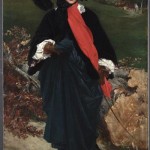
Portrait by Sir Frederick Leighton of May Sartoris
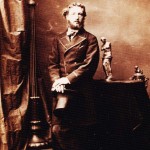
Sir Frederick Leighton, photographed in the 1860s
Detail from painting – the windmill
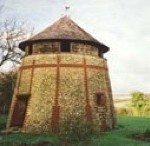
Marland Mill, to the north west of West Meon
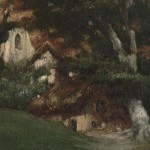
Detail of Leighton painting – village church.
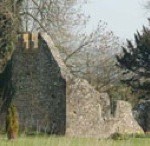
Ruins of the chapel in the grounds of Westbury House today.
Detail of portrait of May Sartoris
We were contacted by the Senior Curator of the Kimbell Museum in Austin Texas asking us to help him establish the location of this portrait of May Sartoris who lived in Westbury House in East Meon in the 1860s
Follow the story as we use clues in the painting to come to no particular conclusion …
Malcolm Warner, Senior Curator of the Kimbell Art Museum in Fort Worth, Texas, asked for help in establishing where this splendid portrait was painted. It was painted in around 1860 by Sir Frederick Leighton, the celebrated Victorian painter who had strong links with the pre-Raphaelites.
The painting features May Sartoris who lived at the time with her family in Westbury House (the westernmost property in the parish of East Meon, despite the fact that it borders West Meon). They rented the property from Viscount Gage, the descendant of a distinguished Irish peerage who owned a great deal of the Meon Valley.
Malcolm Warner asked for help in identifying the two buildings featured – the mill at the top right of the painting and the church at May’s right shoulder. He wanted to establish where May would have stood for the painting to be made.
The Sartoris family was colourful. May’s mother Adelaide was one of the illustrious theatrical family, the Kembles, and one of the greatest opera singers of her time. Adelaide and her wealthy husband Edward lived at Westbury as tenants from 1859 to 1863, in which year they inherited the nearby Warnford Park and moved there. Adelaide was a great hostess and friend of many of the great artistic, literary and musical figures of their age – including Robert Browning … and Frederick Leighton.
There are two buildings in the painting. The windmill on the hill was almost certainly Marland’s Mill – which sits on a hill a mile north of the village and which couldn’t be seen from Westbury House.
The second building is the tower of a church. It is harder to establish which church this might be. It is certainly not the church of East Meon . The present church of West Meon was built after Leighton painted this portrait. In the grounds of Westbury are the ruins of St Nicholas chapel which is reputed to be 13th century in origin. It is much smaller and ruinous today than at the time of the painting. Our colleagues in West Meon have found reference to the chapel being restored in the 1790’s or thereabouts for use by the family of the third Viscount Cage. However, it is a small building and would never have had a square tower.
It is most likely that the church tower is that of West Meon’s previous church. There is no viewpoint from which Marlands Mill and West Meon Church could have been seen together (still less St Nicholas Chapel) so it is most likely that Leighton painted May first, then walked around the neighbourhood with his easel, filling in the background from items which caught his fancy,
Malcolm Warner wrote to us: “I’m thinking, somewhat reluctantly, that I’ll have to say that Leighton composed a background for the portrait based generally on the landscape in your area but not showing any particular view. Isn’t that the conclusion we’ve reached?”
The Gage family later sold Westbury House; the original building was burned down in a dramatic fire in 1904 ((Click here for an account in The Times of the fire,) It was rebuilt at considerable expense, became a preparatory school for boys, and is today a nursing home for patients with head injuries.