Some families living in East Meon today can trace their ancestry to Norman times; their names appear in the Winchester Pipe Rolls. In many cases, descendants of East Meon families who now live abroad or in other parts of the UK have contacted the History Group and asked for help in tracing their ancestors.Several of these accounts come from the parish magazine, Meon Matters. (To access the reports use the links menu on the left.)
William Taylor Tregear was the second Head of East Meon National School
Next to Jeremiah Christmas, on the left, is Stanley Searle, nicknamed Curly
Jeremiah Christmas, on the left, was great grandfather to a NASA spaceman.
Frank Collyer, First World War Hero
Millie Christmas, one of the sisters who went to America and married three brothers.
Herbie Goddard, the “Mayor” of East Meon
Elsie Butler’s Wedding – one of two East Meon brides whose weddings are revisited in this Meon Matters article
Margery Lambert as a young nurse. She was described by the Vicar in his funeral address as ‘the nearest thing to a saint’.
Kath Adams waving to a neighbour
Peter Brook, East Meon villager who headed up BBC TV’s team of continuity announcers.
The life story of Frances Childs, from Meon Matters
Right to left, John, Nobby and Ian Whitear, part of one of East Meon’s largest resident families.
Currently, the History Group is embarking on a campaign to conduct interviews with today’s residents with memories of their families reaching back into the first half of the last century. These Oral Histories provide a graphic picture of life in the village when there were over twenty shops and tradesmen, as opposed to one shop and two pubs today.
We invite anyone who wishes to learn about their East Meon ancestors to to contact us from the home page of the site.
The wife and daughters of Jeremiah Christmas. Two of the sisters, May and Milly, married three Canadian brothers, two of whom were in Britain as soldiers during the First World War. The third, Dolly, sailed out later in to see if there were ‘any more at home like you’ and did indeed find herself another brother to marry.
Middlesbrough Iron Works blast furnace iron-making plant in the1840s We were contacted by Richard Pink, the descendant of a prominent East Meon family who lives in Middlesborough. Richard had already conducted research into his family’s genealogy and we were able to help him with some details. This is his full report, starting in Sunderland.
The Sunderland connection
It is probably best to start this account with a bit of background information on Middlesbrough, the town where I was born and have lived all my life. Middlesbrough is a fairly large town in the north east of England, at the mouth of the river Tees. Although it is surrounded by, and, as it expanded, has swallowed up several ancient villages, ones that are mentioned in the Domesday Book and whose histories stretch back to the Saxons and beyond, Middlesbrough itself has an elusive, history. There is a theory that the high ground where the old part of the town started was once the site of a Roman signal station, safeguarding a crossing of the Tees that linked York to Hadrian’s Wall. Another theory is that a Saxon church stood on the site from the seventh century. However there is no concrete evidence for either theory. A monks’ cell was established here in the twelfth century whose ownership was disputed by the Augustinian Priory at Guisborough and the Benedictine Abbey at Whitby. Unlike its near neighbour and rival on the other side of the Tees, Stockton, the population of Middlesbrough remained small and static, up until the nineteenth century. In 1801, Middlesbrough was a hamlet with a population of just 25, living in four farmhouses. In 1829, the population was still only 40 and yet by the end of the century, it had grown rapidly to become a large industrial town of 91,000 inhabitants. The period of growth started in the 1840s, first as a port for exporting coal from the Durham collieries and then the iron and steel industry dominated the town’s economy. Therefore the family history of most people in Middlesbrough reflects this rapid influx of migrant workers who arrived in the town from the mid to late nineteenth century. I have Scottish and Irish ancestors, as well as Yorkshire and Hampshire ancestors, via Sunderland.
The name Pink is an unusual one in the north east. One family theory was that we were descended from Cornish tin miners, who had come to the area to cash in on the boom in the iron industry. It was a fact that miners did travel from all over Britain, Europe and further afield, to work on Teesside. There were certainly people from Cornwall living and working in Middlesbrough and some of them can be found recorded on the 1881 census, which was about the time the Pinks moved to Middlesbrough. However I have not, as yet, found any Cornish miners working in the Teesside iron industry. It was not until later that I found out that Cornwall is one of the top three counties in England for having the highest concentration of inhabitants named Pink. The other two are Kent and Hampshire.
I was fortunate when I started to do my family history that someone had already made a start on it and had made their research available on the internet. Therefore in tracing my family name of Pink, it was largely a case of verifying what had already been done.
St Peter’s Church, Monkwearmouth, where James Pink of Hampshire was married to Margaret Charlton in 1836
From this I soon found out that I was related to a James Pink of Hampshire, who was married to Margaret Charlton at St Peter’s Church, Monkwearmouth (Sunderland) on 5th January 1836. Although I live in Middlesbrough, I had visited this church prior to finding out any family connection. It is the site of a famous Saxon monastery founded in 674, the one where the Venerable Bede grew up and is twinned with the more famous St Paul’s Monastery in Jarrow, where Bede spent his adulthood and wrote his famous historical and theological works. St Peter’s still retains a lot of Saxon stonework, particularly in the Church tower, and recently put in a joint bid with St Paul’s for World Heritage status. However, in the 1830’s a lot of the churchyard had been covered by a huge mound of ships’ ballast that was dumped there by passing traffic on the River Wear. This had been going on since the Middle Ages and St Peter’s, which once stood on a hillock, became surrounded by sand hills and the west end of the church and the lower part of the tower were hidden from view. It was not until the 1860s, when the church was restored, that the sand was removed and the Saxon features were revealed. The ballast hills were sometimes built upon and James Pink’s brother William lived on one, Lookout Hill, in 1851.
Sunderland shipbuilding in the 19th century
It was interesting to read on the East Meon History Group website the essay by the Vicar of All Saints, East Meon, Rev. Terry Louden, on the history of Christianity in East Meon. This looks at the role of Wilfrid of Northumbria in spreading Christianity to southern England in the seventh century. Wilfrid was Bishop of Northumbria from 668 to 677, the time when St Peter’s Monastery was founded at Monkwearmouth. Then from about 678-686, he was based at Selsey, spreading the Christian message to Southern England, including Hampshire.
The Lambert Barnard mural of St. Wilfrid commissioned by Bishop Sherburne c 1508-1536 in the North Transept of Chichester Cathedral.
James Pink’s occupation is variously given as: mariner, shipwright and carpenter. On the 1841 census he was living at Wreath Quay on Monkwearmouth Shore. At this time, Sunderland was one of the biggest shipbuilding centres in Britain and it attracted workers from far and wide. He was living with is wife Margaret and young son, also James, and a William Pink, probably James’ brother, aged 15 (this is an approximate age, as ages on the 1841 census were rounded to the nearest 5) and his occupation was a ship’s blacksmith (“ship smith ap”).
James and Margaret had 8 children, before James died in 1859. These mainly lived and worked in the north east, although the eldest son, Edward Pink, born in 1838 (who is not listed with his family in Sunderland on the 1841 census and who appears to be missing altogether from this census), was a shoemaker, who worked in Sunderland, Newcastle and Hartlepool. This was apart from a period around 1881, where he appears on the census with his wife and 3 of his children, plying his trade in Alton, Hampshire. Also on the 1881 census, Edward’s eldest son, James William Pink is recorded as a Royal Marine, who was in the Royal Naval Hospital, Haslar, Alverstoke, Hampshire.
It was the fourth child of James and Margaret, Samuel George Pink, who moved to Middlesbrough, around 1878, with his wife and 5 children, where they had a further 7 children. Samuel George Pink was my great great grandfather. His occupation was carpenter and shipwright. He married Dorothy Ann Sanderson of Southwick (“Suddick”), Sunderland at the Independent Chapel in Dundas Street, Sunderland in 1866. Dorothy eventually became a midwife in Middlesbrough. Samuel’s mother Margaret also ended up in Middlesbrough, first living with her daughter in North Ormesby and ending her days in the workhouse.
The Hampshire Connection
All Saints Church, Hinton Ampner, where James Pink of Bramdean married Elizabeth Brier in 1817
One problem I have had is in making the leap from the era of birth registration and the census, to the early part of the nineteenth century and from the north east of England to Hampshire. This is because the person who did my family tree linked the James Pink who was married in Monkwearmouth to a James and Elizabeth Pink who were married in Hinton Ampner in Hampshire in 1817. James Pink of Bramdean married Elizabeth Brier of Hinton Ampner at All Saints Church, Hinton Ampner on 18th June 1817. They had several children, the first being Francis Pink, baptised at St Simon & St Jude Church, Bramdean on 11th August 1817. Their second child was James Pink, baptised at Hinton Ampner on 11th July 1819. Two more sons, George and John Pink were baptised at Hinton Ampner on 18th March 1824 and William Pink was baptised at All Saints, East Meon on 6th March 1825.
I have not been able to contact the person who did my family tree in order to ask him what evidence he has for claiming that the James Pink of Monkwearmouth was born in Hinton Ampner. From the CD ROM produced by the Hampshire Genealogical Society (HGS) of Church of England baptisms, the Hinton Ampner James Pink is the only one returned when searching on that name that could fit with being married in 1836. However, this would make him either 15 or 16 when he got married, which, although not impossible, would seem unlikely. It is possible that he was born before 1819 and then baptised later, which was common practise at the time. However, the fact that Francis Pink was baptised in 1817 would make this unlikely.
From the census records of 1841 for Monkwearmouth, James Pink gives his age as 25 and he was born out of the county of Durham. On the 1851 census, he gives his age as 35 and his place of birth as Eastmere, Hampshire. Living with James in 1841 is William Pink, presumably a younger brother. This census records his age as 15 and his birthplace as being out of the county. By 1851, William was married and making his way in the world separate from his brother. This census records his age as 27 and his birthplace as East Meon, Hampshire. On the 1861 census he records his birthplace as Petersfield and, for 1871 and 1881, he again gives East Meon as his place of birth. It may be that James Pink was confused about his birthplace. His family did appear to move around the Bramdean, Hinton Ampner and East Meon area quite a lot. Somehow though, this did not ring true with me and I always suspected there was something wrong with the Hinton Ampner connection.
The East Meon connection
It was not until fairly recently that I did a free text search on some search results I had downloaded from the baptism CD ROM and discovered a James Pink baptised in East Meon on 25th August 1816. The reason I had not found him previously was because he was illegitimate and was listed in the database under his mother’s name, Elizabeth Tull. The baptism entry for James Pink reads:
25th August 1816 James Pink son of illegitimate Elizabeth Tull of East Meon, pauper, F Dunderdale officiating minister.
It was not until the following year that his parents were married:
21st January 1817 James Pink and Elizabeth Tull married by Banns by Dunderdale Curate in presence of Robert Smith and Sarah Chace.
This couple had children: Jane, born around 1820, Samuel, born around 1826, Henry, born around 1828, Mary, born around 1832, and Eliza, born around 1835. I have not been able to find baptism records for these children and have taken their details from census records. It now also seems likely that the William Pink baptised in 1825 at East Meon was their son and not from the Pink family married in Hinton Ampner. The entry reads:
6th March 1825 William son of James & Elizabeth Pink, East Meon, Maltster. Spencer Rodney Drummond officiating Minister.
[Incidentally, Francis Pink, mentioned earlier, married Ellen Blackman from East Meon and lived there for a short time around 1850 (at “Berely Lodge” according to the 1851 census). Ellen Blackman’s mother was Hannah Tull, who was the younger sister of Elizabeth Tull and so the two Pink families were distantly related through marriage.]
All Saints Church, East Meon
Why two of the children were baptised at All Saints Church and the others were not, may have something to do with the religion of their parents. A James Pink of East Meon applied for a dissenter’s meeting house certificate on 16th February 1828 (also Robert Pink of East Meon applied for his house to be used as a dissenting meeting house in 1844). An illegitimate girl was also baptised at the East Meon Church in this year:
16th September 1828 Ellen dr of James Pink East Meon Maltster and Ann Abburrow Hambledon.
Although James Pink is referred to as a maltster in this record and on William Pink’s baptism entry in 1825 and on a surrender of land document also in 1825, on the 1841 and 1851 census, he is referred to as an agricultural labourer. By this time, the family had moved to Ramsdean.
Therefore, there were two James and Elizabeth Pink families in Hampshire at this time. Both couples were married in 1817 and both had sons named James and William. It would appear that the genealogist who looked at my family tree got these two families confused, mixing the Hinton Ampner Pinks with those in East Meon. In order to verify any findings I came up with, it was necessary to examine both families and try to trace both family histories.
The James Pink who married Elizabeth Tull was baptised at All Saints, East Meon on 25th January 1790. He was the son of William and Sarah Pink, the father’s occupation being surgeon. Making things harder from a research point of view, there was another William and Sarah Pink who lived in East Meon in the latter part of the eighteenth century. This William Pink was a farmer and his marriage produced at least ten children, the last one, also a James Pink, died only a few months old in 1784. William Pink the surgeon had his second child, Sarah, baptised in East Meon on 26th September 1785. It is at this point in the register that William Pink is noted as a surgeon, to distinguish him from the other William Pink in East Meon.
There is a reference in the Hampshire Directory of 1784, to a William Pink in Alresford recorded as a “Surgeon and Man-midwife”. According to the HGS cd rom of Hampshire baptisms, William son of William and Sarah Pink was baptised on 25th July 1783, at New Alresford. From the East Meon Memorial transcriptions online:
To the memory of William Pink who departed this life 15 Sept 1819 age 59, also Sarah his Wife who departed this life 23 Oct 1830 age 74, also 3 of their children, Sarah, eldest daughter, Jane 2nd daughter & William their infant son.
The burial records for East Meon, show that “William Pink inf.” was buried on 27th Feb 1785. The only William Pink in the East Meon records prior to this was baptised in 1774. Therefore, it seems likely that William Pink practised as a surgeon in Alresford and had his first child there, before moving to East Meon.
There is a possible reference to William in the late eighteenth century from the Star, from Wednesday 24th October 1798:
Finchdean Volunteers.
William Pink, Gent. to be surgeon.
William Pink’s will from 11th May 1813 names three executors:
…my Brother in law James Andrews Minchin of Petersfield in the said County of Southampton Gentleman my Son James Pink and my friend William Weeks junior of Oxenbourne in the said Parish of Eastmeon yeoman…
It was not until I contacted the East Meon History Group that I found out that William Pink had married Sarah Minchin in Portsea on 24th April 1781. I was also informed that the witnesses to the will were cousins of Sarah’s, Thomas Andrews Minchin, an Attorney and Banker, and Thomas Minchin, who had a successful career in the Navy. From the information I was provided with, it became clear that James Andrews Minchin was a notable figure in the area. The Minchins were ‘returnees’ from Ireland, where they had acquired land as a result of service in Cromwell’s Army. Their main occupation was carpentry, James Minchin was a Master Carpenter, involved in the furniture and carriage making trades and as a timber merchant, who employed apprentices throughout his career. He was also very politically active, campaigning for political reform in the area, prior to the 1832 Reform Act. The Minchins provide an opportunity for work in carpentry and the Navy, which may have benefited James Pink’s sons, James and William.
William Pink’s death was reported in the Hampshire Telegraph and Sussex Chronicle on 20th September 1819:
Died, on Wednesday, suddenly, Mr Pink, Surgeon, of East Meon.
At this time, the Pink family appear to have suffered financial difficulties, land was sold and surrendered, as the following newspaper extracts show:
Hampshire Telegraph and Sussex Chronicle, 31st May 1824.
To be SOLD by AUCTION…
Lot 5.-Six Acres (more or less) of capital ARABLE LAND, and one acre (more or less) of PASTURE, situate near the village of Eastmeon, in the occupation of Messrs. Barnard and Pink.
Hampshire Telegraph and Sussex Chronicle, 14th February 1825.
EAST MEON,-HANTS.
FOR SALE by PRIVATE CONTRACT…
Lot 3.- Two Closes of Arable and Pasture LAND, containing about seven Acres, situate near the Village of Eastmeon, in the occupation of Messrs. Barnard and Pink, Copyhold of Inheritance of the same Manor.
For particulars apply to Messrs. T. A. and W. Minchin, Portsea and Gosport.
James Pink’s partner in these transactions is probably one of the Barnard family that was linked to the Barnards Cottages on East Meon High Street.
I also found this reference to a land transaction in the Hampshire Records Office, which shows the surrender of land in East Meon by all three executors of the will of William Pink:
New Alresford, Bishops Sutton etc deeds – Date 21st April 1825.
Record: 583 of 1199
Finding No 26M77/E/T25
Title Admission and surrenders, with regards to land in East Meon
Description A toft and 10a in Meon Manor called Mould’s, a toft and 10a in Meon Manor called Gentleman’s and a close of bondland in Oxenborne Field, 1a called Harbords parcel of Potters now or late called Bonham Paddock. Admission of Thomas Andrews Minchin, gent and John Small the younger, devisees of James Andrews Minchin, gent, deceased on the surrender of William Pink, gent, deceased by forfeit on non payment of mortgage of £450. Surrender to James Pink of East Meon, maltster and William Weeks the younger, yeoman, survivors of James Andrew Minchin and surrender by all 4 parties ie Thomas Andrews Minchin, John Small the younger, James Pink and William Weeks the younger to Samuel Newton Humphreys of Petersfield, gent.
William Pink died in 1819 and his wife Sarah died in 1830, aged about 70. I believe that William Pink owned Duncomb Farm in East Meon because of a reference to Sarah Pink in the Hampshire Telegraph from 1825:
Hampshire Telegraph and Sussex Chronicle, 12th September 1825.
Farm to let – Eastmeon
To be LET by AUCTION, at the George Inn, Eastmeon, on Thursday the 22d day of September inst. At twelve at noon, upon a Lease for Fourteen Years, determinable on the life of Mrs. Sarah Pink, widow, of the age of 67, subject to such conditions as will be then produced, All that FARM called DUNCOMB, containing 60 Customary Acres (more or less), with the Barn, Carthouse, Stable, and Gateroom thereto belonging, situate in the Parish of Eastmeon._ For particulars, apply to Messrs. Minchin, Solicitors, Gosport and Portsea.
This perhaps shows that the sudden death of William Pink could have been the trigger for financial troubles. William Pink owned Duncomb Farm, but after his death, this, along with other plots of land, had to be sold. Perhaps James Pink was unsuccessful as a maltster and this meant that he had to sell off the land he had inherited. It is also around this time that James and his family moved from East Meon to Ramsdean, and James’ occupation changed to agricultural labourer.
William Pink’s second surviving son, George Pink (1794-1886) was a surgeon at East Meon from at least 1841 until the 1870s. From the History Group’s website, there is an old Freddie Standfield article from Meon Matters which has details of White’s History, Gazetteer and Directory of Hampshire 1878. This includes George Pink who was still active as the “surgeon and medical officer” for East Meon. However, he was recorded on the 1881 census as a retired surgeon. The census records also show that he was a member of the Royal College of Surgeons, a licensed apothecary and a GP.
George Pink had married Ann Guy at All Saints, East Meon on 4th August 1832. The Guys were a prominent and well-to-do East Meon family. George and Ann had six children, three of whom died in infancy. Ann died young, at the age of 38, and her passing was recorded in the Hampshire Telegraph and Sussex Chronicle on 23rd February 1850:
DIED.
Pink – On Tuesday last, Ann, wife of George Pink, Esq., Surgeon, of Eastmeon, much regretted by her family and a large circle of friends.
George Pink’s brother-in-law, George Guy, was also a surgeon at East Meon, but he died in 1846 at the age of 29. Since George Pink had only one son who died in infancy, it may be that George Guy was apprenticed to him.
I knew that George Pink owned land in East Meon because of a list of property owners in the Petersfield area from the Hampshire Telegraph of 1876. This also lists all the landowners in East Meon, including a Richard Pink. Presumably this is the same Richard Pink I found mentioned in Standfield’s notes:
Documents in the possession of George Kille of East Meon: 24/10/1888 – Surrender by Richard Pink of East Meon Miller of a cottage late in the occupation of Arthur Prouting but now of Nun Kille consideration £15.
Brooklyn, the home of George Pink GP, is the middle house of the row.
Details of the tithe apportionment map for East Meon of 1852/53, supplied by the East Meon History Group, show that George Pink owned land and property in East Meon and Frogmore, including the house that became known as “Brooklyn”, next to Glenthorne House on East Meon High Street. Since I was informed by the History Group that the current owners lived in America, I had assumed that this was why the house had its present name. However, I noticed that it is referred to as “Brooklyn” on the 1901 census, so it would be interesting to find out when and how it acquired this name.
Bridge Cottage, as it is called today – probably Bridge House in the 19th century.
Further information from the tithe apportionment map shows that George Pink rented a cottage in Frogmore to William Weeks Jr, who was an executor of William Pink’s will in 1813. A Bridge House was rented to William Kille. From the 1841 census, William Kill (or Kille) was a miller and close neighbour of George Pink. William’s brother Samuel Kille was a butcher and another neighbour of George Pink. The tithe apportionment map shows that Samuel was renting a cottage to Henry Pink and others in 1853. This Henry Pink was from a different Pink family to the one I am related to and not to be confused with James Pink’s son, Henry, who was working as a servant in George Pink’s household at around this time.
George Pink appears to have had a close association with the Kille family of East Meon. From the census records, Allan G Kille was his groom in 1861 and Walter Kille (aged 5) is recorded as a visitor on the 1871 census. He also must have had close links with the Strugnell family of Cheriton. Mary Strugnell was his servant in 1851, Hephzibah Strugnell in 1861 and Alice Strugnell in 1871. Hephzibah Strugnell married Caleb Kille, the father of Walter Kille and cousin of Allan G Kille, and George Pink was recorded as lodging with this family on the 1881 census:
Village Caleb Kille 42 Carpenter East Meon
Hephzibah Kille 39 East Meon
Walter Kille 15 Carpenter East Meon
Nun Kille 11 Scholar East Meon
Ernest Kille 9 Scholar East Meon
Clement Kille 7 Scholar East Meon
George Kille 5 Scholar East Meon
Arthur Kille 13 Carpenter East Meon George Pink 86 Retired Surgeon East Meon
It is difficult from the census to tell exactly where in East Meon they were living, but it does not appear to be at Brooklyn. From a comparison with the residents on the 1871 census and using proximity to the New Inn (now the Isaac Walton) as a guide, George Pink’s successor as GP, Edward Noott, and his younger brother, Frank Noott, a student of medicine, from Dudley, Worcestershire, were living at Brooklyn. Doing a similar comparison on the 1891 census, it would appear that, after Dr Noott, this house was owned by Luke Merritt, a cattle dealer, who had married Lucy Pink of East Meon in 1876. Lucy was the daughter of Robert Pink, who was born on the Isle of Wight around 1796 and married Sarah Ratty of East Meon in 1823. It is only on the 1901 census that the building is named as “Brooklyn” and Lucy Merritt, now widowed, was still living there. It is tempting to think that Lucy Pink’s family must have had some connection to George Pink, but it is probably just a coincidence.
Despite the early death of his wife, George Pink lived a long life and had a long career as a GP. His older brother, James, did not fare as well and his fortunes appear to go into decline in the 1820’s, shortly after the death of his father. Although land and property are not included in the will of William Pink the surgeon, it would appear that his two surviving sons inherited various plots of land in and around East Meon. George Pink married into a well-to-do family and had a long and stable career. However, James Pink appears to have failed as a maltster and Duncomb Farm and other land he had a share in had to be sold. He then moved from East Meon to Ramsdean, becoming an agricultural labourer.
The fact that William and George Pink were surgeons and James Pink was a maltster and that they owned land, implies that they were from the middle class. It took about seven years to qualify as a surgeon and only wealthy families would have been able to afford the apprenticeship. The Pink family did have a certain amount of property, but the different branches of the family had mixed fortunes. It could be that William and his son George learnt their trade in the Navy, although so far I have not been able to find any details from naval Records or the Royal College of Surgeons. (The close proximity of Portsmouth may also explain the later James and William Pinks’ involvement in shipbuilding.) What is intriguing is the apparent difference in character between the two brothers, James and George, and the resulting difference in their fortunes.
I have not yet been able to determine whether there were any family connections between George Pink and the other Pinks of East Meon, such as Richard Pink the miller, Robert Pink from the Isle of Wight, or Henry Pink and his family in Frogmore. I know from Standfield’s History of East Meon that there have been Pinks living in East Meon for several hundred years. For example, he mentions Nicholas Pynke, “yeoman of Oxenbourne”, who died in 1570, amongst others. From information supplied by the History Group, it seems that in the mid-eighteenth century, Glenthorne House, next to Brooklyn on the High Street was owned by Pinks.
(From the list of owners of Glenthorne House: “1729 Robert Pink, 1757, his son Thomas Pink, then in 1779, his son Thomas Pink, who surrendered it that year to
1779 John Hawkins …”
There are also various records kept at Hampshire Records Office, which detail the Pinks activities in East Meon, going back several hundred years. One of the most useful of these is:
23M76/11: Volume containing manuscript extracts from court rolls of the manors of Hambledon (1648-1814) and East Meon (1647-1805) relating to the Pink family.
This contains an enormous amount of information on property ownership and transactions relating to the Pink family going back to the mid-seventeenth century. Here are a few examples, the first documents a gift by the Pink family of “le Malthouse” for the use of the poor:
Tourn of Hock, 1 Geo II
AD 1728
Admission of Robert Pincke, Stephen Steele Stephen Woodman, William Baker, Robert Stale, John Silvester, Joseph Terrell and Stephen Tulett to a close containing an acre now or late an orchard called Backclose with a cottage built thereon lying on the east of Duncombe Lane and also a house called le Malthouse, for the use of the poor of the parish of East Meon in the tithing of Meon Manor/ except and reserved to Thomas Pinke his heirs and assigns a tenement lying on the west of le Malthouse now in the occupation of John Long, and the use of a well pertaining to a cottage and house called le Malthouse by surrender of Thomas Pinke.
The second documents the transaction of a piece of land called “Bunney”, which appears to have been in the possession of various members of the Pink family for many years:
Tourn of St Martin, 11 Geo. II
AD 1737 [in margin: widow of John formerly Jane Locke]
Admission of Chadwick Parsons the younger and Jane his wife late Jane Pink widow, of an “acremen” of land called Bunney in the tithing of Meon Manor by surrender of the said Jane when sole. To hold to the said Chadwick and Jane with remainder to the heirs of the said Jane.
From another Freddie Standfield article available on the History Group’s website on Tithes, it notes that the small meadow fronting Clanfield Road and adjoining “Pastures” was called “Bunny Meadow”. This information is taken from the terrier (the schedule or inventory of land) that accompanied the tithe apportionment map. Bottle Ale Cottages in Frogmore today, probably Bottle Ale House in the 18th century.
The book of court rolls extracts shows that the Bottle Ale House in East Meon was in the possession of Richard Pink in 1764. Since this house was owned by George Pink in 1852, it may show a connection between my branch of the Pink family and the Pinks of East Meon that dates to before William Pink the surgeon.
It would appear that the only way to sort out the confusion of surrounding the various Pink families with any certainty is to map all the Pinks who were either born in East Meon or lived there. I am only in the early stages of this task, starting with the nineteenth century and the information that is available from census and registration records. The next step will be to move back in time through the parish records and the court rolls information. (Click here for slides showing Richard’s geneaological charts of the different branches of the Pink family)
So far one interesting fact that has emerged is that Sir William Pink of Shrover Hall, Cosham, who was Mayor of Portsmouth five times between 1875 and 1891, had a connection to East Meon. He was born on 15th December 1829 at Durley, near Botley, in Hampshire, the son of a farmer, Thomas Pink. Thomas Pink was born in East Meon in 1785 and, although he lived at Durley from about 1812 to 1841, producing thirteen children with his wife Sarah, the 1851 census shows that he lived at Oakshott, Froxfield, farming 120 acres and employing two men. One of his other sons, Richard Pink, was a miller at East Meon, appearing on the census records at Upper (or South) Mill in 1881 and 1891. In the biography of Sir William Pink on the History in Portsmouth website, it is noted that: “The Pinks were a notable Hampshire family having their family seat, for over 300 years, at Kempshott Park near Basingstoke.”
As for the James and Elizabeth Pink who married at Hinton Ampner in 1817, they eventually moved to Froxfield, where they appear on the 1841 and 1851 census. By 1861, Elizabeth, now widowed, was still living at Froxfield, with her grandson John Pink. Two of their sons, James and William, appear to have married sisters, Naomi and Mary Jane Hunt respectively. William and Mary Jane married in Portsea in 1856 and James and Naomi were married there in 1860. On the 1871 census, the two couples and their families were living a few doors away from each other on Sinah Lane, South Hayling. The occupation of the two brothers is given as agricultural labourer.
From Margery Lambert’s recollection of shops in East Meon in the 1920s, “1 Hardware Store (Pinks) supplied the village with hardware.” From recollections of World War !! “When he came home, he’d stand on the bridge at Pink’s corner and play marbles with the children.”
Each property has been time time-lined where ever the records found to-date allow.
The records for the 1861 and 1871 census have yet to be searched for East Meon Kill/Kille’s.
Other records have been found but the locations given are “village”, “East Meon” or not defined.
Where the family member is known to be “in service” at a property, it has not been included.
1841 Frogmore – Nicholas and Grace Kille and family of six. Agr Labourer. (census)
1842 – Louis Kille (from burial record).
1851 – Nicholas and Grace and family of four. (census)
1859 – Nicholas Kille ( from burial record).
1861 – Nicholas and Jane and family of three, Thatcher/Agr Labourer. (census)
1878 – Ellen Kille (from burial record).
1881 – Nicholas and Jane Kille. Thatcher. (census)
1895 – Jane Kille (from burial record).
1906 – Nicholas Kille (from burial record).
1929 – Emily Kille (from burial record).
1861 Also Frogmore Mill, William and Ellen Kill and family of two. Farmer of 15 Acres and Carpenter. (census).
1841 Oxenbourne – James and Ann Kille and family of three. Agr Labourer. (census)
1851 – James and Ann and family of two. (census)
1841 High Street – Benjamin and Elizabeth Kille and family of four. Carpenter (census)
1841 High Street – William and Ellen Kille and family of two. Miller (census)
1841 High Street – Samuel and Sarah Kill and family of three. Builder. (census)
1841 Alley of Temple Lane – Joseph and Sarah Kill and family of six.Bricklayer. (census)
1861 17 Alley Street – Joseph and Sarah and family of three. Bricklayer. (census).
1845 East part of cottage lying on the west part of Heycrofte in the tithing of Meon Manor.
George Kille Carpenter on the surrender of Thomas Chase.
1863 To Frances Hiard widow on the surrender of George Kille.
1878 To Caleb Kille glazier, devisee of Frances Hiard Widow,late of East Meon.
1893 Surrender by Caleb Kille builder to Geroge Kille bricklayer on £100 mortgage.
1902 Admittance of Dorcas Kille of Bath spinster, saving the mortgage rights of George Kille.
1904 Conveyance of Rose Cottage, The Square, East Meon, formerly described as the east part
of a Cottage on the west part of Heycrofte in the tything of Meon Manor.(detail to yet to be examined).
1849 Court roll, Manor of East Meon: Admission of Samuel Kille builder of East Meon and William Alderslade yeoman of East Meon to a cottage, built upon 1 acre of land, and a garden in Riplington after the death of Robert Aburrow.
1856 Court roll, Manor of East Meon: Surrender of a cottage as above, by Samuel Kille and William Alderslade, to the use of Henry Hall Viscount Gage.
1851 Crop Street – James and Anne Kille and family of two. Agr Labourer. (census)
1851 Crop Lane – Benjamin and Elizabeth Kille and family of six. Carpenter/Joiner. (census)
1851 Holly Street Joseph and Sarah Kille and family of five. Bricklayer Journeyman. (census)
1851 Holly Street George and Lydia Kille. Carpenter Journeyman. (census)
1851 Holly Street Nicholas and Jane Kill. Thatcher / Agr Labourer. (census)
1851 Church Street Samuel and Annie Kill. Carpenter Journeyman. (census)
1861 3 Church Street – Samuel and Annie Kille and one child. Carpenter (census)
1851 Church Street – Stephen and Harriett Kill. Agr Labourer. (census)
1861 6 Church Street Benjamin and Elizabeth Killand family of four. Carpenter/Joiner
Elizabeth school mistress. (census)
1861 1 Little West Street – George and Lydia Kille, two nieces and Thomas Warren father in law
Carpenter and Grocer. (census)
1874 Spring Holes William Albert Kille (from burial record).
1881 Spring Holes Alfred and Mary Kille and family of four. Agr Labourer. (census)
1881 Providence Villa – Elizabeth Kille, Retd.School Mistress, Elizabeth Kille (daur), School Mistress and William Kille (bro) Agr. Labourer. (census)
1891 – Elizabeth Kille. Retd. School Mistress. (census)
1881 Rookham Lodge –Walter and Sarah Kille and family of six. Agr Labourer (census)
1891 – Walter and Sarah Kille and Family of four. Thatcher (census)
1911 The Hyde – Walter and Harriet Kille and one child. (census)
1914 Chapel Street – Walter Kille ( from burial record).
1986 Glencross, Chaple street – George Stanley Kille (from burial record).
1921 The Square – Arthur Kille (from burial record).
1922 A cottage in The Square, East Meon lately in the occupation of Mrs A. Kille, for sale by auction on 26th April 1922.
1924 Templars Brow – Dorothy Charlotte Kille (from burial record).
1927 High Street – Samuel Gilbert Kille ( from burial record)
There can be few people in East Meon who have not encountered the delightful smiling face of Frances Childs. Even Bleriot’s exploits pale into insignificance compared with this lady’s decision to take to the skies in Dave Baker’s new flying armchair! She is now looking forward to another flight on her 90th birthday!
What next for this intrepid lady – free fall parachuting with the Red Devils? Abseiling Canary Wharf? The mind boggles, but then Frances and her younger sister Ivy, who sadly died a few years ago, have always demonstrated a willingness to go that extra mile. They crossed the River Meon when it was some four feet deep and fast running, cycled through the Blitz, one always daring the other. When they were kids they even penetrated what is now Denys Ryder’s orchard in search of apples. They also dared each other to venture into the dark mysterious depths of Mr Naylor’s woodland copse at Greenway Lane, later to find that Frances had left one of her boots behind!
Talk to Frances about those days and her exploits with Ivy, and a discerning eye quickly discovers an impish wit and beguiling glint in her eye. This rather betrays her image as a well dressed lady with beautifully coiffured white hair, a picture of sartorial elegance, whose warm friendly smile and hairstyle make her a spitting image of the Queen. In fact she is to many the “Queen of the Meon Valley” and on the 27th January she celebrated her 88th birthday.
Part of the fascination that Frances evokes is undoubtedly the sheer span of history that her life has encompassed. She has lived through and witnessed the Great Depression of the Thirties, the horrors of a world war, the loss of Empire, the creation of the National Health Service, the arrival of radio and television, mobile phones, computers, and the Internet. A period which saw an end to the old social structures, the emergence of a home owning democracy, with the arrival of many professional and retired people from the middle classes in the village.
Her fascinating life provides us with a unique glimpse of what many still believe to be the “good old days” but for many they represented endless hardship and deprivation.
Frances was born in 1922, in the Hampshire village of Warnford, just south of West Meon, but very soon the family moved to Hillhead, Stubbington where they lived until she was four.
In 1926 the family moved again, as her father looked for work, this time in Meonstoke, a village at the foot of Old Winchester Hill, a few miles south of West Meon.
“At five years of age I started at school. My journey entailed walking two miles each way across the fields, since there were no school buses in those days. Mind you, I was very careful never to be late – it didn’t pay to be late! We moved to Old Down Farm near East Meon, where Dad got a job working on old Mr Broadway’s farm. As a result, I switched to the school in Privett, where I stayed until I was nearly nine. In those days we children were all given a slate and a stick of chalk to write with! This time my journey to school meant that I had to cross more fields, through some woods, then onto the main road that led up to the school. In the main I enjoyed school.”
“Then the family moved again, this time to Pond Cottage, at Lower House Farm in Oxenborne. There I continued my schooling at East Meon School until I was 14, whereupon it was the custom in those days for girls from working class families to leave school and enter service. Ironically I went to work at Meonstoke for the same people that my Dad had worked for much earlier, but instead of the warm, loving family atmosphere that I had known before, my employers were sharp, cold and very unfriendly. I was required to live in, my morning starting prompt at 7am, with the cooking of breakfast. Once I had finished washing up and cleared away all the breakfast things, I then had to start scrubbing floors and cleaning. Then it was time to prepare and serve dinner at 12 o’clock. Once again I would wash up and clear away all the cutlery and crockery. In between dinner and afternoon tea I would busy myself cleaning and polishing. My meals were always taken alone in the kitchen. At 7.00 pm I was allowed to retire to my bedroom. Life was hard, the work arduous, and the hours very long. In fact my working week averaged 72 hours. Twice a week I was allowed an afternoon off to visit my Mum and Dad at their home 5 miles away, though I was still expected to be back by 9pm!”
“My wages for the week were 15 shillings a week, or 75 pence in today’s money, and I gave my Mum 10 shillings a week – a lot of money in those days. Ten shillings could buy you a lot of clothes. A jumper typically cost 2/11d, or about 15pence in today.”
It wasn’t very long before my employers’ moved to Brown Candover, about 5miles north of Old Alresford. I was expected to go with them, this took me even further away from Mum and Dad, and being some 15 miles from East Meon, it took me even longer to cycle to and from home. Remember that I still had to be back in my employer’s house by 9pm!
Then things began to change for the worse. The arguments between husband and wife grew more bitter and heated. The atmosphere had always been pretty strict, and officious, but now it was becoming distinctly unpleasant. It wasn’t long before matters reached a head and I decided to leave their service and return back home to live with Mum and Dad”
“When I was 16, I met Jim, my first and only boyfriend. I had a job in Petersfield, cooking in a café. Although Jim was born in the village of Compton, near West Marden he too had moved to Petersfield with his Mum and Dad. He was 17 and worked for South Eastern Farm Milk Lorries. For me it was love at first sight! Jim with his grey-blue eyes and cheeky grin was very good looking. There was a fair in the village that evening, so I seized the opportunity to ask him what he was doing that night. He nonchalantly agreed to join me there and from that day on we were inseparable.”
“With the outbreak of war I left the café and returned home to help my Dad on the farm. I milked the cows and helped out on the farm. This meant getting up at 4.30am in order to start milking around 5 am – most people were still asleep in their beds!”
“In 1942, when I was 20, Jim and I decided to marry. With Britain fighting for her life during the Second World War, Jim had enlisted in the Navy and quickly became a chief stoker aboard a destroyer. For three and half years his ship regularly patrolled the coasts of North Africa, Malta and the greater Mediterranean. Convoy protection in the Mediterranean was essential to the success of the Allied Campaign in North Africa. The British forces, like Rommel’s, depended totally on their supply lines. Yet all throughout his time at sea, Jim’s ship was never put out of action. He finally returned home to Portsmouth in 1945 and was discharged.”
“We set up our first home together at Hill Hampton Farm in East Meon, where we were very happy together. It was here that I gave birth to my daughter Shirley! We lived there for 23 years until Jim got a job in the kitchens at HMS Mercury. We made our final home at Hill View in a bungalow with lovely views across to Park Hill. We both enjoyed gardening, walking and the simple things in life. In 1991, two days before my 70th birthday, and after almost 50 years of married life together, Jim, who had suffered from emphysema for many years, suddenly expired in his chair. Eighteen years later, I still live alone in the same bungalow, surrounded by many friends and many wonderful memories of our life together.”
Frances Childs may live alone, but rarely has anyone ever been so loved and respected by the people of East Meon. Talk to Dr Stuart Christie and a broad smile spreads from ear to ear, even the Chairman of the Parish Council turns out to repair the road or pavement for Frances, such is the appeal of this lady. I even have to make an appointment to see her, such is the demand to see her. Mention her name to Terry Louden, Denys Ryder, Diana Chadwick, or Rosemary Ryder and they all have stories to tell.
Despite having endured many hardships in the earlier part of her life, and suffering her fair share of sadness following the deaths of her husband Jim and her sister Ivy, plus the loss of her beloved Corgi’s (Cindy, Tramp & Brandy) , Frances harbours no ill will. She is known and loved by so many, and today she remains undaunted and lovely and serene as ever!
Nurse Berry
We received this email from Reg Caspall who lives in Victoria, Australia.
“I am endeavouring to locate a daughter of the Berry family who owned and operated a farm at East Meon, to my knowledge, at the outbreak of the Second World War.
In 1939 my brother David, sister Patricia and I were evacuated firstly to Horndean where after a short while, my sister was taken by a family at Catherington and my brother and I were sent to The Old Mill House, Clanfield. Whilst there we were cared for together with many other children by a Matron and a Nurse Berry.
Unfortunately we never learned the Christian name of Nurse Berry but she was about 21 years of age in 1940. Whilst under her care, she took my brother and I for a holiday to her parents farm at East Meon. My brother David was aged 11 and I was aged 7.
My brother phoned me this evening to advise that as he is now a widower and because it has always been a desire of his to show his family where he was born and to show them where he was evacuated during the war years, his daughter and her husband have decided to take him by car to these special places.
My brother also expressed his wish to visit Nurse Berry, if she can be located. I mentioned that this may be very difficult. Firstly we don’t have her Christian name, we have no way of contacting any member of her family, should they even still be alive. We do however know that the family farm at East Meon is no longer a farm but that a hotel has been established on the land. Of course, even if Nurse Berry is still alive, she may have married and now with a different surname.
Is there any way that you could help with any of our problems?”
Denys Ryder, a long-time resident of East Meon, was able to put the Caspalls in touch with the Berry family.
Ernest Christmas on the left of this photograph of the Leydene House gardeners building the driveway. The man next to Jeremiah is Curly Adams, and the man in the middle smoking a pipe is Jack Cook. Following the account given by Loni Marcotte of her East Meon ancestors (Lost & Found/Christmas/Barratt) we have been given more information about Jeremiah Christian’s family and descendants.Jeremiah Christmas’ most notable offspring was Herbie Goddard, the unofficial “Mayor of East Meon”.
Hazel told the story of Jeremiah’s wife Ellen walking her two infant sons five miles to Petersfield (and back). A robin hopped all the way just behind them, a possible harbinger of the death of the two boys – Freddie died just two days after that journey. Their other brother and one sister also died in infancy; they were survived by six girls, including Nellie.
In 1924, a fatherless boy, 16 year-old, Herbie Goddard, arrived at Upper House, Oxenbourne, and was employed by the farmer Philip Berry. Nellie Christmas was working as a housemaid. In 1929, Herbie travelled north to join an industrial engineering firm near Manchester. Two years later, he returned to East Meon and worked as chauffeur for the architect, Morley Horder (see Court House). In 1933 he married Nellie.
They moved to Barnards at some point before WWII; during the war, the house was designated as suitable for lodging 10 and a half people, including two land girls both of whom married local lads. Herbie was a member of the auxiliary fire service.
After the war, Herbie managed the petrol station and garage business in the coach yard next to Glenthorne; later, he bought it. He was later helped in running the garage by his son-in-law Chris Pamplin and daughter Hazel. They looked after many of the local farm vehicles, in return for which they were often paid in produce such as eggs – which were, in turn, sold in the shop attached to the garage.
Herbie joined the Parish Council on which he served for 37 years and was Chair for 16. He was also Church Warden, a member of the Horticultural Society and, during the war, a fire warden. He was known as the unofficial Mayor of East Meon and among his achievements was the building of the Village Hall, of which he was Chairman. When Herbie was planning the new Village hall, Hazel remembers fund-raising by creating a mile of pennies – a strip of till-roll stretched along the high street; motorists were stopped and asked to donate pennies.
Click here for a collection of newspaper articles collected by Hazel Pamplin recording Herbie’s public life in the village.
Frank and Rose Collyer with Jenny aged 10 in Herford West Germany
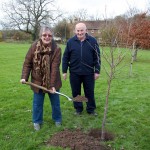
On 17th November, 2012, Frank Collyer’s granddaughter Jenny Mosedale and her husband Colin attended the planting of a memorial wile cherry tree on the Village Green. Jenny is seen here with John Whitear, who assisted in the planting
My grandfather from East Meon was a Member of the British Empire and a holder of the Military Medal. The family referred to him as Frank. What an inspiration he was to my father and it is easy to understand why he also chose the Army for a career.
The Military Medal (MM) established in 1916 was (until 1993) a military decoration awarded to personnel of the British Army and other services below commissioned rank, for bravery in battle on land. Frank won his for his gallant conduct in the Battle of the Somme and the Third Battle of Ypres in World War 1, whilst serving in the Rifle Brigade. He fought at Delville Wood , one of the early engagements in the Battle of the Somme at the age of 19.
The Rifle Brigade had been formed in 1800 as an infantry regiment of sharpshooters, scouts and skirmishers. They were armed with a Baker rifle which whilst it took a long time to load could be effective up to a range of 300 yards. Riflemen were trained to think for themselves and operated in pairs ahead of the main infantry.
Frank was Rifleman No 6326, having enrolled at the age of 18 on 23rd October 1915. He left behind his agricultural labouring in East Meon to train as part of the First Battalion.
2 years later he was part of the 24th Division of the British Army. This was a new Army division comprising 4 brigades, (the 17th,71st 72nd and 73rd) and 20 battalions that were sent to France between August and September 1915 to serve on the Western front throughout the World War. Frank was part of the 17th Brigade.
Whilst Frank was in France in 1917 his mother Esther was taken ill and he was not allowed to come home for her funeral.
As well as the Somme Frank had fought at Ypres Cambrai and Passchendaele. The Battle of Passchendaele was one of the major battles in Flanders in 1917 and one that Hitler himself fought in. He was a member of the Bavarian 6th Services division and was injured as part of a British gas attack.
Frank found it difficult to talk about his experiences as a fighting soldier. Having survived the Somme, a battle in which Britain has never lost more casualties and having been close to death many times he must have really have understood the old adage of “taking each day as it comes”. The muddy trenches, walking over dead colleagues, the blood, the noise – he was a very brave man. He did talk to me once about the first time he ever saw the tanks, it “scared him to death”.
In 1919 Frank came home and stripes were offered to him but no pay. He refused and transferred back to the 1st Battalion of the Rifle Brigade. As a Sergeant in the 1st Battalion, Frank was posted to Mesopotamia which comprises modern day Iraq, N.E. Syria, S.Eastern Turkey and S.Western Iran. He finished his foreign postings in India.
He was awarded the Indian General Service Medal and the Iraq and N.W. Persia Clasp.
We have some memorabilia showing how he learned to drive and maintain a Lancia lorry in 1923 in India. As Sgt. Collyer No. 6906201 he also attended Army school there and attained a second class certificate of education. This was nothing like today’s G.C.S.E.’s but it covered the basics of arithmetic writing and composition.
He returned to the U.K. from India to East Meon and married Rosina Alice Parfoot in the Spring of 1924 at All Saints Church.
Upon the declaration of War, most men who joined the regular British army signed up for 12 years made up of full time service with the Colours of generally 7 years and then 5 on reserve. Frank served 8 years and 3 months on Colours and 7 years 9 months on reserve. After 16 years of service to his country he was discharged in Winchester on 23rd October 1931.
After WW1 ended Frank worked as a lorry driver for a local firm and for some time was the village postman. He was also a parish councillor. At the outbreak of WW2 he tried to enlist again but was told he was too old – by 6 months! He became an air raid warden before joining and commanding the East Meon platoon of the Home Guard. The antics of Captain Mainwaring on Dad’s Army always brought a wry smile to Frank’s face.
When interviewed by the local paper he said “I prided myself on my strict discipline. I would be barking and shouting at them all the time. If they had been anything like that lot on television I would have gone up the wall”.
He reflected on a key difference between the Home Guard and the Rifle Brigade. In the former he could go and have a pint with them. In the latter no soldier was allowed to talk to any soldier below their own rank.
The East Meon platoon had 60 volunteers before membership became compulsory. At one time it rose to 102 men. One evening Frank recalls he had to take on 15 new recruits. Rosina helped him a lot with all the administration but when Frank was made a CSM he was able to employ a clerk.
The busiest night was when 27 bombs were dropped in and around the village. Surprisingly they did little damage and the only buildings in the village that were badly damaged were a few pig pens in a field.
On Tuesday 12th December 1944 the following words can be found in the fourth supplement of the London Gazette:-
“The King has been most graciously pleased to give orders for the following promotions in, and appointments to the Most Excellent Order of the British Empire, in recognition of Meritorious service in the Home guard:-
To be additional members of the Military Division of the Said Most Excellent Order:-
Captain William Frank Collyer, MM, 15th Bn Hamps H.G.
Even better was to follow, a few weeks later as part of the 1944 New year Honours, an M.B.E. was bestowed by King George VI on Frank for his many years of public service
My husband Colin and I attended Frank and Rosina’s golden wedding anniversary in 1974. The Local paper recorded their special day with a headline “Couple with a host of golden memories”.
Frank was sexton at All Saints Church for 30 years and I can remember going with him to stoke the fires for the heating and making sure the clock was on time. He was also the local grave digger and I went with him on many occasions.
One of Hampshire’s most photographed scenes – the springtime daffodils in the grounds of East Meon church – owes its very existence to Major Frank, who planted them with a friend in 1935. The village in my opinion is the most beautiful I have seen in England and I can fully understand why Rosina and Frank never left it.
Margery holding the map she prepared showing shops and trades in East Meon in the early 1920s
Margery Lambert at 18, at the start of her nursing career
Obituary, February 20th 2007, by Reverend Terry Louden
Marjorie Lambert was recently described to me as ‘the nearest thing to a saint’. She would have disagreed very firmly with that assessment, pointing out her personal shortcomings, and saying that in whatever she did she was only doing her Christian duty.
Duty is today a very unfashionable word. The trend in society is to be more concerned with rights rather than with responsibilities and duties. Duty carries the hint of obligation, of doing things because you have to rather then because you want to. But duty really means giving other people their due (God included) and duty embraces ideas and concepts like honour, respect and love. Throughout her long life, Marjorie gave others – patients, colleagues, family, friends, neighbours – their proper due.
Marjorie died six weeks short of her 90th birthday. She was born in Westbrook Cottages, the only child of a tenant farmer, who was one of three brothers who worked Duncombe Farm. She never forgot her family background, and although she spent nearly 40 years working in London, she was always tuned in to the cycle of the agricultural year, and those who worked on the land, including her own family, who were always close to her heart. Typically, she insisted that she did not want to die during lambing, as she did not want those making arrangements to be put to extra trouble. Her wish was granted.
A week or so before she died, at her bedside in the Royal Hampshire County Hospital in Winchester, Marjorie reminded me that it was in the same hospital, over 70 years before, that she had started her nursing training. By the outbreak of the Second World War, she was a Staff Nurse, earning £90 per annum. In 1940, Marjorie went to Guy’s Hospital in London to begin midwifery training, taking a substantial pay cut in the process. I don’t know why she decided to specialise in mums and babies, but it was certainly highly appropriate for someone born on the 25th of March, the Feast of the Annunciation, nine months to the day before Christmas. Some of her work in London was as a district midwife, out on a bicycle in the Blitz, helping to bring new life into a world of war. In 1943 she was sufficiently experienced to become a teacher and trainer of midwives in the Bermondsey and Southwark areas. By 1946, she was back on the maternity ward at Guy’s, and the following year she was promoted to Sister, often on duty at night.
In 1948, Marjorie was appointed Superintendent Midwife of the South London Hospital for Women, in charge of a unit of 50 beds and a district midwifery service covering Clapham, Balham, Battersea and Brixton, as well as teaching and training 50 pupils every year. In 1957, she was joined in this work by Eileen Alston, who is here today.
In 1962, Marjorie moved a little further out into the south London suburbs when she was appointed Superintendent Midwife of Mayday Hospital, Croydon. Mayday’s maternity unit was large, with 150 beds. Marjorie continued teaching and examining in the midwifery training school. The 60s and 70s were an era of great change for midwives, with new job titles (Senior Nursing Officer) and suits rather than frilly caps. Marjorie admitted that the last ten years of her career were difficult, with a very demanding job, and family responsibilities for her mother and her aunt, both of whom were in poor health. Marjorie retired in 1977, when she was awarded the Queen’s Jubilee Medal for services to midwifery. The MBE, which she would have said she didn’t deserve, but of which I think she was quietly and properly proud, was awarded some years later.
So in 1977, she returned to the village where she had been born and brought up. Marjorie had not neglected East Meon during her London years. Indeed, she had been known to cycle here from Croydon to visit her mother. It has been East Meon’s privilege to have her living at the centre of the village for the past 30 years.
Those 30 years were years of much activity. There was the regular Saturday visit to the family at Stoneylands Farm. There was the Lunch Club, where Marjorie, as she used to joke, was eventually older than most of the members. At Lunch Club we all observed Marjorie’s attention to detail – the flower arrangements, the menus written in that wonderful hand, the cards sent to the unwell and the housebound. There were all the village activities, the Country Fair and the Fetes, and the human fruit machine. Marjorie, though a single woman, was a strong supporter of the village school and its children. There was this Church. Marjorie was the most faithful of communicants. If Marjorie was not in church on Sunday, or at weekday services, it was because she was not in the village or she was unwell. Her Christian faith was a foundation of her life. For many years she looked after the church’s linen and vestments. If we wanted to know what she was like as a trainer of midwives, we need look no further than the thorough, precise and painstaking instructions, complete with diagrams, that she gave to those preparing and setting up for church services. She prepared for this service, of course, by choosing the bible reading and the hymns. For years she was a sidesman at church funerals and memorial services like this, welcoming and gently consoling the bereaved. There was Marjorie’s hospitality. How many cups of tea and coffee and biscuits have been offered and served in Woodford House over the years – always with a good-humoured smile and even sometimes a raised eyebrow and naughty glint in the eye, always with a genuine interest in the visitor, a funny story to relate and a bit of wisdom to be dispensed. Marjorie was a keen and gifted photographer, and her photos, which we often saw at the Garden Club Show, illustrated the range of her interests, and especially her love of the outdoors.
There was also a great deal of unseen and unsung activity on Marjorie’s part – regular visits to the housebound and the unwell – meals prepared, shopping done, errands run – often for those who were not Marjorie’s closest friends and acquaintances. I remember an occasion only last summer, when Marjorie herself was not at all well, when she went by bus to the hospital in Winchester and back to visit someone, because she knew that person was not having many visitors. That was a typical example of her generosity of time and spirit, a mark of her Christian love and what she would have regarded as her Christian duty. In Marjorie we saw an old fashioned virtue called constancy – a faithfulness and a reliability which made her so attractive as a sharer of personal joys and sorrows.
Marjorie had her own idiosyncracies, just like us all. She had likes – flowers, especially garden flowers, chocolate éclairs (I think) and she had dislikes, of which untidiness was certainly one. We have made sure that the linen altar cloths are straight today. She had firm opinions, but they were always expressed with politeness and graciousness, which made you respect her even more. She had a strong element of stoicism, perhaps as a result of things she had seen and been part of in her working life, and in recent years you sometimes wished she would actually admit to the pain and discomfort she was in. She gave so much to others, but she would not always allow others to help her, because she felt that was not important. With those who knew her well though, she did enjoy ‘an hug’ now and again.
Marjorie’s funeral was on 27th February, the day in the Christian year when the Church remembers a man called George Herbert. George Herbert lived about 400 years ago. He was a poet and a hymn-writer and a Church of England vicar. There is even an East Meon connection. Most of what we know about George Herbert’s life is because of his first biographer, the man who wrote his life story. That man was called Izaak Walton.
I mention Herbert today because so much of what he believed about the Christian faith and Christian love can be seen in Marjorie Lambert’s life.
Take some words from the hymn ‘Teach me my God and King’.
Teach me, my God and King,
in all things thee to see;
and what I do in anything
to do it as for thee.
All may of thee partake;
nothing can be so mean
which, with this tincture, “for thy sake,”
will not grow bright and clean.
A servant with this clause
makes drudgery divine;
who sweeps a room, as for thy laws,
makes that and the action fine.
I think that sums up Marjorie so well. Her strong Christian faith was the background to her long life of practical service, both as a midwife and trainer of midwives, and for all that she has done in the past thirty years living in East Meon for family, friends, and neighbours. Even those of us who knew Marjorie well know only a fraction of what she did on behalf of others – the many generous kindnesses, unsought and unlooked for. She would do anything for anyone, if she could. Nothing was too mean for her, to quote Herbert’s words.
Today we mourn the loss of a relative – cousin, auntie, dear friend. We are sad, and there will be a huge space in our lives, and in the life of the village, because Marjorie has died. But we are also immensely privileged that we knew her, that she was our companion and friend, and that she was a shining example throughout her life of what it means to be a follower of Jesus and to be a channel of his love and care and peace. And if that is what a saint is, then Marjorie is to numbered among that great cloud of witnesses by whom we are surrounded, and by whose prayers and Christian example we are inspired.
Tribute by Denys and Rosemary Ryder, from Meon Matters, April 2007
To try to emulate the address (reported elsewhere in this edition) given by the Vicar, Cannon Terry Louden, at the Memorial Service held on Saturday 10th March, for Margery Lambert, would be an insult to his words. However I would like to add my own thoughts to the many that I have heard people express about her over the last few days.
I was so pleased to be able, in the last issue of Meon Matters, to be able to tell the story of Margery’s Grandfather who was one of the village Postmen at the turn of the last century. Since Margery returned to the village in 1977 after over 40 years of acting as a nurse and midwife, that, whenever we met, she was always ready to talk about my family, and in particular our children how were they getting on, and about what they were doing. Rarely would she talk about herself. On occasions I would enquire about her life and what she had done during her career, and she would tend to say “ Oh, I’m of no interest to the village, other people around the village have had far more interesting lives than me”. That of course was the essence of Margery. She didn’t only ‘have time’ for people, she ‘made’ time for people and was always thinking about others never about herself.
Her life had been dedicated to her chosen profession and her nearest relations Joan and Winifred Walther from Stonilands Farm have given me permission to reproduce here, a photograph of Margery taken when she was 18. Of the many that Margery had in her photo album going back to her Great, Great Grandmother Gladys Moorman in 1831, together, Joan, Winny and I chose one taken in 1935 of Margery in her nurses uniform when she was 18 and starting her career at the Eye and Ear Hospital Portsmouth. To me it shows that one lasting memory of Margery that I so admired, her lovely smile, which was her hallmark whenever you met her. Although slightly less upright in her later years than in the picture, she would always greet one with her head tilted to one side and that lovely open face and impeccable dress sense that she had, as can be seen in the picture of her.
It was reported in an article produced in 1977, that her friends and relatives were not in favour of her choice of career. “They told me it was not the thing for a girl like me. They said: ‘You’ll never stand it’.” She recalled. “So I stuck it”. Sticking to it meant that she was given the Queen’s Silver Jubilee Medal for more than 40 years service. “When the medal came through the letterbox in its official envelope, I thought it was something to do with pensions” Margery said at the time, “ When I found out, I kept quiet about it. I think it was for my services to Midwifery”.
That was typical of Margery and her attitude to her achievements in life. However in 2006 I was so very pleased to get a call from Margery at the time I was arranging a display about East Meon to be shown in the Petersfield Museum, to say she had drawn a map, with coloured crayons, of East Meon as she remembered it during the 1920s, when she was growing up. Would I like it for the exhibition? I quickly recognised that her work was a priceless visual record of life in East Meon at that time. The map, which is on A3 size paper, shows where the Midwife, Doctor, the persons able to offer Herbal Advice, the Layer-Outer and Undertaker lived as well as the Grocers, Butcher, Fishmonger, and Dairyman. Saddler, Chimney Sweep, Cobbler, Wheelwright, Blacksmith and Carrier all are shown on the map, as well as the Pubs, Post Office, Churches and Chapels. All written in her beautiful handwriting. Margery’s relatives have also given me permission to have a limited number of copes made of this unique map for sale to those people who would like to have a copy. They will cost £10 unframed and £20 framed with all funds going towards Margery’s chosen Charity, All Saints Church, East Meon. Anyone wishing to have a copy made in memory of Margery should contact me (01730 823 271) by the end of April 2007 and they will be ready for collection a week later. They can also see a copy of the map on the village notice board out side the shop.
In the opening lines of Terry Louden’s address at her Memorial Service, he said “ Margery Lambert was recently described to me as ‘ the nearest thing to a saint’”.
Well even people who are ‘the nearest thing to a saint’ have their faults. If there is one thing that can be levelled at Margery it is that she had a rather poor sense of direction when coming to draw maps. She drew the road leaving the village for Petersfield as going straight north through Park Hill. If that Margery is all we can find at fault during your life then all the people you have served during your working life and those many friends you have made in the village of East Meon during your retirement are so lucky and privileged to have known you. Her map will hang on a wall in my study as a reminder of Margery and all that she meant to our family. We, as a family, shall miss her. I’m sure many in the village will do so as well.
Click here to see Margery Lambert’s map and Denys Ryder’s notes on the contents.
Eames Cottages, Frogmore, where Kath lived as a small girl.
Floods were a common event, especially in Frogmore
East Meon National School, where Kath went to school
Parsons Store front
Barnards, where Kath lived – there were six households living there at the time
War Memorial decked out for Coronation in 1953
Princess Margaret leaving All Souls Church, from Kath’s collection
Curly Searle Seen in the middle of this photograph of the East Meon Road team, next to Jeremiah Christmas in the photo was Stanley William Searle, nicknamed Curly. His daughter, Kath Adams, was 89 years old when she died in 2010; she was born in East Meon in 1921 in one of the cottages at Barnards . Where there are now three houses there were then six dwellings. Kath went to school in the old School building.
Kath Adams
Stanley was a road builder and was responsible for the upkeep of a ‘Length’ of road from The Square up to Coombe Bottom; this involved digging ditches, clearing drains and keeping the length neat and tidy. She relates how at Christmas he would black up his face and go round the village, playing the banjo and raising coppers for Christmas presents.
He died of pneumonia in 1928 when Kath was only 7 years old. After his death, his widow moved to Eames Cottages in Frogmore; she was largely supported by the Parish, to whom she gave a list each week of her basic necessities.
Kath remembers going to school in the original building, which was later converted into the house by Peter and Audrey Street (now occupied by John and Margaret Ball). During heavy rain, the teacher would announce that ‘the children from Frogmore should go home now …’ Frogmore was regularly flooded; the Searles’ front door had a weather board to hold back the water but she remembers having to go upstairs because the ground floor was immersed– she and her brother made paper boats which they dropped into the floodwater from their bedroom window. The children would walk as far as Buriton and back to pick hops; their mother promised them a special present as a reward for their labours and Kath remembers her buying a watch for five shillings. She also picked potatoes for Wilson Atkinson. Her husband was also called Stanley and they were together for 46 years. He worked for Brian Blacker at 40 Acre Farm. They had 9 children of whom two died in their forties.
The village then had half a dozen shops including Mr Pink, greengrocer, Parsons, general emporium the Post Office, Warrens haberdashers and Joan Blackman’s flower shop. A saddler would visit from West Meon. The family would from time to time walk to Petersfield for special treats, sometimes coming back in Mr Lambert’s ‘Little Wonder Bus’. The bus also went to Clanfield, whence they could go by bus to Portsmouth.
Before the present Village Hall was built in the 1970s there was a collection of buildings in The Square, where Park Vista is today, opposite East Meon Stores (left, bottom picture). This was built in 1888 and included a shooting range, a library and the previous village hall where Kath remembers there being a dance every Saturday night. The photo at the top of Princess Margaret leaving All Saints Church in the 1950s, accompanied by Rev Rod Smith was collected by Kath.
A memorial service was held for Peter on May 19th – a blustery day at the start of the wretched summer weather. Suitably, those who came ranged from villagers and fellow ex- cricketers from Steep to erstwhile BBC colleagues and Peter’s brother-in-law Simon Brett, broadcaster and writer of radio and TV comedies, who gave the main address.
In it, Simon chronicled Peter’s ‘global’ career, starting as a true son of East Meon – his parents were Geoff and Eileen Brook who ran a wonderful High Street general store in the days when we had as many as six shops in the village. Peter went to New Zealand in his twenties, visiting Eileen’s family and finding work where he could. His glorious voice and English accent found favour with local radio stations so that is where he got his first experience behind a microphone.
Peter decided to return home at a time when the New Zealand government was anxious to attract more residents and offered citizenship in return for completing a single form, so Peter became a Kiwi as well as a Brit. He came back to Hampshire, joined the BBC as a continuity announcer (the out-of-vision voice which takes viewers seamlessly from one programme to another), met Mirabel and married her. Simon told tales of the aplomb with which Peter would switch from snoozing or listening to cricket commentaries, to fully alert conduct of the broadcast omnibus even in times of crisis.
Peter and Mirabel moved to Lythe House and started a tripartite working pattern which would have left most of us gasping. They developed outhouses as luxury self-catering apartments (and later added the Martello tower further down the Buriton road) while Peter made a business out of his passion for wine by starting Hampshire Wine Shippers, a cornucopia of well-chosen French varieties which led to many an addiction among other villagers – ours was for Chateau Pierrail.
The Brooks earned a paragraph in the history books by being the first British couple to adopt three children, Alexi, Anton and Anna, direct from a Moscow orphanage. Their lives were heavily influenced by the needs of these three and when they decide to go to New Zealand it was partly to provide a liberal and caring environment for them. Peter and Mirabel bought a ‘batch’ – a plot of land near Havelock North in the Hawke’s Bay area. They then found a suitable house which was transported on low-loaders to Cape South. Another house was later added as part of a small colony of wonderful self-catering cottages – Tricia and I enjoyed a glorious stay there and unreservedly recommend it to other Limeys seeking a luxury break in New Zealand.
It was the worst possible blow for the family that they no sooner had Cape South in shape and visitors starting to arrive than Peter was diagnosed with an aggressive cancer. He had superb care especially in the hospice in Havelock North to which donations at the Memorial Service were made. Peter and Mirabel came to Europe in September last year to meet friend and family in the near-certain knowledge that this would be Peter’s last visit and to visit their favourite holiday home in Cyprus. Peter said firmly that he also wanted to attend the 2012 Olympics …. an unquenchable spirit and a redoubtable son of East Meon.