
History Group
History of the History Group
By Michael Blakstad
By 2010 the East Meon parish council website was receiving enquiries from around the world from relatives who had lived in the village and who were looking for information about their antecedents. A retired solicitor, Freddie Standfield, had written a History of East Meon ten years earlier, but he had died and there was no other historian to whom I could refer enquiries, and as yet no Ancestry.com to which I could refer. I tried passing enquiries to either the vicar, Reverend Terry Louden, who like most men of the cloth had a literary interest in the history of his church and parish, or to Denys Ryder, who had lived in East Meon for over 50 years and knew every family of long standing in the village. Denys had a fund of anecdotes about East Meon, not all of them founded on historical fact.

Reverend Terry Louden

Denys Ryder
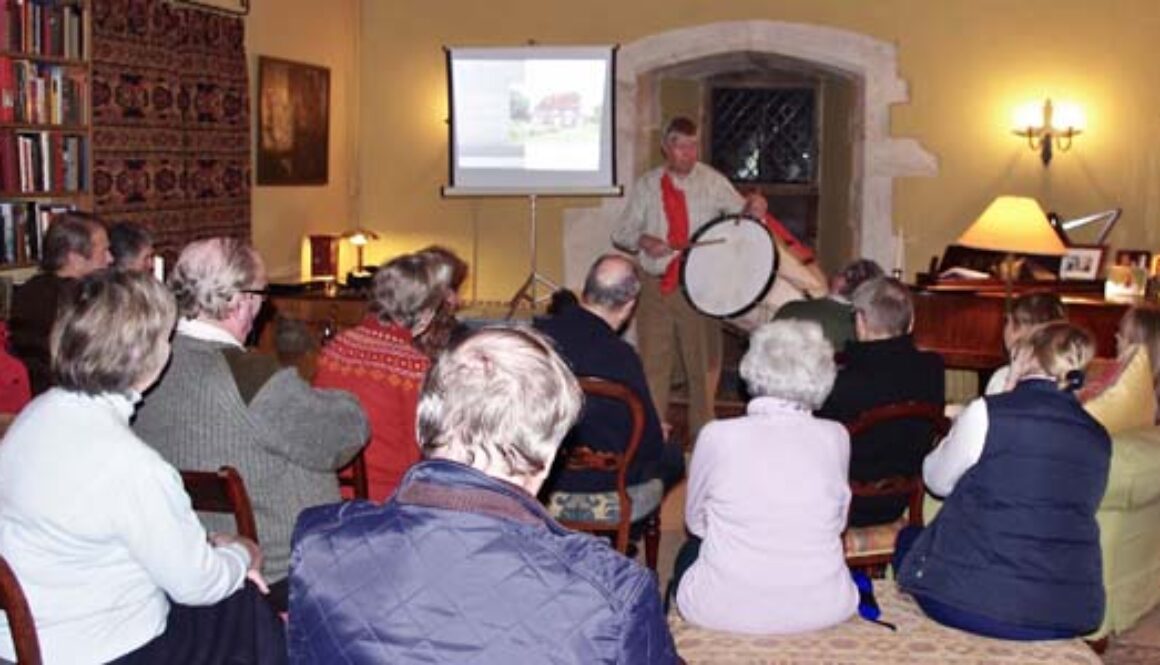
Some of the web enquiries were addressed to the non-existent History Society and it occurred to me that a village with such a colourful a history as East Meon really should have one. So I canvassed neighbours who might have an interest in history and invited them to an initial talk to be given by Tim Concannon, a local barrister and had written about Saxon East Meon. The talk did not go well but several of those present demonstrated that they were indeed knowledgeable about history. We agreed to give a small, informal society a go, focusing on local history and keeping the membership small enough to hold meetings in members’ sitting rooms, those which were large enough to hold 20 or so. That limit did not last long. In our first full year we decided to move to the new Church Hall which sat 40 comfortably and more at a pinch. We had to pay for the hall and the speakers, so we started with a subscription of £10 a year.

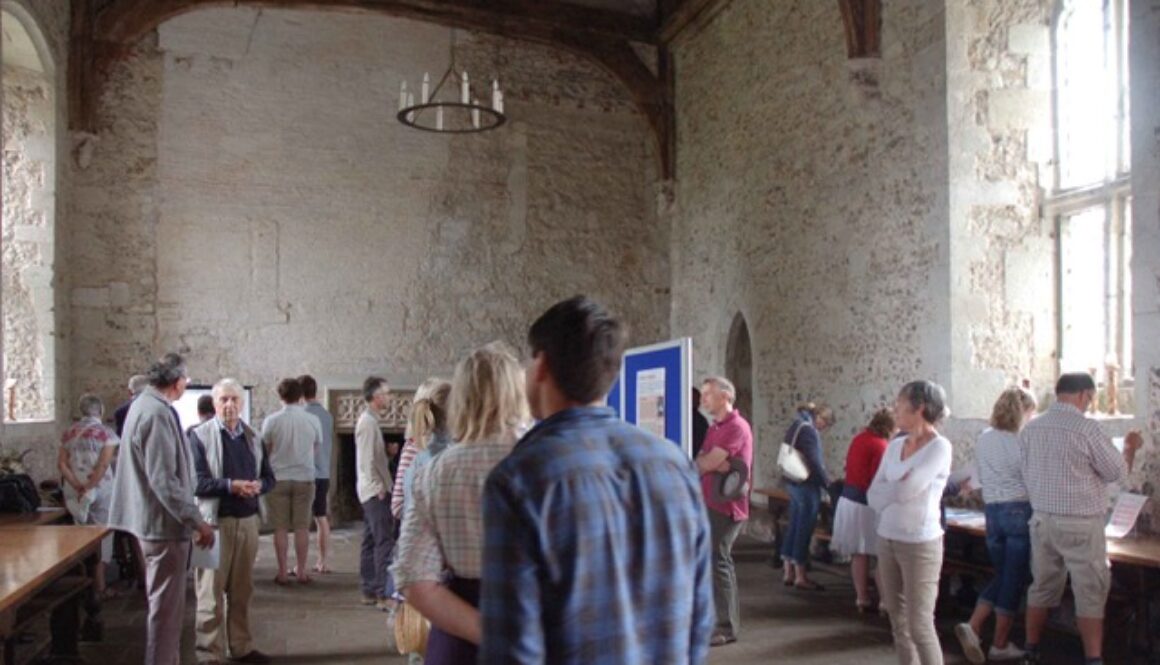
2012 Court House Hall Exhibition
The first speaker to fill the hall was Nick Barratt, an archivist at the National Archive, who had been discovered by the BBC when they were preparing the first series of “Who do you think you are?” He briefed us on tracing House Histories which became our first research project in which members studied the history of either their homes or other village buildings. These were written up for a series of exhibition panels which were displayed in the summer of 2012 in The Hall of The Court House.
I now abandoned the parish council website and commissioned a new website for the History Group: www.eastmeonhistory.net. The following year I applied to the Heritage Lottery Fund for a grant of £7000 to enable us to organise an Open Day in the Village Hall. Villagers were invited to bring any old photos, documents, memorabilia etc which we would scan digitally and then take them home again. We then indexed the files and uploaded them to a new archive website, www.eastmeonhistory.org, the creation of which cost the bulk of the grant. We arranged quizzes for families, dressing up in historic costumes and, in association with the Saxons in the Meon Valley project, we staged an event for school children in which they enacted the Norman invasion in 1066 and the resistance of King Harold.
The Saxon re-enactment marked the first of several collaborations with East Meon primary school; we subsequently took classes on walks around the village describing to them, for instance, life in Victorian East Meon and in November 2018 helped commemorate Armistice Day with a large exhibition in the Village Hall.
We also engaged in recording ‘Oral History’ interviews, which are a valuable resource of local history. This involved persuading members of the community who had lived a long time in East Meon to recount their memories of the past.

Malcolm Painter, Shepherd
We soon notched up a range of villagers including Malcom Painter, the shepherd who had appeared on the cover of Freddie Standfield’s book and a reclusive couple who lived in one of the oldest houses in the village. The rules were strict and the interviews had to be transcribed exactly as they were recorded. They were made available to the Wessex Film and Sound Archive and the Petersfield Museum. We also loaded them onto our archive website where there are now 20 interviews including two by myself.
The History group arranges a couple of visits each year to places of local places of historic interest and is often asked to help organise visits to East Meon by other groups such as the Hampshire Archive Trust and the Hampshire Field Club and Archaeology Society.
In 2016 we started our biggest project to date, Farming in the Valley. I applied for a second HLF grant which enabled us to employ David McCutcheon, a professional cartographer, to create maps of East Meon over the centuries and Zoe Kay, a designer, who is responsible for the layout of the book. I also obtained another grant from the Hampshire Archives Trust to cover the production costs of the heavily illustrated book ‘Farming the Valley’. Since East Meon had only one source of income for over 100 years, this was in effect the history of the community which in its time had been the largest Hampshire estate of the Bishops of Winchester.

This was an ambitious project and we were keen to involve as many members as possible. However, this didn’t really pan out. The content of the book is based on 18 research reports which are published on our website. Ian and Betty Wesley took over writing about the early history of the valley up to Norman times, Robert Mocatta covered the 19th century and I wrote the rest and edited the book. Although we received a grant to cover the costs of printing, we decided to raise further funds to cover the cost of producing a hardback edition of the book. Residents of East Meon were invited to pay £100 for this limited edition in which their names appeared as subscribers.
In the course of our research we had collected hundreds of digital files including maps, images and source documents. Our grant from HAT provided us with an allowance to index and place these files in our archive website (eastmeonhistory.org.)
During the Covid lockdown the History Group suffered, as most societies did, from not being able to meet or organise visits or other activities. We tried some Zoom meetings but these were less than satisfactory. However, we managed to resume activities in October 2021, with a normal winter programme of meetings which continues to this day.
Origins of East Meon History Group
Until 2010, there was no historical society in East Meon. Freddie Standfield, a solicitor and prominent resident of the village, had written ‘The History of East Meon’, published by Phillimore in 1984, was an authoritative record, and successive vicars had written and spoken on the history of All Saints Church. When Michael Blakstad established a village website in 2005, there was a page on its history, and it generated a number of enquiries from people from all around the world about their antecedents in East Meon which prompted him to publish these two articles in the parish magazine.
These are extracts from two articles written for Meon Matters in January and May 2010, seeking to establish whether there would be an interest in forming a History Group.
Interested? March 2010
We’d like to establish whether others are interested in learning about our past. As previously described in Meon Matters, the website has generated a lot of interesting queries and information, including the Saxon ‘royal peculiar’ . I have been asked to put people in touch with the East Meon Historical Society …. Thinking about it, we have more history than many villages with very active societies and it is perhaps an anomaly that we don’t have one.
It would be interesting to get together and discuss what topics interest people and whether we might invite those who have done research to give talks to a small group. If anyone would like to spend an evening talking about the possibilities, please contact me.
Looking into the History of the Village, May 2010
East Meon now has the beginnings of a Historical Society. Following the article in the January edition of Meon Matters, sufficient people made contact and we organised a meeting in March at which we discussed how the group might operate.
We agreed it should be a small, highly informal group, numbering no more than 20. We shall arrange a mixture of talks by visiting speakers, tours and visits plus, importantly, active research into the history of East Meon. All these activities will focus on East Meon whilst looking at the wider context in which each subject is framed. We also want to record and index the topics on which talks take place or research is conducted.
We have already had two such events. At that first meeting, we were treated to an entertaining and very wide-ranging talk on the history of Christianity in East Meon (and the wider Meon Valley) by a local barrister, Tim Concannon. He believes that in Saxon times, East Meon was a ‘monastic settlement’, so important that the great Saxon King Edgar granted ‘that famous place which the locals have always called Aet Meon’ to his grandmother Eadgifu, who retired here to live a holy life. How things change ….
Those of us lucky enough to live in one of the more ancient village houses have come to welcome visits by learned parties led by Edward Roberts, who used to teach the History of Buildings at what is now the University of Winchester. Because Tricia and I have put The Tudor House on the market, it was suggested that Edward be invited back to give the neophyte society a guided tour of this building, which he did on a chilly evening in early May.
If you would like to join this group, do get in touch. There are still a few places open!
Michael Blakstad
So, the Group started as a bunch of interested people, no academic historians among us, interested in arranging and listening to talks on local history and in visiting nearby sites of interest. Because most of our meetings took place in the sitting rooms of members, we limited our membership to 30, a third of whom are content to attend talks and go on visits.
A minority, however, wanted to go further, and in our second year we embarked on research into the ‘historic buildings’ of East Meon – not just the big and old, but also some smaller, newer houses which had been lived in by less well-off villagers. From this modest beginning grew a membership of 50 or more, a regular programme of talks and visits, and a number of activities which research and promote the history of East Meon.
Group Activities


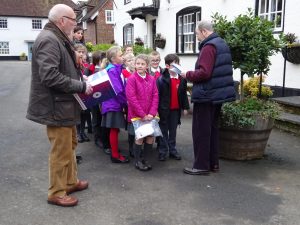
In addition to the programme of talks and visits, the Group undertakes a range of research, exhibitions, guided walks, oral histories, open days and archaeological surveys; we also work with East Meon CoE Primary School, supporting the learning of local history. We have twice secured grants from the Heritage Lottery Fund to support these activities, which are described in this section.
Origins of East Meon History Group is a brief account of the foundation of the society in 2010, including extracts from articles in Meon Matters which led to the foundation of the Group.