Michael Blakstad is the 'publisher' of the East Meon History Group. His career was spent initially in broadcasting, in BBC TV, and both Yorkshire TV and Television South, and as in independent producer. His company Workhouse was a pioneer of interactive media. He lives in East Meon and manages the History website.
Enclosures of farmland have had a bad press. Particularly in the 19th century, a rash of Acts of Parliament enabled landowners to enclose land by fencing in their fields, which up till then had been open spaces divided into strips of land mostly cultivated by tenant farmers.
Three official Enclosures are recorded in the parish of East Meon, enclosing land at Oxenbourne and Ramsdean Downs. The first was a formal Agreement in 1661; it is notable that most of the signatories were illiterate and marked their consent by making crosses.
Detail of the 1661 Enclosures, with three Xs marking the consent of illiterate farm tenants.
The later Enclosures were by Acts of Parliament in 1845 and 1861. The 1845 Act enclosed 612 acres, awarding 135 to a prominent local landowner, John Bonham Carter: a further 158 were distributed among members of the Weeks family and the rest divided into smaller portions. The 1861 Enclosure awarded a further 122 acres, 38 to Bonham Carter and 20 acres to another wealthy landowner, Sir William Jolliffe. In other words, the bulk of the farmland was awarded to wealthy landowners, while small farmers were confined to reduced holdings, often of poor land, or forced to give up farming altogether.
1845 Enclosure map showing division of land at Oxenbourne into large holdings for Sir John Bonham Carter and Sir William Joliffe, and smaller sections for tenant farmers. One field is set aside for ‘Poor Cottagers’.
This Victorian land grab forced many farm workers to seek new places to live and to look for work where they could find it. A lucky few ‘farm servants’, usually young men and women, still lived on the farms where they worked while ‘agricultural labourers’ were forced to find employment where they could, usually only at harvest and sowing times. Many were migrant, moving from parish to parish in search of work. By 1871, 91% of rural workers in the South East were in this category, struggling to survive.
Early East Meon censuses show how many agricultural labourers were crowded into inadequate accommodation. What are now two cottages at Barnards, for example, were subdivided into four households; the 1861 census shows one of these, No 8, High Street, housing the Sloper family of 12, four of them (including a 19-year-old girl, Jane) listed as ‘agricultural labourers’.
1920s photograph of Barnards Cottages, with four door where there are now two.
It can, however, be argued that Enclosures were inevitable and contributed relatively little to the rampant rural poverty which pervaded Hampshire in the Victorian age. Firstly, the population of England was growing astronomically – it doubled between 1801 and 1851, and again by 1911. Secondly, British farming was under intense pressure to become more efficient. The repeal of the Corn Laws in 1846 had removed the guaranteed high prices designed to protect British produce: grain imported from the Continent once again undercut local prices. New technology, including steam-powered machinery, and new farming techniques, including improved fertilisers and better irrigation, reduced the numbers of workers needed. Steam-powered ships carried cheap food from North America. In the South East of England, where farms mainly cultivated cereal crops, successive years of disastrous weather in the 1870s ruined crops.
Farming in Britain had to become more efficient to survive, and larger farms were more productive and employed fewer workers. Many migrated either to the cities, or to the colonies. Of the farm workers who remained, most had to take second jobs. In 1801, 66% of the population had been rural, by 1851 this was reduced to 46%, and by 1911, 21%.
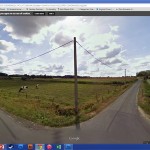
Oxenbourne fields seen by Google Earth
As a footnote, the beauty of the Meon Valley owes a great deal to the Enclosures. Land allotted by Acts of Parliament was divided into regular field patterns and. today’s landscape, defined by fences, walls and hedges, was the result. Perhaps we should not be too hard on the Enclosures.
Many details of the East Meon Enclosure documents held in the Hampshire Records Office are available in the digital archive, click here.
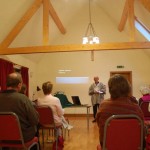
The Rev Terry Louden gives a presentation on the Parish’s associate parish in Ghana.
History Group meeting in Hall
Children’s activity in Church Hall
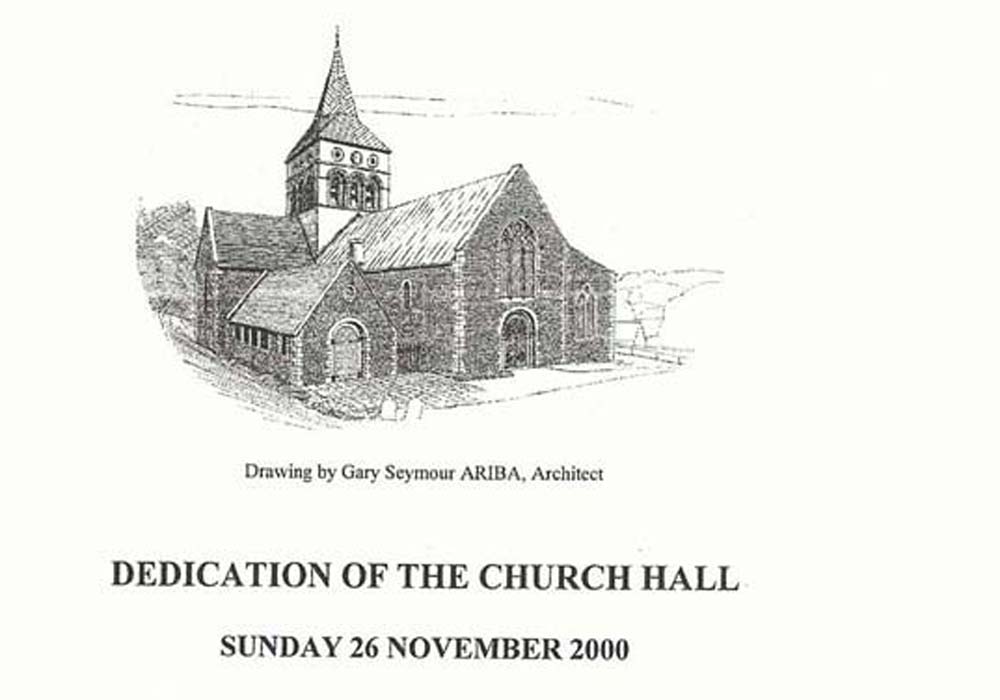
In November 2000, a new Church Hall was opened by the Rt. Revd. Dr. Kenneth Stevenson, Bishop of Portsmouth. This was the outcome of a vigorous fundraising campaign, as well as sensitive architecture within the constraints of the site and the heritage of All Saints Church. Captain Chris Cobley RN led the project, and here summarises the project.
The Challenge
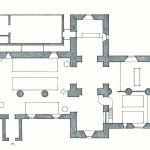
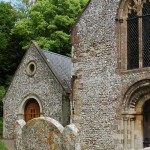
The size, shape, overall design and siting of the Hall were greatly constrained by Church of England and Local Authorities’ planning requirements, and by the overwhelming requirement to have minimum visual impact on the historic Norman church itself. The building therefore had to be sited behind the Church, and set back from the line of the Church’s West end.
This brought two immediate complications: The slope of the hill required additional excavation; and the North side of the church had once been (following ancient custom) the traditional site for unconsecrated burials in unmarked graves. There was also the possibility that remains of other ancient church buildings might exist in that area.
The site therefore had to be excavated under the supervision of Hampshire County Council archaeologists. Fortunately, no evidence of buildings was revealed, but a considerable number of human remains were carefully unearthed, recorded, and subsequently reburied elsewhere in the churchyard.
Funding
Total cost of the project was just under £221,000.
Existing funds and legacies provided sufficient funding for the first phase of excavation, planning and design to start in 1997-8. This was quickly underpinned with a major fundraising project. Applications were submitted for grants from suitable charitable foundations. A number of fundraising events were held, including a Grand Auction of antiques, collectibles and promises conducted by Chris Jacobs, the local auctioneer.
But by far the largest proportion of the funds raised, was donated by some 90 individuals: members of the congregation and many other friends of the church, donating sums ranging from £25 – £10,000, and enhanced by a considerable amount of tax reclaimed under Gift Aid.
A very popular scheme was the ‘sale’ of Chilmark Limestones with which the building is dressed. Donors wishing to make a lasting contribution, could donate the cost of a stone, perhaps in memory of someone.
Construction & Management
The Church Hall was built by Everest Construction Ltd, to a design by architect Gary Seymour. The project was managed by the Standing Committee of the PCC:
The Rev’d Canon Terry Louden, Vicar
John Rendle CBE, Sara Cobley and Anthony Perkins, Churchwardens
Captain Chris Cobley, Project Leader
The Hall was opened by the Rt. Revd. Dr. Kenneth Stevenson, Bishop of Portsmouth, on Sunday 26 November, 2000. Chris Cobley, PCC Project Leader, received the keys from David Everest, Builder, and presented them to the Bishop, who blessed the new building and dedicated the Keystone in memory of John Rendle, CBE, who was Churchwarden at the start of the project and one of its strongest supporters.
The Church Hall Today
The Church Hall provides essential facilities in support of Church activities, such as: PCC and Deanery Synod meetings; Sunday Club for children; Tea and coffee after services; and Choir Practices.
It also provides a venue for other suitable activities, such as presentations and meetings when the village hall is unavailable. For private and non-church-related activities, a hire charge is made to offset heating and running costs, and to include a contribution towards Church expenses. A fundamental principle is that the Church Hall does not deprive the Village Hall of custom or revenue.
Facilities.
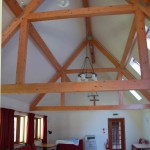
Church Hall facilities include: a 60 sq. m. Meeting Room, Toilet with disabled access, Sink and preparation facilities for hot drinks and refreshments, and storage for crockery, choir music and Sunday Club activities.
More material, including posters promoting the fundraising and commemorating the donors, can be found in our online archive, click here.
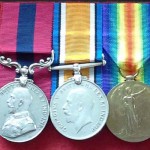
Bone’s medals, the Distinguished Conduct Medal, the British War Medal and the Victory Medal.
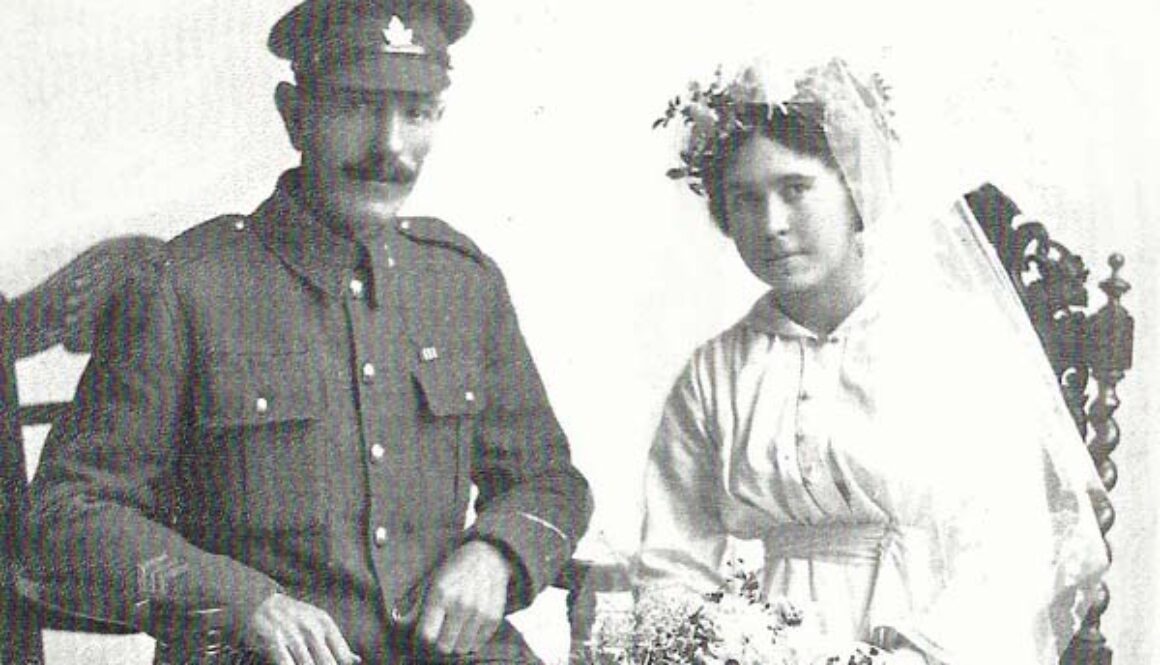
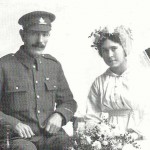
Marriage of Edward Bone to Alice May Richards, August 1915
David Hopkins gave this account of the battle in which Edward Bone won his DCM to the History Group on December 16th 2014.
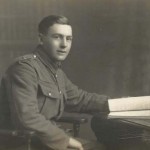
Edward Bone won the Distnguished Conduct Medal on this day, in Geluwe, West-Vlaanderen, Belgium. He was promoted to Lance Corporal and survived the remaining six weeks until the Armistice. The son of Benjamin Bone and Sarah Knight, he was born on 01 Mar 1891 in East Worldham, Hampshire. He met Alice May Richards in East Liss and married her. They moved to East Meon after the war.
Edward Bone served in the 2nd Battalion of the Hampshires. Just six weeks before Armistice, he and his platoon commander played a vital part in unblocking fierce German resistance to the Allied advance.
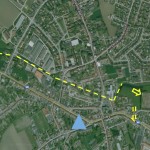
From their start lines at Ypres. the Allies had rapidly advanced south-east along the Menin Road. The 2nd Battalion had leapfrogged engaged units, diverting to the west of Gheluwe and was held up there by heavy fire from entrenched positions. Two platoons infiltrated the town by following a small stream to the northwest of the town, and emerged in the cemetery on the other side, to be pinned down by German machine guns. Heroically, Bone and his platoon commander stormed the machine guns and captured them, taking 27 prisoners. When a strong German counter attack developed from the east of the cemetery, they repelled it with covering fire whilst their platoon withdrew, with wounded and prisoners, to the south, through the streets of Gheluwe, to re-join their battalion.
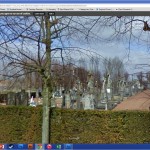
The German machine gun post was located at the corner of the cemetery, (located beyond the fork in the road). The blue arrows show the German positions, the yellow line the British advance.
The German machine gun post was located at the corner of the cemetery,
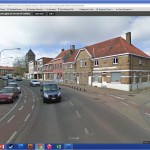
The route of retreat from the cemetery, to the south, via the main street of Gheluwe, as it is today…
A week later, in France, the commanding officer of 2nd Battalion Hampshire Regt, Col H.P.Westmorland, , wrote his account of their action in his War Diary, replicated in Appendix 3: “Two platoons of X company, under the personal command of Lieutenant G.H.Brown, worked down the banks of the Reutelbeek and succeeded in reaching the Cemetery on the east side of the village. Here they were held up after sustaining heavy casualties until two machine guns that were holding them up on the right, were rushed, with great gallantry, by two men of the leading platoon, resulting in the surrender of 27 of the enemy. The locks of the machine guns were removed and the two men withdrew with their prisoners.”
Both the men were promoted, Lieutenant Brown to Acting Captain, Private Bone to Lance Corporal, and both awarded medals, Brown the Military Cross and Bone the Distinguished Conduct Medal.
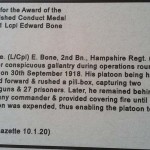
Inscription of citation in London Gazette
Regimental citation
Edward Bone came to live in the parish of East Meon after the war, to work at Leydene House. With his wife Alice, he lived first in Coombe Bottom and then at Hambledon Lodge at Leydene.
On this day, three young men from East Meon died in the same battle, and are buried alongside each other at Voormezeele Enclosure No.3, Ieper, West-Vlaanderen, Belgium. This is David Hopkins’ report on the battle in which they lost their lives.
War cemetery at Voormezeele Enclosure No.3, Ypres, where three soldiers from East Meon are buried in adjoining graves
The first was George Sylvester, Lance Corporal 204876, aged 21, who lived at Peake Farm. He had been born at Hoe Farm Bishop’s Waltham., a farmer’s son working on a farm
The second was Norton Broadway, Private 205501, aged 23 who lived at Lythe Farm. He was born at Exton, another farmer’s son working on a farm.
Charles Collyer was the third, Private 45594, aged 19, the son of John and Esther Collyer of 70 Old Idsworth, Horndean, Hampshire. He was born at Primrose Cottage, Liss,, The 1911 census shows him as a ‘scholar’ (i.e., at school) and living at Hambledon Farm, Rogate.
They died alongside each other on 04/09/1918 at Vierstraat, in Belgium, in a sadly bungled action. At this point, the Allies, now bolstered by the arrival of American units, were pushing back through the old battlefields of northern France and south Belgium. Vierstraat is near Ypres, which had seen horrific losses earlier in the War.
During 1917 the British Army on the western front learned many lessons from the disastrous losses earlier in the Great War. They refined their tactics and training, no longer relying on sheer numbers in attack, and on “the British fighting spirit” which had resulted in such severe losses at the Somme. Instead, they adopted the German approach of “defence in depth” whilst in attack playing to Britain’s growing superiority in air reconnaissance and greater production of artillery and shells. The standard British mode of attack became meticulous reconnaissance, elimination of German Artillery by counter-battery fire, suppression of strong points, advance immediately behind a rolling artillery barrage, which suppressed enemy machine gun fire, and rigorous “cleaning-up” of captured positions.
Unfortunately, all these tenets were neglected, largely beyond their control, in the action of the 15th Hampshires from the night of 2nd September until the unit was withdrawn from the front line on the night of 5th September.
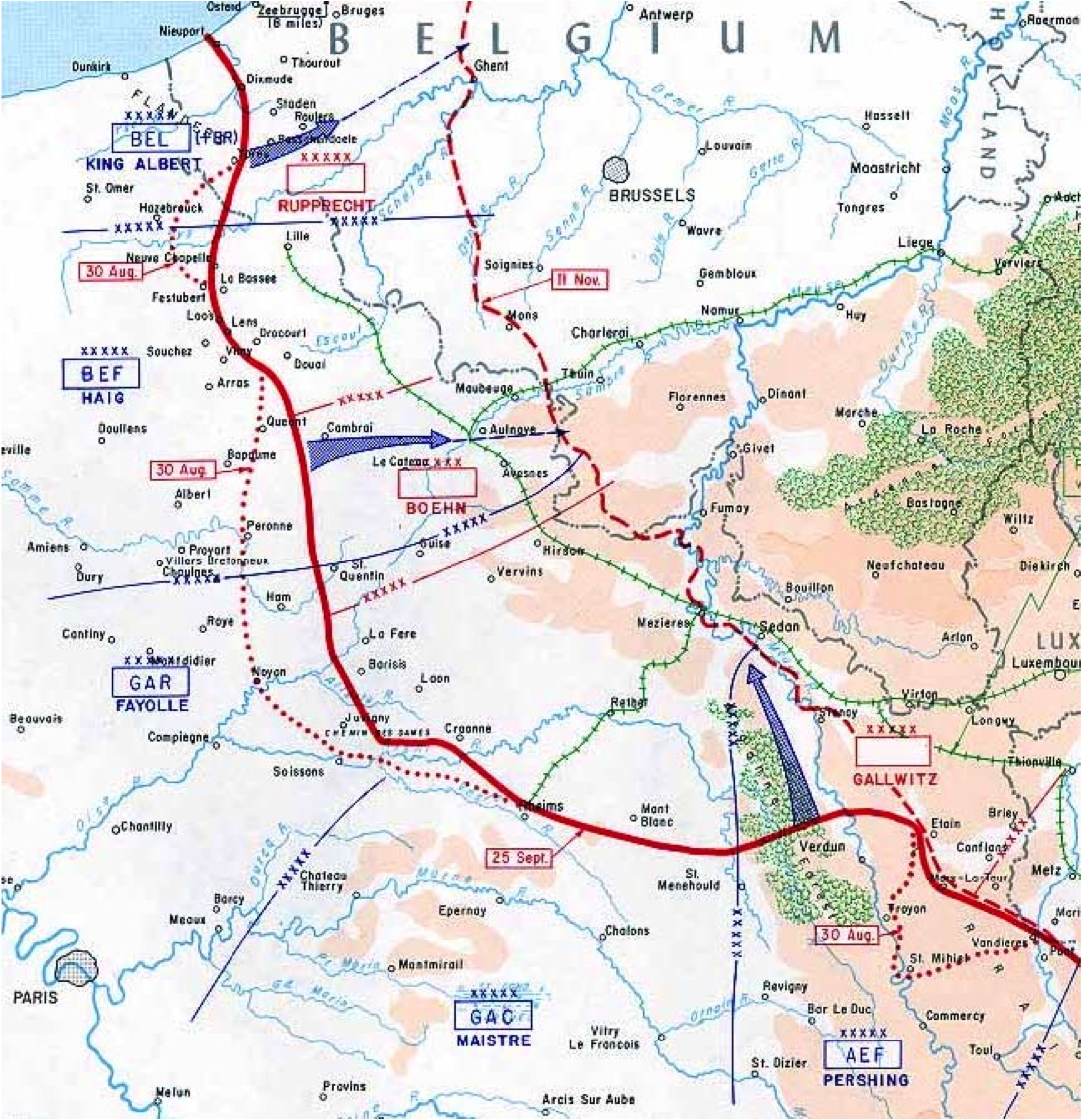
The main thrust of the Allied advance. The 15th Battalion, Hampshires was part of the force (‘King Albert’) advancing along the line of the blue arrow at the top of this map.
The action centred on Vierstraat, to the South West of Ypres, flanking Mount Kemmel. Ypres was a vital Allied salient to the northern end of the Western Front, which had seen see-saw battles throughout the war. 1918 was to see the 4th and 5th Battles of Ypres (the latter also known as the “Advance into Flanders” and “The Battle of the Lys”). Ypres was a saucer-shaped depression, the town at its centre surrounded by low hills. The Allied salient was occupied by a joint army, nominally under the command of King Albert of the Belgians, which comprised British, French, Belgium, and American troops.
In spring 1918 the Germans launched a massive offensive across the whole Front, calculated to end the war with the newly released troops from the Eastern Front (Russia having withdrawn from the War) and before the fighting potential of the Americans was available.
At Ypres the Germans over-ran Mount Kemmel and most of the Allied positions gained in the 3rd Battle of Ypres (Passchendaele, etc.), giving them strategic dominance over the salient. However, the Allies’ defence in depth, together with a massive reinforcement programme, brought the German advance to a halt with heavy losses.
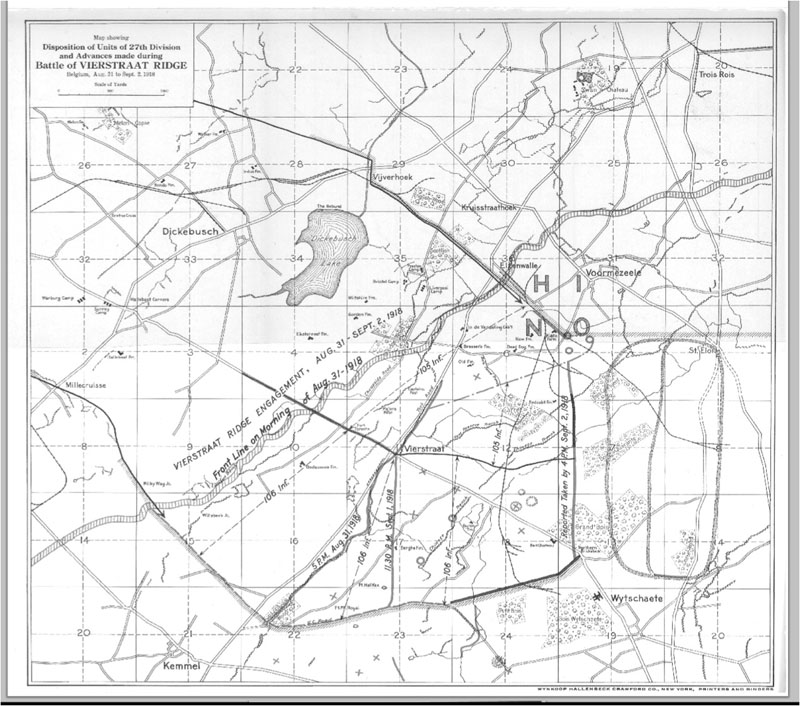
All British maps of this part of the campaign have been lost, but we are fortunate in having a US army map which shows the Vierstraat Ridge.
In August the Germans were forced to “straighten and shorten their lines” due to lack of resources. In Britain, huge drafts of new recruits were moved to the Front. The minimum age for front line duty was lowered and inhibitions on recruitment of those employed in agriculture relaxed. Hence, probably, the recruitment of George Sylvester (a farmer’s son from Peake Farm), Norton Broadway (farmer’s son from Lythe Farm) and Charles Collyer (agricultural labourer living in East Meon), who all joined up at Petersfield, where the 15th Battalion, The Hampshires (also known as the “Portsmouth Pals 2nd Battalion) was training.
At the end of August 1918 it was reported that the Germans were abandoning their positions on Mount Kemmel and the British 2nd Army was ordered rapidly to press this withdrawal and to exploit it to the full. Caution seems to have been thrown to the winds. On the 1st -2nd September the American 105th and 106th Regiments fought the Battle of Vierstraat Ridge. Their battle map (above) defines the area and features of the Hampshire’s following disastrous action. The Americans were charged with hingeing from a North to South position to a West to East frontage and taking the eastern end of the Kemmel heights. The map significantly shows the “reported” final position of their advance. Sadly (and as the map hints) this was inaccurate. The commanding and relatively safe position had not been achieved, the Germans were not in full flight but dug in on higher ground in wooded cover with strong machine gun resources and able to deploy both frontal and flanking fire.
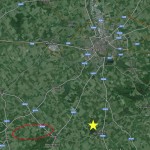
The planned advance at Vierstraat, the area of the Vierstraat represented by the yellow star and Mount Kemmel ringed in red.
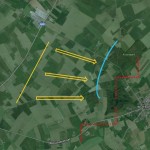
Today’s lie of the land, courtesy Google Earth, showing the proposed lines of attack by the 15th Battn, Hampshire Regiment
The crossroads, today, looking towards the Vierstraat Ridge
The fields at the foot of Vierstraat Ridge, seen today.
The British Command, with a degree of over-confidence, put aside most of its hard-learned tactical approach. The field was not reconnoitred, the battle was launched with inadequate preparation with misconceived awareness of positions resulting in the detailed orders needing to be abandoned at the start, and to cap it all… a failure for any artillery support to materialise. To quote the Battalion War Diary of the day (see Appendix 2) “An attempt to comply with battalion Operational Order D.F.1 was unsuccessful owing to the fact that the posts therein stated as occupied by the Americans were in possession of the enemy….. Orders were given at very short notice and Company commanders were unable to arrange all they wished….” And in a masterpiece of understatement: “Artillery arrangements were not quite satisfactory as the barrage came down to the east of the railway … leaving a number of enemy M.G. posts… unmolested to fire on our advancing troops”.
The advance from the Vierstraat-Kemmel Road start-line towards the hills began at 4.00am. The advancing Battalion was decimated by the heavy unsuppressed machine gun fire from multiple directions, snipers, and gas shelling. It eventually reached the light railway at the foot of the hills … but was unable to hold it due to the accuracy and strength of the enemy M.G. fire and shortage of men”.
Finally …”About dusk 2nd Lieutenant J J Potter, M.C., collected and reorganised all the men that remained of the Battalion and formed a line…” (all senior officers being dead or wounded by then). The Battalion sustained 323 casualties from sniper fire, machine gun, and gas – more than half its fighting strength.
George Sylvester, Norton Broadway and Charles Collyer were all killed, probably together as they are buried in adjoining graves at Voormezeele Enclosure No.3, Ypres, West-Vlaanderen, Belgium next to each other On the night of 5/6th September the Battalion was withdrawn from the line to Lappe for “…rest and cleaning up…”, followed a few days later by “…specialist training and reorganisation” and including what must have been a very poignant church parade at the YMCA Hut in Remy.
This is David Hopkins’ report on Langrish’s second VC, Sergeant Ernest George Horlock, who won his medal in the Battle of the Marne in August 1914, but died at sea in 1917.
Ernest George Horlock wearing his Victoria Cross
Laundry Cottage, Langrish
8 pounder battery at the Battle of the Marne
Ernest George Horlock was awarded the Victoria Cross on 25th November 1914. The citation in the London Gazette reads: “For conspicuous gallantry on September 15th, 1914, near Vendresse, when his battery was in action under heavy shell fire, in that, although twice wounded, he persisted on each occasion in returning to lay his gun after his wound had been dressed.”
Horlock was born on 24 October 1885 at Beech Farm, Alton. He and his parents, John and Emily Horlock, moved to Langrish around 1911 his farther being a carter and mother a laundress on the Talbot-Ponsonby estate. They lived on the estate at Laundry Cottage
In February In 1903, at the age of 18, Horlock joined the regular army. He trained at Woolwich and Larkhill and by the outbreak of World War I had achieved the rank of Bombardier.
He was posted to the 113th Battery Royal Field Artillery and in late August 1914, equipped with 18 pounder artillery pieces, embarked for France. On 15th September 1914, at Vendresse in France, engaged in the Battle of the Marne, the 113th came under heavy shell fire whilst trying to retreat to Mons. He was posted to the 113th Battery Royal Field Artillery and in late August 1914, engaged in the Battle of the Marne, the 113th came under heavy shell fire at Vendresse, whilst trying to retreat to Mons.
Family memories recount that Horlock was called the soldier who ‘defied the doc’. Twice, Horlock was ordered to the army hospital by doctors for treatment, but he chose to ignore these orders and returned to his gun. He remained with his gun until it was finally blown up, and he was carried away from the scene. Ten of his comrades had been killed in the action. On the third occasion that Ernest George Horlock was injured, it is reported that he again refused to see a doctor because he was ‘scared of getting a rocket’ for having disobeyed doctors’ orders and continued to fight. Sometime later, by December, he had been promoted to Sergeant.
Horlock’s medals, the VC above.
Ethel Horlock with her late husband’s medals.
The ring donated by Lord Peel, later Sergeant Horlock’s wedding ring.
When King George V visited the Front on 3rd December, 1914 he decorated Horlock with the Victoria Cross, a purse of gold and a gold signet ring with his name, number and battery inscribed on it.
His heroism was subsequently so celebrated that he even appeared on contemporary playing and cigarette cards.
His bravery and Victoria Cross did not go unnoticed in the locality. Horlock was taken on a parade in a landau through the streets of Petersfield, pulled by members of the local fire brigade,. Many local dignitaries turned out for this occasion, which culminated in many speeches, which included the Vicar of Langrish and Lord Peel of East Meon. He was also awarded a gold ring (right) by Lord Peel which he subsequently used as his wedding ring.
In November 1916 Horlock was promoted to Battery Sergeant Major. He was subsequently posted to Egypt. Sadly on 30th December 1917, just two months after his marriage to Ethel Halsted he was torpedoed whilst on the troop ship SS Aragon voyaging from Marseille to Alexandria. He survived the sinking, but when he and other soldiers had been rescued by the escorting destroyer HMS Attack, she too was torpedoed, Horlock was one of the 600 who did not survive.
Ernest George Horlock is buried at Hadra War Memorial Cemetery, Alexandria and his name appears on the war memorials in the Royal Artillery Chapel, Woolwich and in St. John’s church in Langrish. On 16th November, 2014 an inscribed paving slab was added to these memorials, and blessed, identical to another recently laid at the War Memorial at Alton, the town of his birth.
It was dedicated by the Reverend Jane Ball, Vicar of East Meon and the service was attended by members of Ernest Horlock’s family, some of the Horlock Troop of the Royal Artillery (recently returned from Afghanistan and based at Larkhill), and parishioners. His achievements were celebrated at a reception given by Nigel Talbot -Ponsonby in his ancestral home at Langrish House, where Horlock and his family were originally employed and lived on the estate of Nigel’s forbears. The memorial has now been erected for posterity in a gable end of “Hanger View” (the home of Mr John Harris) the southern portion of Laundry Cottage where Horlock and his family lived.
The gravestone at Hadra Cemetery
Rev Jane Ball receives the colours at St John’s Langrish
The memorial erected at the gable end of Hanger View (part of Laundry Cottage)
EMHG member David Hopkins gave a talk on December 16th, reporting notable events in World War I. This is his account of the first of two winners of the Victoria Cross who lived in Langrish.
Eric ‘Kipper’ Robinson as a young naval officer.
HMS Vengeance, on which Robinson was serving at Gallipoli
Achilles’ Tomb, the hill in the Dardanelles where Kipper Robinson won his VC.
The White House in Langrish where Admiral Robinson retired after World War II.
Admiral Robinson’s gravestone, in the churchyard of St John’s Church, Langrish
Eric ‘Kipper’ Gascoigne Robinson was born at Greenwich, London on the 16th May 1882, the third child of the Reverend John Lovell Robinson, and Louisa Aveline Robinson. His father was born in Ireland in 1849, entered the Royal Navy in 1871 and served as a Naval Chaplain.
His nickname was possibly given in recognition of the fact that he was a heavy smoker.
In 1897, aged 15, Robinson joined HMS Britannia, the Navy’s officer training ship, an old wooden-walled vessel which had been laid down in 1860 as the 131-gun Prince of Wales.
He was first appointed midshipman in 1898 to HMS Majestic, which had been launched in 1895 as a first-class battleship. In June 1899 Midshipman Robinson was posted to the cruiser HMS Endymion, and sailed to China. He arrived just in time for the outbreak of the Boxer Rebellion and was involved in the relief of the Siege of Peking.
Following his exploits in China Kipper was promoted to Sub-lieutenant in 1901 and Lieutenant in 1903. In 1905 he joined the torpedo training school HMS Vernon where he was trained in the use of torpedoes, mines and explosives.
In January 1915 he was on board HMS Vengeance (right) when she sailed to the Dardanelles, as part of the attempted invasion which Winston Churchill, then First Lord of the Admiralty, believed would shorten the war. On February 26th, as a result of his reputation for a cool head, he was given command of a shore station to eliminate some Turkish shore batteries.
The force landed unopposed on the Asiatic shore but as it moved towards the Turkish guns, came under heavy rifle fire. The British sailors were wearing white uniforms, standard issue for tropical Mediterranean postings, which made them extremely easy for Turkish marksmen to spot. The ships fired at the local village demolishing windmills, but firing continued from front and flanks.
Kipper led a small task force of sailors and marines towards Achilles Mound, reputed to be the burial site of the Greek hero of the Trojan Wars. There were two Turkish guns in the hollow at the top of the hill, though it was not clear if soldiers were defending the post.
Seemingly oblivious of the heavy fire and weighed down by the explosives and fuses he was carrying, Lieutenant Robinson walked up to the Turkish guns, and placed the explosives and set the fuses.
He then led his men back down Achilles Mound, to the next battery and into the gun position. In full view of the battleships, Robinson’s slow, deliberate pace gave the appearance of sauntering unperturbed from task to task, despite great danger; his reputation for coolness was further enhanced. As they returned to their boats, they were subjected to heavy Turkish fire, partly relieved by accurate fire from HMS Dublin. Only one marine was killed and three of the party were wounded.
Robinson saw further action in destroying a stranded and top secret British submarine, E15, in April 1915. Others engaged in the same expedition were awarded medals for gallantry but he was not – probably because his commendation for a Victoria Cross at Cumcale was still under consideration. However, he was promoted to full Lieutenant.
After the Great War, he commanded a flotilla of motor torpedo boats in the Caspian Sea during the Russian Civil War. During World War II, he came out of retirement, seeing service on the Atlantic convoys and as officer commanding the naval base in Dundee.
After World War II, Rear Admiral Robinson retired to live in the White House, Langrish. He died on 2nd August, 1965 and was buried at St John the Evangelist’s church, one of two men in the parish who were awarded the Victoria Cross.
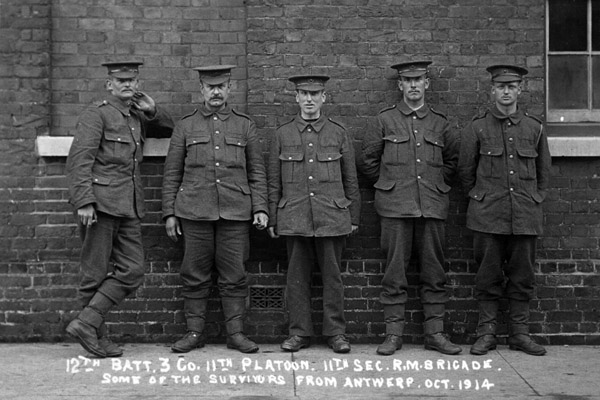
Owen Budd is in the centre of this photograph of Royal Marines taken in 1914.
Alan Newbold wrote this account of two relatives who served in World War I, the sons of William and Sophia Budd from East Meon. The Budd Family collection is stored in the online archive, click here.
Albert Cosham Budd (1882 – 1922)
Albert and Minnie Budd
Albert Cosham Budd was the son of William and Sophia Budd at the time of his birth, he was the only child of William and Sophia not to have been born at the “Olde George Inn”; when he was born the family were living in Cosham, near Portsmouth, where William was working as a bricklayer. It is presumed that Albert was named Cosham for this reason. As a small boy, Albert had golden curls and winning ways, he grew to be 5′ 11″ tall. He was handsome with a fair complexion. As a youth he enlisted in the Royal Marines, and he continued in this career for the rest of his life. Albert became a colour-sergeant in the Royal Marines. At the start of WW1, Albert was serving on H.M.S. Bulwark, when, in 1914, this battleship blew up in Sheerness harbour, whilst loading ammunition. Albert was in the mess at the time of the explosion and he was blown through the side of the ship .
The Evening News, November 1914, reported: “The battleship HMS Bulwark, which was lying in Sheerness Harbour, blew up. The Vice, and Rear Admirals who were present, reported their conviction that it was an internal magazine which rent the ship asunder. The ship had entirely disappeared when the smoke had cleared away. Only 12 of the 800 men and officers of the crew survived.”
And Naval records state: “Sgt. John Albert Budd, RM, who suffered from burns and a broken leg, stated that at 7.30 he was finishing his breakfast on the portside second mess deck, when he saw a sudden flash aft. As he turned, the deck opened up under him and he was thrown into the sea. He remembered coming to the surface of the water but the ship had disappeared. He had not heard the explosion.”
While Albert’s eldest son Jack was serving in the marines there was an older man with him who had witnessed Albert’s rescue. He said that Albert swam around hanging on to a piece of board , fully conscious until he was rescued. Later, in hospital, he asked for a Woodbine cigarette and then lost consciousness.
Albert was one of the twelve that survived, and he outlived the other survivors. He developed diabetes, and the leg wound he received in the blast did not heal. He declined amputation, and walked with a ‘stiff leg’ for the rest of his life. However, he recovered sufficiently to resume duties with the Marines, in a clerical capacity, at Haslar marine base near Gosport. He did not return to sea duties and died as a result of his wounds in 1922.
While Albert was stationed at Deal, he married Minnie Elizabeth Purse, daughter of William Purse from Southsea. She was a talented musician and taught piano. Their first two children Albert Walter Jack and Charles Owen were born at Deal; Arthur Edward was born at Chatham and Leonard George and May Victoria Lillian were born at Gosport.
Although disabled, Albert remained on full salary, but upon his death Minnie was obliged to care for her family on a meagre widow’s pension from the Royal Marines. Compounded by a difficult and dangerous life on a naval base during the war, Minnie’s health began to fail. She remained at home despite the diagnosis of tuberculosis (T.B.) Her mother came to care for her during the terminal stage of her illness. Minnie died in 1925.
Arthur, Leonard and May went to stay with their Aunt Emily (Newbold) at Old Alresford, until the boys left for Canada to live with their Uncle Hubert. May remained at Old Alresford until later that year, when her uncle (William Newbold) died. She was then taken into the care of her Uncle Owen (Budd) and referred to as Lillian to distinguish her from their daughter May.
Albert was given a full military funeral with his coffin, draped by a Union Flag, carried on a gun carriage hauled by Royal Marines in full dress uniform. Minnie was also buried with him.
The inscription on their grave reads:
In loving memory of
My dear husband,
Albert Cosham Budd.
Late Colour Sergt R.M.L.I.
Survivor of the H.M.S. Bulwark
who passed away after much suffering
caused by the explosion.
October 2nd 1922
Age 40 years.
Also Minnie Elizabeth
Wife of the above April 9 1925
Age 37 years.
Owen Charles Budd (1888 – 1969)
The wedding of Owen Budd
Owen Budd in 1905
Owen Charles Budd, known to our family as “Uncle Owen”, was the only member of the Budd family (other than Emily) that I knew personally. He was the son of William and Sophia Budd and was most probably born at High Street, East Meon. Owen’s trade is given on his enlistment record as ‘shop assistant’, but on his discharge papers as ‘caretaker’ or ‘bank messenger’. He was always a religious man and from the age of 13 became closely associated with All Saints’ Church. When he went to join the Royal Marines three years later, the vicar’s wife wrote him a glowing reference.
Owen was 5′ 10″, with brown eyes and thin brown hair. He joined the Royal Marines, at Gosport, on 21st March 1905. He lied, when joining up, adding 16 months to his age; by giving his birthday as April 9th 1887 he appeared to be within days of his 18th birthday, which was presumably the age for full service and of course this date remained unalterable thereafter.
He was made corporal in 1906 and in 1908/9 sailed on H.M.S. Antrim to South Africa. In 1910 he sailed, again to South Africa, aboard H.M.S. Balmoral Castle. In 1911/12 he was aboard H.M.S. Cochrane, which escorted the Royal Yacht ‘Medina’ taking the newly crowned King George V on a state visit to India. His diary of this voyage remains.
Owen married Mabel Sarah Stone in 1912 at the Parish Church at Alverstoke. His age was given on the marriage certificate as 25 but should have read 24. His father, William Budd, was deceased and described as a bricklayer. Owen was then a Lance Sergeant in the RMLI.
Great Britain entered World War 1 in August 1914. Owen saw immediate action at Dunkirk, on September 19th and was promoted to full sergeant the next day. At the renowned defence of Antwerp in October, he was one of the five survivors of 12th Battalion, 3rd Company, 11th Platoon. He was then landed at Gallipoli in April 1915, four days after the allied invasion commenced. Here he gave solid service, was shot through the hand by a musket ball, and achieved a certificate for zeal and devotion to duty in July. He fell ill early in September, probably with dysentery and was hospitalised out of Gallipoli in September. The whole army retreated from Gallipoli in October. Part of his diary from this campaign, on scrap paper, still remains in his family’s possession. On his return to England, Owen became a gunnery instructor in the Portsmouth Division of the RMLI for the remainder of the War. He completed the war with the 1914 Star with clasp and roses as well as the usual victory medal. Owen was made up to Quarter-Master Sergeant in May 1921 and kept that rank until the completion of his service in 1926.
Back home, Mabel bore two daughters, May in January 1914 and Violet Doris in May 1917. May recalls the day a Zeppelin airship dropped a bomb on the barracks at Deal; it blew the windows out where she had just been standing and destroyed her favourite doll.
In the year of the General Strike, 1926, Owen found it hard to find new work. His promised job at Dover fell through. He eventually moved in October 1926 from Walmer, to West Dulwich, London, where he found work as a commissionaire or similar with the Automobile Association and the British School of Motoring. For his wife and daughters, this was something of a downturn in their fortunes, after being the family of a senior Marine NCO in a small town.
In 1938 the family was living in Bromley. Owen was called up again for World War II as a QMS and was mobilised in April 1940, but discharged in December of the same year “in consequence of being physically unfit for R.M. service”. He was stationed at this time in the Orkneys or Shetlands. The story goes that his illness was a stomach problem caused by eating tinned food.
Shortly after discharge he and Mabel moved to King’s Worthy near Winchester, where he became verger of St Mary’s Church, living in the Verger’s Cottage, Church Lane. From there he finally retired in spring 1954 to a post-war pre-fabricated bungalow in Winchester. He remained a pillar of the community, active in the local Red Cross and the Over-60s Club. Upon the final demolition of the pre-fabs, they moved again.
Owen suffered from heart and circulation problems for some years and died from myocardial infarction at Winchester hospital in April 1969, aged 80. Mabel survived him by some years.
Marriage of May Christmas to Jack Barratt, October 1st 1918
Hazel Pamplin wrote this account of her great aunts who married Canadian brothers in and after World War One.
My Grandparents, William Jeremiah (born 1866) and Ellen Christmas (born 1869) had 11 children, eight girls and three boys. One girl and all three boys died in infancy. My mother was the youngest of the seven remaining girls.
William Barratt from Iowa had two girls and three boys and moved to Gabriola Island, Canada when World War I broke out. Sons Joseph and older brother Jack joined the Canadian Expedition to fight the Kaiser. They left brother Tom at home to care for their ageing parents.
Jack and Joseph fought in France. Jack was wounded there and recuperated in Bordon, Hampshire. His nurse was Alice May Christmas (known as May and my Aunt). Jack and Alice May were married on the 1st October 1918 in East Meon Church. May got married from 2 Temple Brow Cottage, but the family lived in other houses in the village at various times.
Joseph met May’s sister Millie and when the troops went home, Millie sailed to Canada to marry him. Brother Tom enquired if, “there were any more like you” and corresponded with yet another sister, “Dolly” who also sailed over and they eventually married too….
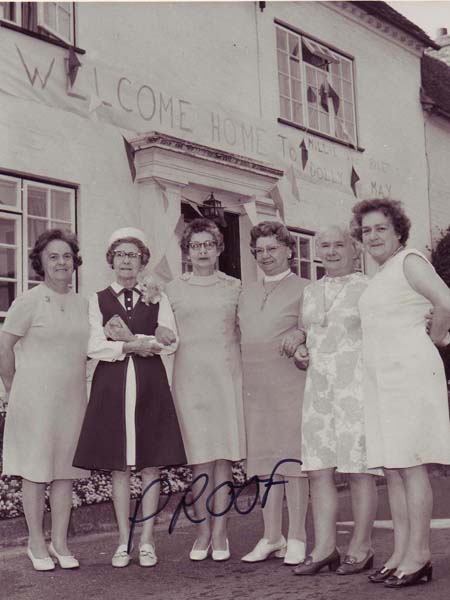
Three Christmas sisters married three Barratt brothers. After the Barratt parents passed away all three families re-located to Camas, Washington, USA. Six of the daughters outside Barnards, c 1980. L to R, Nellie Goddard, May Barratt, Dolly Barratt, Millie Barratt, Lillie Nicholson, Rose Mauback. The eldest sister, Maud Christmas, had died by this time.
Reredos screen of All Saints, commissioned by Rev Masters.
Basil Denne Reed had a busy war. He was the curate of All Saints, living at Orchard Cottage; he had to deputise for his extraordinary Vicar, Rev Thomas Heywood Masters, who was absent from the parish from 1914 – 1918.
The Rev. Masters was 49 when he volunteered for active service. Subsequent medical examinations established that he had previously suffered from chest congestion, but this doesn’t seem to have prevented him being accepted. He served first as a Red Cross ambulance driver and then, from 1915, as Chaplain to the 4th Army; he served in France, including the Somme, and was twice mentioned in despatches. In October 1918, a medical board sent him home on three weeks’ rest leave,, suffering from debilitation – ‘rest, tonic, change’. He still managed to return to the front, just in time to witness the end of the war.
Even without his distinguished military record, Masters would have been a notable vicar. Educated in Manchester, Inverness, Hanover and Cambridge, he was inducted as vicar here in 1902. (He also offered services as a ‘University tutor’.) He was an accomplished piano player, and during his curacy in Staffordshire he had met and befriended the composer William Havergal Brian, a working class self-taught composer, celebrated after his death.
Masters knew one of the most distinguished architects of the time, Ninian (later Sir Ninian) Comper, and embarked with him on extensive refurbishment of All Saints Church. It was Comper who designed much of the beautiful woodwork – the lectern, with its carved angels, the riddel posts and frontals of the sanctuary altar, together with the statues of the four apostles, the reredos and other screens in the Lady Chapel, the vestry door and the roof of the lych gate. After the War, Comper was invited by Masters to design the magnificent East Window, which John Mackinlay described in a previous edition of Meon Matters, an outstanding and unique War Memorial, which must have had special meaning for our vicar.
East Window, designed by Ninian Comper as a memorial of World War I.
Carving in archway between south aisle and Lady chapel, designed by Comper
One of Comper’s angels, which adorn the lectern.
Masters went on to become Vicar of St Peter’s in Petersfield, then Rural Dean at Portsmouth, then Provost at the Cathedral and an honorary Chaplain to the King, being honoured with a CBE. He died in September 1939 and is buried in our churchyard, next to Frank Partridge, the second bishop of Portsmouth.
Betty and Stewart Bussell researched the story of Rev Thomas Heywood Masters, as part of their investigations into the histories of East Meon’s vicars. Despite their best efforts, there is no photo or portrait which definitely depicts Rev Masters. However, the photograph of the dedication of the War Memorial in 1923 shows a clergyman standing by the plinth which may be he …
Detail of dedication service, possibly depicting Rev Thomas Heywood Masters
In his War Diary for Oct 2nd, 1918. Col H.P.Westmorland, commander of 2/B Hampshire Regt, wrote, in pencil: “Two platoons of X company, under the personal command of Lieutenant G.H.Brown, worked down the banks of the Reutelbeek and succeeded in reaching the Cemetery on the east side of the village. Here they were held up after sustaining heavy casualties until two machine guns that were holding them up on the right, were rushed, with great gallantry, by two men of the leading platoon, resulting in the surrender of 27 of the enemy..”
Private E. Bone and his platoon commander had played a vital part in unblocking fierce German resistance to the Allied advance near Ypres. They helped relieve two days of British losses when they charged two machine gun posts, taking 27 prisoners. The two men were promoted, Lieutenant Brown to Acting Captain and Private Bone to Lance Corporal.
Edward Bone came to East Meon after the War, to work at Leydene House. With his wife Alice, he came to live first in Coombe Bottom and then at Hambledon Lodge at Leydene. When Leydene was requisitioned in World War II as HMS Mercury, Edward worked as a lorry driver and Alice in the NAAFI.
G.W.Atkinson
George Wilson Atkinson was the son of George Atkinson who, with his brother Joseph, had migrated from Cumberland to become tenants of South Farm in 1906. George W lied about his age to sign up for the Hampshire Regiment, joining the15th battalion, along with other East Meon recruits. He was taken prisoner in March 1918 during the German Offensive at St Quentin, fought on the same ground as the original Battle of the Somme; he was posted as missing.
By coincidence, Albert Smith, the village thatcher who lived at Frogmore, was taken prisoner in May 1918 and met George Wilson at a reception camp. In a letter home to he mentioned that they had met – and this was the first indication the Atkinsons received that their son was alive.
When he finally returned home, after the War. GW arrived at Petersfield Station in the middle of the night and walked home to South Farm, arriving unannounced at around 4.30am, to the joy of the family and of the herdsmen, Arthur Dowlen and his two sons, who were milking at that hour.
Research into Edward Bone was initiated by his grand-daughter, Denise Moody, who lives in Dunedin, New Zealand; she contacted the History Group for help in tracing her ancestor – which David Hopkins has provided. George Atkinson and Denys Ryder supplied the information about George’s namesake and forebear.