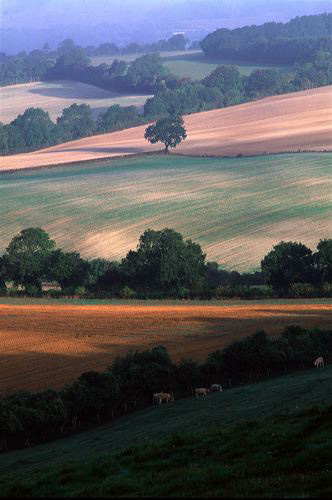
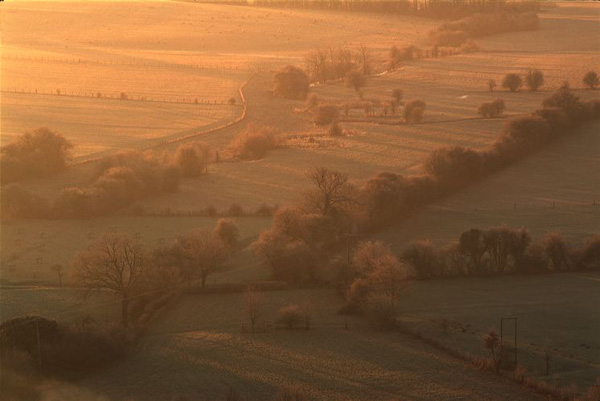
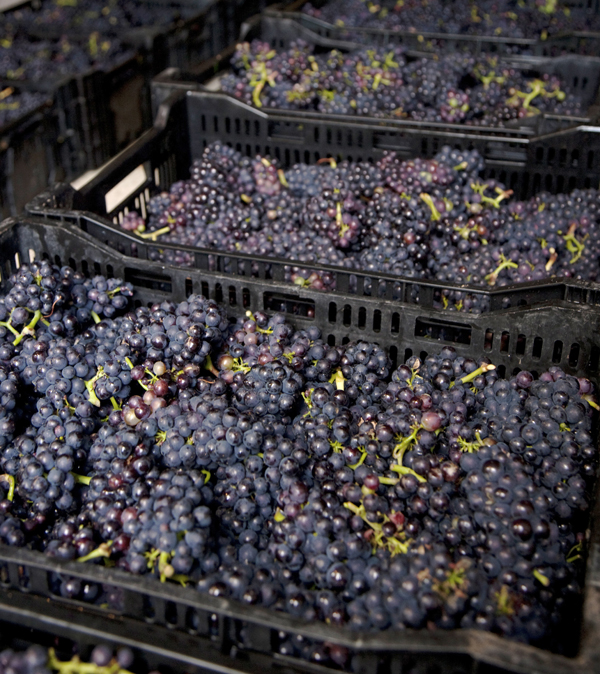
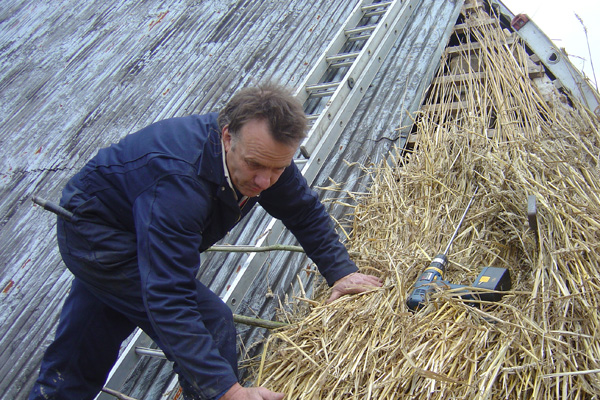
These three photographs are by East Meon’s Chris Warren.
The village of East Meon sits under Park Hill, to the north of the beautiful Meon Valley. The South Downs define the other side, and farmers have over the centuries both provided the main source of income and employment for the village, and have acted as custodians for the countryside. In 2016, the History Group embarked on an ambitious project to research the history of Farming the Valley, from the late Iron Age to the 20th century, and the progress of this project will be recorded in the History Group section.
This section records, through a series of articles (many written for Meon Matters), aspects of the history of farming in the Valley.
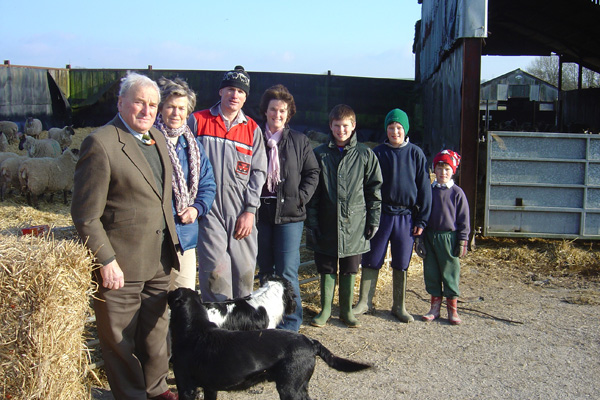
Wilson Atkinson, on left, is the grandson of George and Mary Atkinson, who migrated from Cumberland to the Meon Valley over 100 years ago.
During World War II, farmers had to deal with mountains of paperwork
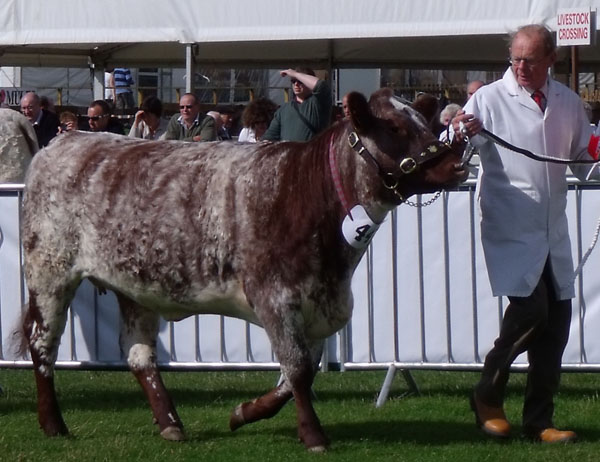
Frank Moffatt, another descendant of Cumberland farmers, has been a champion breeder of livestock.
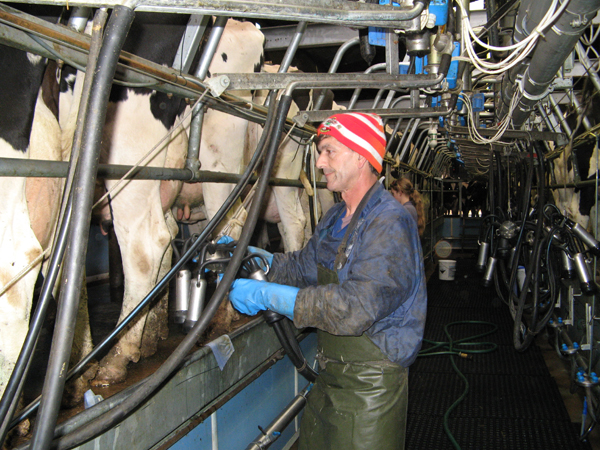
Rob Barnett, Head Milker at Whitewool Farm.
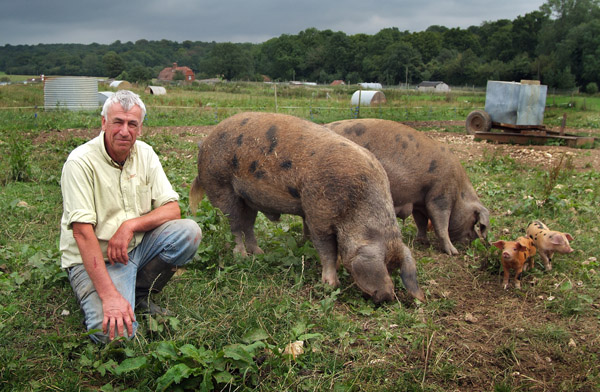
Richard Jones of Hyden Farm Organics, with some of his Oxford Sandy & Black pigs
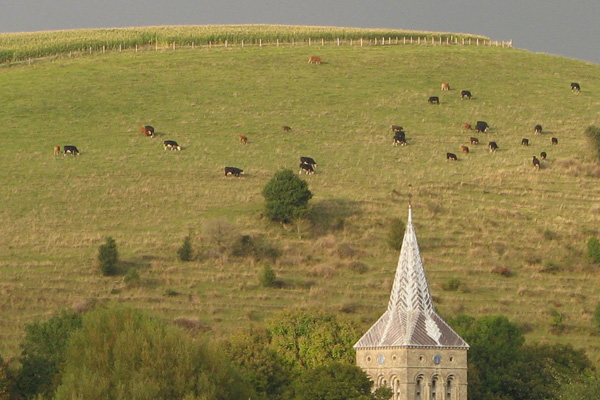
The Bereleigh Suckler Herd grazing on Park Hill
The first vineyard since mediaeval times has been established at The Court House.
Enclosures of farmland have had a bad press. Particularly in the 19th century, a rash of Acts of Parliament enabled landowners to enclose land by fencing in their fields, which up till then had been open spaces divided into strips of land mostly cultivated by tenant farmers.
Three official Enclosures are recorded in the parish of East Meon, enclosing land at Oxenbourne and Ramsdean Downs. The first was a formal Agreement in 1661; it is notable that most of the signatories were illiterate and marked their consent by making crosses.
Detail of the 1661 Enclosures, with three Xs marking the consent of illiterate farm tenants.
The later Enclosures were by Acts of Parliament in 1845 and 1861. The 1845 Act enclosed 612 acres, awarding 135 to a prominent local landowner, John Bonham Carter: a further 158 were distributed among members of the Weeks family and the rest divided into smaller portions. The 1861 Enclosure awarded a further 122 acres, 38 to Bonham Carter and 20 acres to another wealthy landowner, Sir William Jolliffe. In other words, the bulk of the farmland was awarded to wealthy landowners, while small farmers were confined to reduced holdings, often of poor land, or forced to give up farming altogether.
1845 Enclosure map showing division of land at Oxenbourne into large holdings for Sir John Bonham Carter and Sir William Joliffe, and smaller sections for tenant farmers. One field is set aside for ‘Poor Cottagers’.
This Victorian land grab forced many farm workers to seek new places to live and to look for work where they could find it. A lucky few ‘farm servants’, usually young men and women, still lived on the farms where they worked while ‘agricultural labourers’ were forced to find employment where they could, usually only at harvest and sowing times. Many were migrant, moving from parish to parish in search of work. By 1871, 91% of rural workers in the South East were in this category, struggling to survive.
Early East Meon censuses show how many agricultural labourers were crowded into inadequate accommodation. What are now two cottages at Barnards, for example, were subdivided into four households; the 1861 census shows one of these, No 8, High Street, housing the Sloper family of 12, four of them (including a 19-year-old girl, Jane) listed as ‘agricultural labourers’.
1920s photograph of Barnards Cottages, with four door where there are now two.
It can, however, be argued that Enclosures were inevitable and contributed relatively little to the rampant rural poverty which pervaded Hampshire in the Victorian age. Firstly, the population of England was growing astronomically – it doubled between 1801 and 1851, and again by 1911. Secondly, British farming was under intense pressure to become more efficient. The repeal of the Corn Laws in 1846 had removed the guaranteed high prices designed to protect British produce: grain imported from the Continent once again undercut local prices. New technology, including steam-powered machinery, and new farming techniques, including improved fertilisers and better irrigation, reduced the numbers of workers needed. Steam-powered ships carried cheap food from North America. In the South East of England, where farms mainly cultivated cereal crops, successive years of disastrous weather in the 1870s ruined crops.
Farming in Britain had to become more efficient to survive, and larger farms were more productive and employed fewer workers. Many migrated either to the cities, or to the colonies. Of the farm workers who remained, most had to take second jobs. In 1801, 66% of the population had been rural, by 1851 this was reduced to 46%, and by 1911, 21%.
Oxenbourne fields seen by Google Earth
As a footnote, the beauty of the Meon Valley owes a great deal to the Enclosures. Land allotted by Acts of Parliament was divided into regular field patterns and. today’s landscape, defined by fences, walls and hedges, was the result. Perhaps we should not be too hard on the Enclosures.
Many details of the East Meon Enclosure documents held in the Hampshire Records Office are available in the digital archive, click here.
It was the state of farming in this part of Hampshire at the end of the 19th Century that led to a migration of a group of individual, yet neighbouring, farmers to sell up, in what was then Cumberland, and bring their families, livestock, goods and chattels down to East Hampshre. The land was ‘corn sick’ and said to be ‘only capable of growing grass’. The only water supply being the river Meon and dew ponds on the hills. But that was no problem to sturdy Cumberland farmers.
Hud Smith
In 1890, Hud Smith came to manage Basing Park Estate, just north of the A272, and owned by one of the Nicholson Gin family. Hud Smith told other Cumbrian Farmers that they could come to Hampshire and take on big farms (500 to 600 acres each) at very low rentals. At the time, they farmed between 40 and 80 acres in the northern Lakes, under Skiddaw, one of Lakeland’s highest mountains.
Westbury Manor and Riplington Farms
As a result of this information, Robert Hind of Millbeck Hall and Isaac Wren of Lowgrove Farm came down by train to West Meon from Keswick in 1893, to look at two farms in the Meon Valley; one was Westbury Manor Farm and the other, Riplington Farm. Each man liked the other’s farm better, so Robert took Westbury Manor Farm from Colonel LeRoy Lewis, who owned Westbury House, and Isaac Wren took Riplington. The rent for both farms was 5/- (25p) per acre/annum.
Robert had four children, and the boys, Alfred and Reginald, farmed Westbury after his death. The line died out as none of the children married or had any offspring. Isaac Wren farmed Riplington Farm until his death, when it was taken over by his son Arthur, who farmed it until the mid-1950s. Arthur had five children, Cyril, who farmed at Liss, Arthur, Peter, Jean and Mary, who is married to Tom Luff and farms at Ramsdean with their eldest son Graham and his wife Debbie.
There is a story about the two families and the move down from Keswick. They booked a special train to bring them to Petersfield; they loaded livestock, a few implements and furniture onto the train, and boarded a passenger coach themselves. The train was timed to arrive at Petersfield at 10.am and the carters and wagons from both farms were sent to meet them. Owing to delays en route, the train did not arrive until late afternoon, by which time the carters had spent a ‘happy hour’ or two in the nearby pub and were quite merry by the time the train arrived. Happy Hampshire carters met travel-weary Cumberland framers, neither of whom properly understood each other’s accents. What a recipe for disaster …
Other Cumbrian Farmers Arrive
John Fawcett was next, moving to Manor Farm, West Tisted. Fred Rook followed in 1898, and after a period as a pupil of John Fawcett, took on Church Farm, Priorsdean. Today, Fred Rook’s grandsons, Ian and Nicholas, farm at Manor Farm, Clanfield.
John Edgar, a close neighbour to the Wrens, was next. He looked at Tigwell Farm (now part of the Bereleigh Estate) but came to Old Place, East Tisted. In those days, farms traditionally changed hands at Michaelmas (Sept 29th) or Lady Day (March 25th), the times in the year when rent was due to the landlord. The Mitchells, who lived around Loweswater, one of the loveliest lakes in the Lake District, did not come to East Hampshire but settled at Elsted, just across in West Sussex.
The Atkinsons of Skelgill Farm, Newlands Valley, Keswick, Cumberland
George and Mary Atkinson came next, and took South Farm, East Meon, from September 1905, but did not come down until March 1906. After them, two further families came; Alf Stanley went to Liss and Edwin Stanley to Bydean Farm, Froxfield.
This made a total of 9 families who came down from Cumberland to farm in Hampshire between 1892 and 1925, but (apart from the Mitchells of Elstead, who still farm the same land) only one of the original families continues to farm and live in the same farmhouse to which there forebears came, and that is Michael Atkinson and his family at South Farm.
The Atkinson name has been synonymous with farming and community matters in East Meon for over 100 years. George and Mary arrived with their family of five girls and two boys from the small, 40-acre, Skelgill Farm, about 5 miles south west of the town of Keswick, and at the start of the Newlands Valley. Skelgill is situated under the mountain called Catbells, overlooking Derwentwater, the lake in Beatrice Potter’s story of Squirell Nutkin.
The actual date on which they came down is unknown, but it was about the 19th/20th March 1906; the farm records held at South Farm show an entry in the diary, of certain fields being sown with grass seeds on 22nd of that month. The family, like Isaac Wren before them, hired a special train to bring family, livestock, goods and chattels down from Cumberland, but this time to West Meon station.
South Farm.
George Atkinson took the tenancy of South Farm from the executors of John Bonham Carter of Buriton, with effect from September 1905. Isaac Wren ran South farm for George Atkinson for 6 months until he was in a position to move south in March 1906. The farm was 568 acres (129 hectares) with a rent of £293 per annum, just over 10/- (50p) per acre.
The farm included a working water mill, described in auction particulars as ‘The valuable recently erected brick and slate turbine water mill, driving a pair of gristing stones, having three fine large stores, with hoists to same.” At the sale of the previous tenant’s effects, George bought 5 steers at £5 each and a further 7 at £4.5/- each (£4.25). Other purchases from around the district included a water cart (£7), a tip cart (£9) and a saddle and bridle (16/- or 80p).
Milk Production at South Farm
In the accounts for October 1909, the sale of milk from the farm first appeared, and continued unbroken for 92 years, until 2001, when milk production throughout the whole top end of the Meon Valley ceased due to poor prices. In those days the farmer received 1/6p per gallon (1.5p per litre).
Sale of South and Lower Farms
In May 1908, the Bonham Carters sold 1450 acres made up of Hyden and Coombe woods (530 acres), South Farm (576 acres, George Atkinson being the tenant at the time), Lower Farm (257 acres, with Sam Hardy as tenant) and Hyden Farm (87 acres). Lord Hotham’s trustees purchased them. What is interesting about Lord Hotham is that he created an ambitious water supply scheme which involved putting in a pumping station at South Farm, almost adjacent to the springs, the official source of the river Meon, pumping the water to a reservoir on the top of the downs at Salt Hill, and from there supplying by gravity ‘The Estate and the Village”. This, today, is still the main water supply for the village.
George Wilson joined the army during World War I and was taken prisoner by the Germans in France in March 1918. He was posted as missing. By coincidence, Albert Smith, the village thatcher who lived at Frogmore, was also taken prisoner of war in May 1918. He met George Wilson at a reception camp and in a letter home to his family mentioned that they had met. That was the first indication that George Wilson was alive. On returning home from being a POW in Germany, he arrived at Petersfield Station in the middle of the night and walked home to South Farm, arriving unannounced at around 4.30am, to the joy of the family and of the herdsmen, Arthur Dowlen and his two sons Sunner and Charlie, who were milking at that hour.
George Atkinson senior died in the Petersfield Cottage Hospital on 3rd May 1922. George Wilson and his younger brother Joseph carried on the farming business at South Farm, as partners. Wilson Atkinson, George’s grandson, told me that his father, George Wilson, fell in love with Sarah Cowx and, as they wanted to get married, decided to take on the tenancy of Lower Farm from Sam Hardy when it became available at Michaelmas 1926. By this time Lady Peel of Leydene House was the landlord, and the rent was £216 for just under 300 acres (72p/acre).
In 1928, Lady Peel granted to the two brothers the grazing rights over Hockham and Small Down, plus Hockham Cottage (where Wilson now lives with his wife Jill), a total of 159 acres for a rental of £35/annum. In addition, a further 52 acres was added in 1942, which brought the total farm up to 1079 – a great increase from the 40 acres their father had farmed in Cumberland.
Lady Peel and the Leydene Estate
In 1949, Lady Peel died, and is buried in East Meon churchyard. In 1953 an auction was held in London, when 10.309 acres of lane were offered for sale. It included, under Lot 12, all the land that the Atkinsons farmed, comprising by now some 1178 acres. All the farms had tenants, and it was believed that Sir Dymock White, who owned a large part of the Southleigh Estate outside Havant, met some of the farmers on the north side of the South Downs Way at the Bat and Ball, and suggested they not bid against him, as he would be bidding for the whole estate and would be prepared to sell them their farms after the sale. This is what happened, and in 1953 both Lower and South Farms were bought by George Wilson and Joseph. The brothers continued to farm the two farms in partnership until George Wilson’s death.
Farming now and in to the future
George Wilson died on 26th June 1958 and the partnership of G.W. and J.Atkinson was dissolved on 31st October 1958. J.Atkinson Ltd was formed by Joseph at South Farm, and farmed by himself and his son Michael, until Joseph’s death on 22nd December 1965. Since then, the farm has been run by Michael, and more recently by his two sons, Nicholas and Matthew.
At the same time, Wilson Atkinson (on the left, above, with wife Jill, George and Elizabeth, and their three boys) took over at Lower Farm and farmed it, and Peak Farm, West Meon, until his retirement in 1990, under the name of Wilson Atkinson Farms. His only son, George, and daughter-in-law Elizabeth, now farm it. George has a young family, James, William and Oliver, and I wonder which one will be the farmer taking over from their father. This year they are celebrating 80 years at South Farm.
Currently, Michael divides his time between the farm, where his idea of retirement is ‘doing what he wants to do when he wants to do it’, and his hobby, a passion for vintage tractors. Of these, he has about 20. He is also committed to the Parish Council, of which (like his cousing Wilson before him) he is currently the Chairman. Nicholas is married to Sue, who runs Harvesting Cream Teas at Parsonage Barn through the summer; they have two children, Tilly and Jack.
Matthew, Michael’s younger son, has three children, Jenny and Joe, and Florence by his second wife, Tina. Joe, at the age of 13, is a very keen rugby player and has just been selected for the Hampshire Under 14’s team. Jenny is seen at the head of a scratch team of girls, pulling against the boys in the Tug of War at the 2005 May Fair.
As we go into the 21st century, imagining what happened 100 years ago this month at South Farm, it may be difficult for readers to comprehend the brave decision that the Atkinsons took at that time, moving lock stock and barrel from one part of the country to another. Farmers, by their nature, have to be adaptable; the weather, the public’s buying habits, government legislation and many other factors influence their lives. Will the Atkinsons be the farmers of one of the loveliest parts of East Hampshire, and still live here, in another 100 years’ time? I leave it to our readers to muse on that one.
In the meantime, the editors of Meon Matters would like to wish all the Atkinsons, and their extended families, congratulations on their first 100 years in the valley, and to thank them, and farmers like them, for continuing as custodians of our lovely East Meon countryside.
Do you get annoyed with form filling, and do you wonder if this paperwork has been of benefit to anybody apart from the bureaucrats? Well read on, and learn how some of this paperwork not only played a major part in helping to defend our freedom, but has also left us with a fascinating historical insight into our community during World War II.
In 1940 these islands, with our commonwealth allies and various free forces elements, stood as the sole bastion against the Nazi’s. Germany had abandoned operation Sealion (Unternehmen Seelöw), the invasion of the UK following the military and psychological victory of the Battle of Britain, but the situation was still very grim.
However, they were still rampaging across the Continent, as the war became the first truly global conflict. In 1941 Hitler initiated operation Barbarossa, the invasion of the Soviet Union. The blitz was also continuing across this country, there was fierce fighting in North Africa, and the “official” entry of the United States was still to come in December with the Japanese attack on Pearl Harbour.
Cut off from Continental supplies and the Battle of the Atlantic at full intensity with wolf pack U-Boats operating in the Northern Atlantic (over 1000 ships were sunk during 1940, 1300 in 1941, peaking at over 1600 in 1942), food and fertiliser supplies were severely restricted. Therefore it became imperative to maximise food production, or face the real possibility of not being able to continue the fight. In fact the German High Command estimated that if they sank 150 merchant ships a month they would starve us into submission.
To survive we had to know what the land was or could produce. This led to the ‘Agriculture Survey of 1941 – 1943’. Not only did this play a major role in feeding the nation during those trying times, but now provides a unique insight into our community during the war years.
Starting in 1940, the survey was controlled by the ‘County War Agricultural Executive Committees’, and these Committees were far from toothless pen pushers. They could and did; direct what was grown, take over land, and even order the termination of tenancies if they felt the farm was not being run correctly.
The immediate aim of the survey was to dramatically increase food production. To do this around 85% of farms were surveyed between June 1940 and the early months of 1941, each being giving a rating of A, B, or C, primarily focusing on the productivity of the land. This led to much land that had not been under the plough since the Middle Ages being brought back into production.
Once the initial challenge was over, a more structured survey took place from 1941 until 1943 to create a comprehensive picture of the nation’s agricultural capabilities, and which could form the basis of the post war planning.
Every farm of 5 or more acres would be surveyed, some 300,000 establishments. However this time the surveys, carried out by local farmers, would focus more on the management capabilities of the farmer rather than what was being produced. To do this the survey gathered information around; quality of the land, labour used, type of power supplies, tenancy details, and if there were there any infestations!
So what does the survey for the parish of East Meon tell us? Below are some selections from the documents held at the National Records Office (NRO) Kew, reference ‘MAF 32’ for those of you familiar with the NRO. My selection is purely random!
South Farm is noted as having 378 acres and an additional 150 acres of “rough grazing” to which the farm had sole grazing rights.
The land is split around 140 acres growing very mixed crops and the rest for grazing. In terms of livestock, the farm had 126 cattle and calves and 439 sheep and lambs, 430 total poultry, 6 horses, as well as 8 employees.
Oxenbourne Farm had 533 acres plus 354 of rough grazing. 257 acres was set aside for growing mixed crops. In terms of livestock the survey lists 88 cattle and calves, 287 sheep and lambs, 1 pig, and 45 poultry, 1 goat, and 8 horses, with 10 people employed.
Coombe Cross Farm had 167 acres plus 112 acres of rough grazing. Again the Farm is split with some 111 acres for growing crops. Livestock was again mixed with 51 cattle and calves, no sheep, 21 pigs, 400 poultry, 5 horses, with 3 workers listed.
Duncombe Farm had 64 acres with an additional 6 rough grazing, some 24 acres being put aside for crops. The farm had 22 cattle and calves, 8 poultry, and 2 horses. No workers are listed as working there.
Lower House Farm had 166 acres with no rough grazing. 18 acres were set aside for crops, 92 cattle and calves, 20 pigs, 341 poultry, and 5 horses are listed, with 9 people shown as working on the farm.
Lower Bordean Farm had 526 acres plus 46 for rough grazing, with around 173 acres growing crops. Cattle and calves totalled 132, 684 sheep, 7 pigs, 60 poultry, and 2 horses. 11 workers are employed.
Lower Farm had 279 acres plus 340 rough grazing in addition, with around 170 growing crops. 92 Cattle and calves, 362 sheep, 4 pigs, 1370 poultry, and 3 horses are listed with 7 employees.
Garston Farm; 255 acres with an additional 61 for rough grazing, 95 being used to grow crops, 79 cattle and calves, 175 sheep and lambs, and 5 horses. Employees amounted to 4 people.
When the process moved on to focus more on the capabilities of the farmer themselves, it still rated them A, B, or C. However, if it was not A rated, then the assessor had to enter a reason and select from; old age, lack of capital, or personal failings, the later requiring even further explanation! To save any blushes I will not name the farm where the entry reads; “works very hard but does not organise his labour as he should”. This can seem quite absurd now, and I am sure that present day civil servants would face some stiff remarks, or even a solicitor’s letter, if they made such a comment, you need to remember that observations such as this could have serious consequences for the person and farm concerned.
I have to confess that I have no knowledge of how agriculture has changed since those dark days. Perhaps you could let us know your memories of the period and the changes since, particularly how much more productive modern farms are? However, looking at the farm survey it strikes me that the farms were much more mixed in nature and appeared to be much more labour intensive.
Finally, I would like to use this piece to ask for some help on another local history project that I am working on. I came across this unique resource whilst researching the background to the deaths of the members of our community listed on the War Memorial. Whilst I have been able to obtain much information about those who made the ultimate sacrifice during World War 2, one person has remained a mystery. That person is James Butler, if you have any information regarding him I would appreciate it if you could contact me. Please feel free to call on 823068, or email kerrymore@compuserve.com.
I hope that you have found this unique picture on the history of our community interesting and if you would like to contact me, please feel free to do so.
During late spring, summer and early autumn evenings you often hear a noisy ritual taking place on Park Hill. These evocative honking sounds come from the cows of the suckler herd calling their calves to follow them to whichever special spot they have decided to spend the night. Why they pick a particular spot is not known, but the trails they make as they cross the hill, are clearly visible as they move from one such spot to another.
The cows do not graze on Park Hill all the time, they are sometimes moved to Bordean Down, the hilly pastures to the east of Park Hill. They also graze in Bereleigh Park to the south of Bereleigh House after the hay crops have been taken. There is not enough nutritious grass to feed them outside all year round, so from early November till late April/early May, the timing depending on the weather, they are housed in barns at Park Farm. Here they are fed on silage and crushed barley from the Bereleigh Estate.
You may be wondering what a suckler herd is? It is a way of producing cows and bullocks for beef similar to that occurring naturally in the wild. Each calf is suckled by its own mother, until it is weaned at about seven months old. Cows kept on plain forage, like grass, produce a limited amount of milk, only enough to feed their own calves. This is different to dairy cows, which get supplemented with high energy food and so produce lots more milk. To keep the grass in good condition it is fertilized twice a year, all but the steepest parts, like the sides of Vineyard Hollow are covered. Not a job for the faint hearted!
The herd is looked after primarily by two of the Bereleigh Estate staff, Brian Boisclair,who is the Estate Farm Foreman and Chris Kingham, a Gamekeeper on the Estate. Barry Clavey and Ryan Boisclair also assist with feeding and calving. Their work with the herd is part-time on top of their day jobs. This is not as bad as it seems, as the herd is really semi wild and mostly looks after itself on the hill.
Brian has worked on the Estate farm for 31 years starting at the age of 15. He worked for 4 years, then youthful wanderlust got the better of him and he went off to Tripoli in Libya for 9 months digging holes with a JCB for Colonel Gaddafi. I think it must have been the call of the green hills after all that sand and heat that brought him back to East Meon and he resumed his work at Bereleigh gradually working up to his current role as Estate Farm Foreman.
Chris has worked on the Estate for 29 years. He originally moved into farming working on a pig unit in Sheet, and then moved to a farm near Oxford. Returning to East Meon, he started work at Bereleigh doing relief milking. Bereleigh had four dairies at this time: Park Farm, Lower Bordean Farm, Tigwell Farm and Garston Farm. When the economics of dairy farming got problematic in 1991 the Estate decided to stop this activity. Chris then transferred to game keeping on the Estate.
With the cessation of the dairy side, something still had to be done with the steep hill pastures to keep them from reverting to scrub. The choice was to put sheep on them, which can be quite labour intensive, or a suckler herd of cows. The suckler herd won out! The current herd consists of 63 cows (Hereford crosses) and 2 bulls (Blonde Aquitaines). Fresh cows are bought in as required to supplement the herd as the female calves cannot be retained due to interbreeding imperatives. The bulls eventually become too big to do their work on the very steep hills and are returned to the supplier farm and younger, lither and slimmer versions substituted. Brian and Chris must be doing something right in looking after the herd won ‘Best Beef Enterprise 2009’ at the Petersfield Autumn Show.
The bulls are put with the cows in June, and calving starts in the barns at Park Farm in March and early April, cows having a gestation period of around 9 months. Brian and Chris take turns in keeping an eye on the cows everyday when they are calving and lend a hand if necessary. There were a total of 56 calves born to the herd in 2009. Once born, the calves are given individual ear tag numbers. These numbers are given to Fiona Hearns in the Estate office, who runs the administrative side of the herd. She registers each birth, via the Internet, with the British Cattle Movement. Each animal is then issued with its own passport, which tracks the animal’s movement history every time it is sold to another farm, until it dies.
After 10 to 11 months the calves are sold at a cattle market for further development and conditioning. Getting them to market has become more problematical recently as so many of the local cattle markets such as Guildford and Winchester have shut down. Brian has been taking them to Frome market.
The herd is usually quite healthy and the vet very rarely called out, though there are some problems from time to time. Liquid magnesium is placed in the drinking troughs everyday to prevent them suffering from ‘grass staggers’ (hypomagnesemic tetany) and a mineral supplement in the form of a salt lick is left on the hill for them to help themselves. The herd is brought back to the barns for their ‘blue tongue’ vaccinations twice a year. Sometimes one of the herd needs treatment for an illness, ‘New Forest Eye’ is the most common. This presents a dilemma, as the herd is semi wild. It is difficult to catch an individual animal outside, so the safest thing to do is to bring the whole herd back to the barns and then separate the required individual. This is a lot of hard work and very disruptive to all. To make things easier Brian and Chris have perfected a technique straight out of the Wild West. They have created a lasso device on the end of a long pole to catch the required animal. They use it from a four-wheel buggy, one will drive and the other sitting and working the lasso. So if you see any strange ‘goings on’ on the hill you know what is happening. They say they are very successful with this technique and mostly catch the target, which is then treated on the hillside. Maybe it should be made into a new sport for County Shows?
Many local villagers walk on Park Hill regularly, especially those with dogs. Brian asks that if you have a dog, please keep it on the lead if you are amongst the herd as the calves especially can be very nervy, jumpy and curious all at the same time. In the unlikely event you are approached by threatening looking cattle, they are probably only curious about your dog, please just let go of the lead. Your dog will be able to run faster than the cattle.
Another problem for the herd is rubbish left on the hill, tin cans, sandwich wrappers etc. which the animals may eat out of curiosity and make themselves ill. Please take any rubbish back home with you, and if you see any when you are walking please take this back home or put it in the village rubbish bins. During the recent snow a lot of people tobogganed in the valley to the north west of the Church called Core Bottom and many plastic bottles, cans and broken bits of plastic were left behind, which was very disappointing, and had to be collected by the Estate workers.
The herd shares these hills with many wild creatures including badgers, roe deer, rabbits, hares, foxes, stoats, weasels and many different bird species. We are very lucky to have such a wonderful place to walk and to enjoy the beautiful views over the Meon Valley and beyond. Please respect the cattle and make the jobs of Brian and Chris easier.
East Meon’s heritage is essentially one of farming, with most of the inhabitants working on the land, in trades supporting farming, or in support services such as bakers, butchers, blacksmiths etc. Nowadays the reverse is true, most villagers are either commuters to jobs outside of the village or retirees. However there are still a number of working farms left in the village, plus a large shooting estate, where people still work on the land and help retain East Meon’s link with its agricultural past.
This article features a Rob Barnett who is the Head Milker at Whitewool Farm, also known locally as ‘Butlers Farm’, which lies in the next valley west of East Meon. It also looks at the team of people he works with on the farm. Rob lives in Duncombe Road and travels to Whitewool Farm at least twice a day, and when the cows are calving he often goes back in the evening to make sure that all is well or give a helping hand as required as the calves are born.
Rob’s day starts at 5.00 am when he does the morning milking, he comes home for an hour or so late morning and then gets back to work for just after 1.00pm for the afternoon milking which starts at 2.30pm, finishing between 5.30 to 6.00pm. Quite a day, especially as there maybe that evening visit as well. This is clearly no 9 to 5 job where you can shut the door, lock up and walk away! He tells me he loves the job, loves being outside, and loves the variety of work. The word dedication comes to my mind, especially as this work has to go on 365 days of the year. If any of the team is on holiday or sick the others just have to work longer and harder.
Rob has been working in farming for 22 years, the last 8 years milking. When he left school his father had arranged an electrical apprenticeship for him, but there was a six-month wait until the job started. So to fill in the time and earn some money he took a job working on a farm. He enjoyed farming work so much he never took up his apprenticeship. Previous to becoming Head Milker he ran the pig unit on Whitewool Farm for 14 years. He had just received a top industry award for managing a pig unit when the bottom fell out of the UK pig market – yes pigs did not fly! His pig unit was closed down and he was transferred to the dairy unit, which is how he got to work with cows.
The farm covers approximately 1,200 acres, with over 380 cows. As I write this article at the start of October, just over 300 of these cows are milkers. The number of cows milking varies during the year depending on how many heifers there are, plus how many of the mature cows are coming into calf and have to be dried up before they produce milk again when the calves are born. To keep producing milk, cows need to produce a calf approximately once a year. The female calves are mostly kept on the farm to replace the aging cows, which have to be replaced as their milk production goes down. The male calves are sold off to local farms within 10 to 12 days of being born for rearing as beef cattle.
There are 2 or 3 bulls on the farm, I met a very handsome but docile Hereford bull, but most of the cows are impregnated by artificial insemination to give greater control as to when the calves are born. There are a mixture of Friesian, Holstein and Hereford breeds.
The first day or so of milk from a newly calved cow is called colostrum and is full of special minerals, antibodies, extra goodness etc. to get the calves growing and healthy. So for the first four days after birth this milk is not allowed for human consumption and has to be directed into a special container and then fed to the calves. The system for telling which cow’s milk is to be treated this way is very simple and effective – coloured plastic tape around the lower leg. Different coloured tape is used for other information.
When I got to the farm, before the afternoon milking started, Rob had to sort out a cow that had become lame. He had to clean and pare off the affected hoof with a special knife, see picture below, until the infection was exposed and the puss drained. This one of the many and varied jobs that has to be done to keep the cows fit and healthy. Looking after the health of the cows is a very important part of his job.
Milking started at 2.30pm, with cows milked in relays of 24 at a time. The milking parlour can take 24 cows each side, so when one side is being milked the other side is being prepared ready for milking. The cows came into the parlour like a line of school children and quickly got into their positions for milking. Apparently they have their own pecking order and stay in the same place each time, though this gets disrupted when the new heifers join the line and there is often much pushing and shoving until a new order prevails.
Working on a farm is not without risk. Some while ago Rob was kicked clean across the milking parlour by a cow, and was off work for 8 weeks with torn knee ligaments. Of course there is the ever present danger when working in close proximity with the cows of being covered in muck, so staying alert at all times is very important.
The cows each have their udders and teats wiped down and then the milking array with four suckers is put in place, this automatically falls away when they have finished milking. Rob can place these arrays on the cows at a great pace and even with his eyes shut, I had a fumbling go and would need much more practice to get up to speed. It can take between 5 to 20 minutes to complete the milking of each cow depending on a number of factors, the fast milkers generally come in first. Milking finished, the udders are sprayed with a barrier mixture to stop infection in the teats, which take about 30 minutes to close up, and then the cows are off back to the cowshed or field depending on the time of year. Rob is supported during milking by Kate Kingham, who has worked on farm on and off since she was 15. She is now 19 and has been working full time for a few months and hopes to make this her full time career. Kate also looks after the calves, feeding them the colostrum and cleaning out their pens.
Mucking out and cleaning is an important and constant job if the cows are to stay healthy. If the cows are housed in the cowsheds then there is a race to clean out their stalls each time they go in for milking. The muck is raked out and goes on a big pile, which is later moved to various parts of the farm to rot down for a year before being spread on the land. The slurry runs into a trench and then into the slurry pit, this is then spread regularly on the land as fertiliser. This work is carried out by Peter Richards and Krzysztof, who is Polish. It looked as though the tractors where part of a well choreographed ballet as they raced around picking up the muck, getting the new straw and sawdust down and refreshing the feed. Most of the cow feed is produced on the farm except soya products and sugar beet pulp.
There is a friendly rivalry and banter between the inside team of milkers, Rob and Kate, and the outside team led by Peter who deals with the cattle feed, management of the silage clamps, muck & slurry spreading, moving the cattle around, fencing etc. This all helps the work go round and keeps them on their toes. Paul Baker is the farm manager in overall charge and keeps them all in order. I did not meet Paul as he was on a well-earned holiday at the time of my visit.
As I write the farm was producing approximately 6,000 litres of milk a day. This goes up to 11,000 litres in the winter when all the cows are producing milk after they have calved. This also means winter milking takes much longer! The milk from the cows is cooled and then stored in large tanks. It is collected every other day by a tanker-lorry and is sold to Sainsbury’s, so a number of you may be drinking the fruits of Rob’s very hard work.
There are a number of thatched roof houses in East Meon and many houses that used to have thatched roofs but are now tiled or slated. The way to spot the ones that were probably thatched is to look at the angle of the roofs, if they are 45 degrees or steeper then that usually is the sign. I had a quick look and spotted the following candidates: Wheelwright Cottage, Forge Sound, Barnard Corner Cottages, Heycroft House, The Tudor House, The George. Interestingly, the Forbes Alms Houses which copy an old architectural style, but were built in the late nineteenth Century, would not have been thatched. It is more expensive in terms of timber and labour to build such steep pitched roofs, so modern roofs are generally built at a shallower angle. The steep angle on thatched roofs is to ensure the rain runs down to the eaves and not to the ceilings below.
Lyle Morgans is currently working on his 5th or 6th re-thatching job in the Parish, he cannot remember exactly how many. His current project is Paupers Cottage in Workhouse Lane. He re-thatched the adjoining Malthouse Cottage a few years ago and is doing this one in the same style. Unfortunately he has made very slow progress due to the terrible wet weather we suffered from late October until the start of December, then Christmas and New Year have held him up as well and now we have had a great dump of snow – it might even be his longest job to-date! Normally an average roof will take 6 to 7 weeks to complete using approximately 5.5 ton of material.
He has previously thatched Templars Brow Cottage at the end of the High Street, Lower Farm Barn next to South Farm, White Lodge Cottage at Leydene, Malthouse and Paupers Cottages in Workhouse Lane. He is following in the footsteps of the local thatcher Steve Cleeve, who died about 5 years ago who in his turn had followed his father. Whilst working on Malthouse Cottage Lyle pulled from the old thatch a piece of the Sun newspaper dated February 11th 1987 (cost 18p!). This was probably left by Steve Cleeve, and dates from the last time the cottage was rethatched.
Lyle, who lives in Portsmouth, was apprenticed to a thatcher for 5 years before he became a master thatcher in his own right. This seems a long time to learn the basics of just thatching a roof, but it is the parts such as ridges, window surrounds, eaves and other fancy bits that take such a long time to learn. Even after 5 years you may still come across a house or cottage that has some rare design you have not come across before, but must replicate it to keep the character and obey the planning rules and regulations. He does not have a trademark signature animal like some thatchers add to their roof ridges, but is willing to create one to order if the owner requires. To date he has created pheasants, cats and even a kangaroo on a cottage on the Isle of Wight.
He happened to know an old thatcher who lived in Waterlooville, and wanting to work outside in the fresh air, agreed to become his apprentice. A number of today’s youngsters also think it would be nice to become a thatcher, but not many last the course. This is a physically demanding job often carried out in extreme conditions. In summer you can be working on a south-facing roof for hours exposed to the full glare of the sun, dripping with sweat. In winter you can be working in cold rain, sleet, snow and wind, somehow trying to keep those frozen fingers moving. On balance Lyle says he prefers the cold to the hot, though he may change his mind after this winter!
Re-thatching does not mean taking all the thatch off the roof. Usually only the top layer is taken off and replaced. The lower layer may last for years and years. The type of thatching material used roughly determines how long a roof will last, they are
Long Straw – 20 to 30 years: This is one of the oldest materials in a historical sense and gives a slightly rough and disheveled look. The actual material is threshed long straw and is all mixed up end on end. It can be put down very quickly. Is laid, then racked into position, but does not have that crisp look. This is the cheapest material.
Combed Wheat Reed – 25 to 50 years: This is sometimes know as Devon Reed, though Lyle sources his supplies from Somerset! This is the main material used in East Meon, though both other materials are in use in the Parish. The finish of this material is much neater and gives that crisp tea cosy look.
Water Reed – 50 years plus: Also known as Norfolk Reed and the only material grown specifically for thatching, the others being by-products of farming. This is the most expensive material, but can be more economical as it is easier to lay (less man-hours) and lasts longer than the other materials. It has a slightly coarser appearance with sharper edges than combed wheat reed.
The material life-spans shown above are for the main roof areas. The ridges, parts around roof windows etc. generally have to be renewed more often than the main roof area. The ridges generally last only 10 years or so. The window area thatch life-span is often determined by how steep the adjacent thatch slopes are, too shallow and they hold water and rot much more quickly.
Lyle uses natural materials to keep the thatch in place. These consist of hazel spars that are twisted in to various shapes. Some thatchers use modern plastic spars, but these can show and start to become unsightly as the thatch settles and deteriorates over the years. These hazel spars are produced by ‘Oz’ from Clanfield, from local hazel coppices. It is good to know that these old, and very environmentally friendly, trades still keep going.
The type of material used on a roof is often determined by the local authority planning department as many of the thatched cottages are listed buildings and must comply with the many and various planning requirements and regulations. The average price for a re-thatched cottage roof, depending on the complexity of windows etc. is about £20,000 – quite a commitment for all that cosiness and beauty.
As we know from a recent incident in the village, fire is one of the biggest dangers for thatch roof owners. Lyle believes this is mostly caused by the brickwork getting too hot or the mortar failing and the hot gases getting into the thatch. Apparently there are very few incidences of sparks from the chimney setting the thatch on fire. When starting work on a new roof, Lyle occasionally gets requests from local fire services for them to come and practice ripping off the old thatch with various implements, simulating what they have to do with real thatch fires!
Lyle works over quite a wide area from Basingstoke to the Isle of Wight. He has even carried out work in Macclesfield, Cheshire. Perhaps his most exotic job was creating a heather thatch roof at the Chelsea Arts Club in London. He had to use heather thatch as straw thatch has been banned in this area since the Great Fire of London!
For more information and contact details go to Lyle’s website at http://www.lmmt.co.uk or call 07990 512808.
Click here to access photographs of a previous thatcher at work, under Outdoor Work.
An interest in showing cattle seems to start young in Frank’s family. He first became involved when he was16 years old, inspired by an uncle who bred and showed Dairy Shorthorns. This uncle was the only man to have won Supreme All Breeds at both the London and Scottish Dairy shows in the same year, with two different animals. Frank’s grandson, David, also became interested when he was 16 and his other grandson Thomas, now 14, shares the same enthusiasm.
Today, together with grandsons David and Thomas, Frank breeds and successfully shows Texel sheep and Beef Shorthorn cattle. Texel sheep are bred for good eating quality and Frank raises them to sell on. The rams (150 this year) are sold for breeding at 18 months old – generally to other farmers to use on their commercial ewes. However the rams are sometimes sold to other pedigree breeders. This is “the icing on the cake” Frank says, as these sales realise a higher value. The ewe lambs are mostly kept for breeding, with the surplus sold on to other flocks. Any animal not considered to be of a sufficiently high standard is culled and sold to the butcher. Wool, once a staple of our economy, is now virtually worthless. 15 years ago fleeces could fetch between £5-6, today a fleece is worth about a Pound – less than the cost of shearing the sheep. (However, fleece is now beginning to be used as an efficient method of house insulation – so maybe there is hope for the future of this product.)
The quality and size of the flock is increased by the use of Artificial Insemination (AI) and by the purchase of new pedigree animals, often from the Lanark or Carlisle sales – the best source for Texels. Thanks to AI, the timing of the February lambing can be scyncronised so Frank and his family get some time to relax before everything kicks off. This is essential according to Frank: “When lambing starts it is very full-on. It’s a case of ALL hands on deck, night and day, it must be the adrenaline that comes with the arrival of a new crop of lambs that keeps them going”.
The sheep selected for showing are shorn after the 1st May. Before they go into the ring the animals are given an extra special wash and brush-up This includes a “pearl dip” to enhance the colour of their fleece and a “blue rinse” shampoo for their heads and legs. Amongst the points the judges will be looking for are a good ‘bright’ head with white hair and contrasting dark points (eyes and nostrils) as well as good conformation. The sheep needs to be long and well-muscled with a large gigot ( hind quarters) as this is where the best meat comes from. Shows usually have six classes for which the sheep can be entered: senior ram, shearling ram, ram lamb, senior ewe, shearling ewe and ewe lamb. The Drayton Texel rams are named alphabetically and started with A in 1994, followed by Balmoral (who won the Royal Show in 1995) through to Okey Dokey in 2008 and Performer in 2009. This year’s letter is R and no names have been chosen yet – Frank wonders if our readers have any suggestions.
As well as Texels, Frank’s other great enthusiasm is for Beef Shorthorn cattle. These come from two herds: his own, the Meonside herd, kept at Drayton Farm and the Meonhill herd from a neighbouring farm, Little West End, belonging to Syd and Mary Chaplin.
As with the sheep, preparation for the shows starts many months earlier. When the calves are weaned off in the Autumn (at six to eight months) it is time to start working with them to get them used to being handled and being led in a head collar. From February onwards they learn to walk when asked and, importantly, when to stand still, all to show off their best points. They also have to get used to be washed by a pressure hose. Before a show they are given various ‘beauty treatments’ – a shampoo with special soap followed by a blow-dry, then an application of soft soap to ‘lift’ the coat and a spray to make it shine even more! Their tails are combed and fluffed out and the leather and brass head collars are cleaned and polished. Again, there are several judging classes for beef animals: senior bull, yearling bull, cow and calf, heifer in calf and often a class for a group of three animals from the same herd.
The County and Specialist Shows are a vital component of the pedigree breeding calendar as they provide a ‘shop window’ for the stock. Breeders congregate to display their animals to the best advantage and the consequent buying and selling assures a successful future for the various breeds. Frank clocks up a huge mileage travelling to shows and sales around the country. This year these included the Surrey County Show, the Bath and West, the Highland Show, the South of England Show, the New Forest Show as well as the Edenbridge, Alresford and Newbury Shows.
Happily, all this hard work pays off … Frank, David and Thomas have enjoyed a great deal of success with both sheep and cattle in 2010. Meonhill Charlie Chaplin won Super Bull at the South of England Show and also at Edenbridge; Meonhill Highland Chief won Best Junior Bull (All Breeds) at the Bath and West; a Texel Ram called Madras won Breed Champion at the New Forest Show and Meonside cattle won Firsts in the Heifer class at the Highland Show and at the Alresford Show. Also at Alresford, a young Meonhill bull, Centurion, won Native Champion and Thomas showed the Texel ram, Performer, who won a trophy for Best Ram in Show. And finally, at the Royal Berkshire Show at Newbury, a young Meonside heifer, Waterloo Bryony won Champion Native and two Meonhill bulls, Charlie Chapman and Centurion were judged the Best Pair of Native Bulls.
If all this wasn’t enough to be going on with, Frank is also a noted judge. This year he judged the Texel Classes at the Honiton One Day Show and the All Breed Beef classes at the Ellingham and Ringwood Show. Both Frank and Simon are Breed Society judges for Beef Shorthorns and Texel sheep.
George Bartlett, owner of The Court House, has established a vineyard in the old Berry Garden. In three separate years, he writes about the planting, growing and harvesting of the vines. There was almost certainly a vineyard near to The Court House in mediaeval times … Click here to read more.
Origins, from Meon Matters 2009
Anyone walking along the footpath by the allotments in recent months will have noticed the serried ranks of wooden poles that have appeared on the north side of the drive down to The Court House. Since the middle of May, close inspection would have shown that along the rows between these poles about 2000 vines have been planted. The object is to grow grapes for the production of champagne-type wine. The field to the east of The Court House was known in former times as the Berry garden, and was presumably the place where soft fruit was grown. In 1912 the western half of this field was conveyed to the parish council as allotment gardens, and remained in use for that purpose until 1956. So there is a history of horticultural production. A short distance along the Petersfield road Vineyard Hole testifies to the past growing of vines.
In the last two or three years there has been some quite extensive planting of vines for the production of champagne-type wine in this area. The Hampshire chalk downs, in terms of geology and soil, are similar to the best parts of Champagne, and the climate change has made our area more favourable to the sort of grape production that is needed – warm enough for ripe grapes, but not so warm that they lose the essential acidity. Hambledon vineyard has been replanted with champagne-type grapes and a French champagne producer has planted 10 acres of vines on the south side of Old Winchester Hill.
Our enterprise is rather more modest in scale, and soil and location are probably less favourable. The first task after the ground, an acre in extent, had been ploughed and harrowed was to set out lines of posts that will, in due course, carry the wire to which the vines will be tied. The chestnut posts came from the woods at Adhurst, where the coppicing of chestnut trees is still carried on in traditional fashion.
Three-quarters of the vines are pinot noir and the rest are chardonnay, with a number of different clones of each variety, grafted onto root-stock that is of moderate vigour and tolerant of chalky soil. They came from a nursery in the foot-hills of the Alps, not far from Chamonix, and were kept chilled before being soaked and planted out into warm soil in the middle of May. Terry Louden led the planters in a prayer. Any failures or shortcomings in the crop will now incontestably be attributable to the incompetence of the growers.
For the first three years, while the vines are developing and being trained to the trellis, no grapes will be allowed to form (we are currently removing the little flower bunches that appear). The first crop will be taken in 2009 and will be sent away for the expert, and rather complex, process of making the wine, which should be available in 2010.
Harvest, from Meon Matters 2011
The East Meon Vineyard), 75% Pinot Noir and 25% Chardonnay for the production of champagne-style wine, yielded its first crop in October 2009. The weather in 2009 was for the most part favourable for the growth of grapes for wine. Fine and warm at flowering time (late June and the beginning of July) and a sunny September to ensure sufficient ripeness. 2010 presented much more of a challenge.
It was a cold winter, but, probably because April was relatively mild, the first buds burst from the pruned vines on 27 April, only 3 days later than in 2009. A nasty late frost on 12 May killed some of the shoots, but happily the damage was fairly limited. Late June and early July were fine and warm, so that there was good flowering and fruit set, although the period for this was rather extended. There was the potential for a large crop, given good weather thereafter.
But August, as all who took holidays in this country will remember, was a dreadful month, with about two-thirds of the usual sunshine and a lot of rain, particularly towards the end of the month. It followed a spring and summer that had been unusually dry: only about an inch of rain fell in each of the months April, May and June, and there were less than two inches in July. These conditions were ideal for the development of botrytis, which develops on the grapes as an unpleasant grey mould (and is to be distinguished from “noble rot” botrytis, which, at the end of ripening, brings white grapes that are to be made into dessert wine to a raisin-like sweetness). You spray against botrytis from the time of fruit-setting, but it is never possible to prevent it, particularly in such a summer as this. We first noticed it in the first week of September, as did other vineyards, and over the next few weeks we spent many hours removing infected grapes. Torrential rain in the first week of October encouraged it further.
Because of the extended period of flowering and fruit set there was a wide range of ripeness in the grapes. We planned to postpone picking for as long as possible – to the last but one weekend in October – in order to extract the last bit of ripening from the declining year. A forecast of unhelpfully cold weather, however, prompted us to pick on 17 October (still a week later than in 2009), and it was a good decision. In the course of the next week there were frosts, one quite severe, and we should have lost out by hanging on. On the 17th a slight but undamaging frost opened a most beautiful, sunny autumn day, and our team of helpers assembled to harvest the crop.
Harvesting was less straightforward than the year before owing to the botrytis and the range of ripeness of the grapes. We left unpicked the less ripe grapes, and the team went through every picked bunch to remove the grapes that were mouldy. The result was a van-load of grapes that we thought seemed quite respectable. When we got to Dermot Sugrue’s winery near Findon, Dermot took one look at them and called the staff out from the winery to admire what he said was the most perfect crop he had had delivered to him. The stacks of crates waiting to be pressed from one of the larger vineyards certainly presented a contrast, with many unripe bunches and the suffocating smell of mould.
At that point, therefore, we were feeling modestly pleased that the result of our hard work had in the event produced a decent crop. We felt even more pleased, and possibly slightly less modest, when, after the grapes had been pressed, an analysis of the juice showed the sugar content, acidity and pH to be spot-on the ideal. Despite our rigorous selection the yield was 20% up on 2009 (though far short of the amount that we shall get when the vines are fully mature) and, after a gentle extraction, it will result in about 700 bottles. The wine is now in a large oak barrel following fermentation. I have yet to taste it, but the indications are that it will be very good. It will be bottled, to undergo its second fermentation, probably in August.
So a very different year from 2009, but it illustrates the nature of our little operation. Champagne production, and the production of sparkling wine by the larger producers in this country, is all about blending wines from different batches to produce something that is recognisably consistent with the wine of previous years. In these mixing processes the less good can be absorbed with the larger good. We are simply seeking to produce the best wine we can from the year’s yield. So we will limit the crop as necessary to ensure that the quality is good, and if there are years in which conditions are so adverse that even selection will not produce a wine of sufficient quality we will sell the crop or the wine for blending.
Meanwhile the 2009, which was bottled in August 2010, will already have developed its fizz. Probably in April 2012, the yeast will be popped out, the liqueur d’expédition will be added and the cork inserted. Dermot will no doubt then tell us to wait for a year or two before starting to drink it, but I rather think that is one piece of advice that we shall ignore.
Harvest, from Meon Matters 2012
On 13 and 14 May 2006 about 2000 vines were planted on an acre of land to the east of The Court House on part of the field known for centuries as the Berrygarden .Three years and a summer later, on a sunlit morning on 10 October 2009, the vineyard yielded its first harvest to a team of 50 or so pickers, in which the Garden Club and the Cricket Club both featured strongly.
The vines, 75% pinot noir and 25% chardonnay were planted to produce grapes for the production of sparkling wine, for which England has now an increasing reputation. The year before we planted much more extensive areas were planted at Hambledon (a replanting of the existing vineyard) and at Exton, and a producer from Champagne transformed part of the upper slopes of Old Winchester Hill into what looks like a transplant from the Montagne de Reims. Ours are laid out not in the narrow, dumpy champenois rows or in the much taller, rather claustrophobic, style that is now usual in this country but as they are in Limoux in the south of France, where sparkling wine was first made. With the top wire at 5 feet (the fruiting wire, to which the winter-pruned shoots are tied, is at a height of about 27 inches) when you are in the vineyard you can see across it and out to the village roofs and to Wether Down and Small Down and Yew Down beyond.
Vine growing is labour intensive, though for the most part enjoyable, and a single minute spent on each of our vines amounts to over 30 hours work in total. We pruned during March. Budburst, the first emergence of the green shoots, was on 24 April. A frost at budburst can do great damage, and there was a frost on 28 April and another on 4 May, but both were so slight and over so quickly that no harm was done. Once growth is under way it is necessary to rub off buds that emerge on the trunk, and as the shoots grow they have to be pushed between the double, middle, wires and trimmed when they reach the top wire. Weeding beneath the vines, a tedious task, is also required. Spraying is needed throughout the spring and summer at fortnightly intervals to ward off powdery and downy mildew and, from July, botrytis. The 6 feet spacing of the rows is sufficient to accommodate my articulated Italian tractor, to which I attach an orchard sprayer. During the spring we sowed grass between the rows (it is more easily maintained than bare earth and looks more pleasing) and for cutting this I have a flail mower attached to the tractor.
The most crucial time for a successful crop is at flowering, when the little bunches of buds throw their caps and the single-stamen self-pollinating flowers appear. What is needed then is fine, warm weather, and this year we had it. The second week of Wimbledon (our flowering started on 27 June) was memorably glorious, as indeed much of the month before had been, so that the vines, in terms of the number of grapes, were able to fulfil their potential for the year.
July was a miserable month, with rain on 22 of the 31 days, and August was much less sunny than it should have been. But temperatures were about average and so reasonably conducive to the growth of the grapes. There is a point – the start of what the French call véraison – at which the grapes turn from green to purple (or, if white, to a more yellowy green) and they then swell and ripen rather more rapidly. Véraison started on 29 August, and we then had a 6-week run to harvest when the sun shone during early autumn days of great clarity and beauty (September concentrated almost all its rainfall in a single day, the 2nd). Temperatures were only about average, but they were sufficient to ensure a good and healthy crop.
And so we harvested, and B, which seemed a gratifying reward for five years of planning and work. What was interesting was the difference in yields between the varieties and clones of vines that we had planted. The Chardonnay (25% of the number of vines) produced only 5% of the total yield. We planted three different clones of Pinot Noir, each constituting a quarter of the vineyard, and one of these produced nearly half the total crop (or ten times the yield from the same number of Chardonnay vines). The principal reason for this variation is likely to be differences in maturity, and we expect that things will tend to even out in future as the root systems develop. All being well in a good year we should quadruple this year’s yield.
The pickers harvested with such enthusiasm, filling baskets with bunches and emptying them into crates at the end of the rows, that the task was completed in not much more than two hours. We are very grateful to them – and to those who arrived, eager to play their part, only to find that the work had already been done. By 4 pm we were tipping the crates of grapes into the press at the winery, and shortly afterwards we were tasting the delicious pale pink juice as it emerged. Since it is not left to ferment on its skins, the colour of the wine is derived entirely from the juice, and even the pink particles will sink out of it, leaving it a pale straw colour.
The wine is being made for us by Dermot Sugrue. He was the winemaker at Nyetimber when it gained its reputation as the leading English sparkling wine (and the vanquisher of champagnes in international competitions). Having planted a vineyard for the owners of an estate in Sussex, he has now set up on his own as a sparkling wine producer there at the Wiston Winery, and he will, I have no doubt, establish himself as a world-beater. He is bringing the same care and attention to detail in the production of our, comparatively, little quantity as for the large amounts he is producing for Hambledon, Jenkyn Place and elsewhere.
I tasted the wine after it had just about completed its fermentation, and it was fine and clean. It will move forward to its next stage in the summer of 2010, when it will be charged will some sweetened juice and yeast and put into bottles to undergo its secondary fermentation. Then, two years later in 2012, the yeast residue will be removed and the 650 bottles will be re-corked and labelled, ready for drinking at the end of that year, although it should improve for a number of years afterwards.
And the name? Not finally decided, but we favour “Berrygarden” with underneath “East Meon Vineyard”. Since we doubt our capacity to drink it all ourselves, it is clear that others will have to assist in the task. Sorting out that side of things is for the future. Before then there will be three more harvests, and what they will be like will depend, apart from our work, on the vagaries of the weather. We would readily settle for more years like this last one.