Events from East Meon’s recent history, which reflect the Living History of the village. Many of these reports from from the parish magazine, Meon Matters. The accounts can be accessed by clicking on the links in the left hand menu.
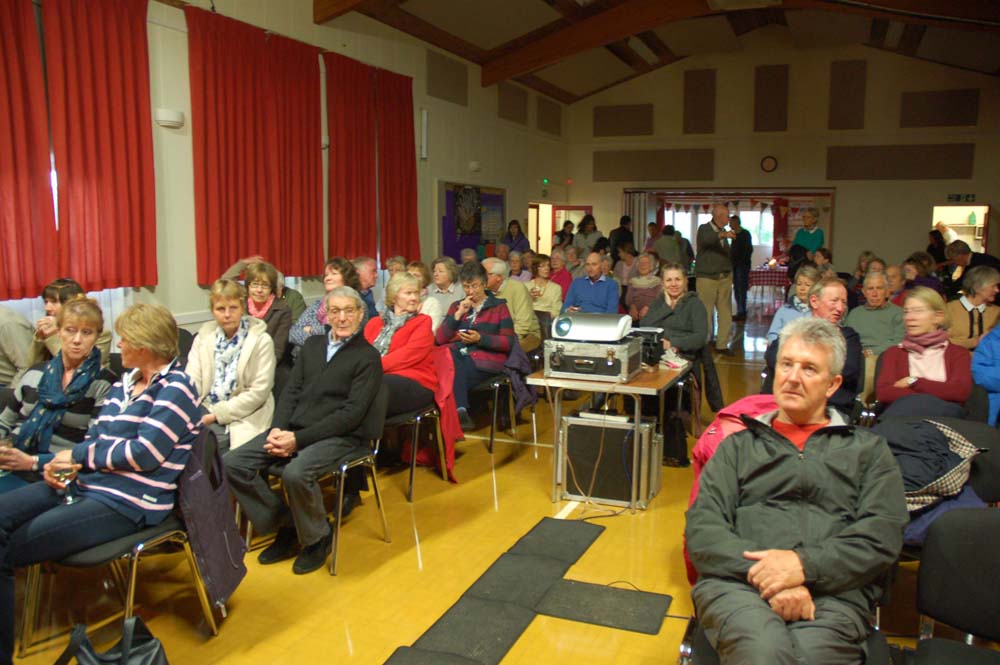
Films were shown in East Meon during and after World War II, and since 2006.
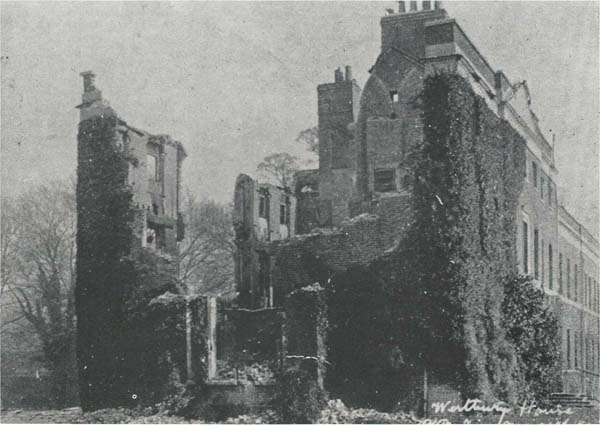
The morning after the catastrophic fire which destroyed Westbury House in 1904. Report from The Times.
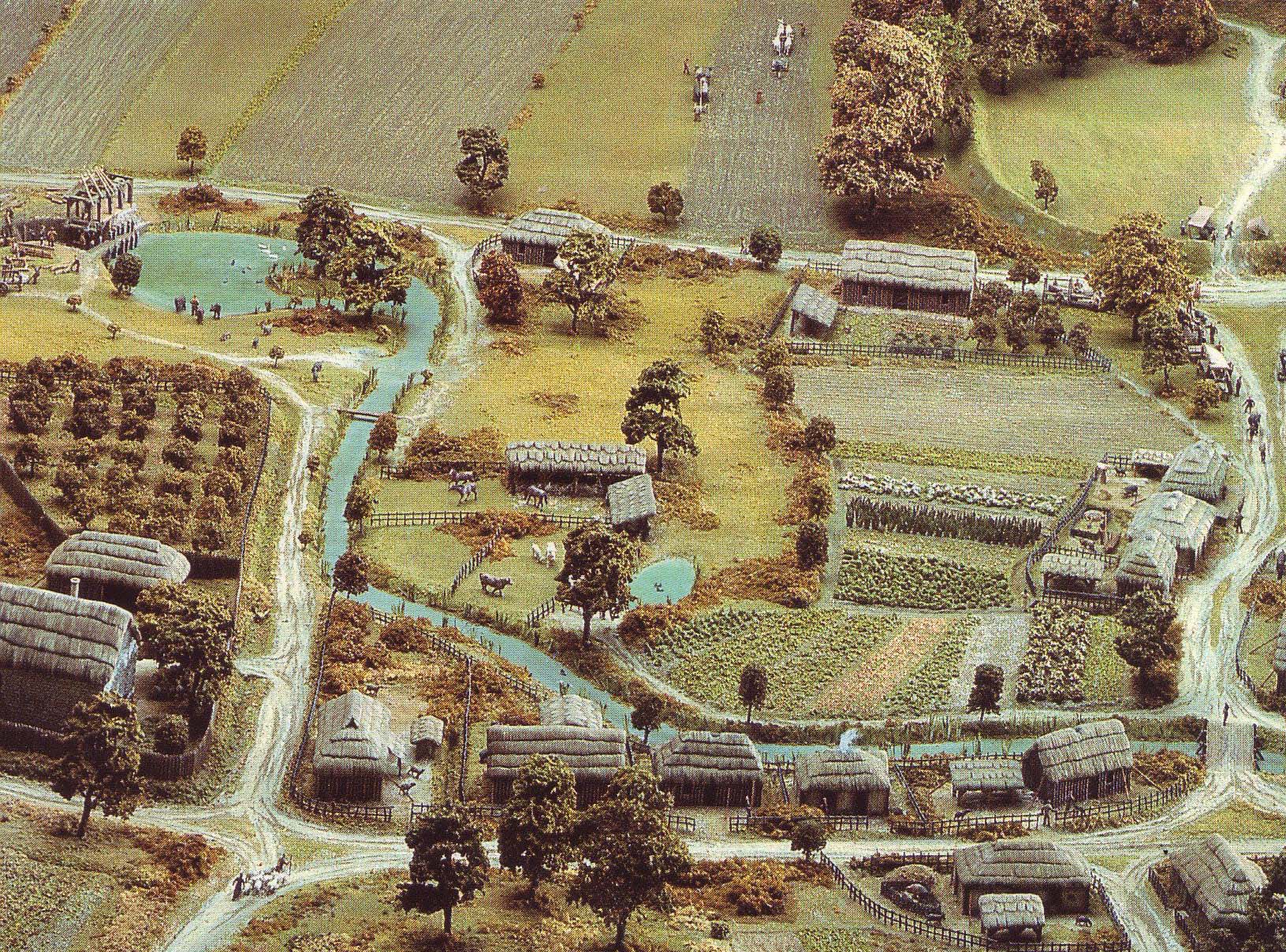
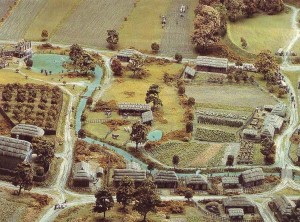
This model illustrated the likely layout of the village at the time the Domesday Book was published. It was created as part of a Domesday exhibition held in 1986 in the Great Hall in Winchester.
In 1993, East Meon introduced a new type of village fair, which reflected countryside activities as well as featuring spectacular displays such as these young bikers jumping through burning poles.
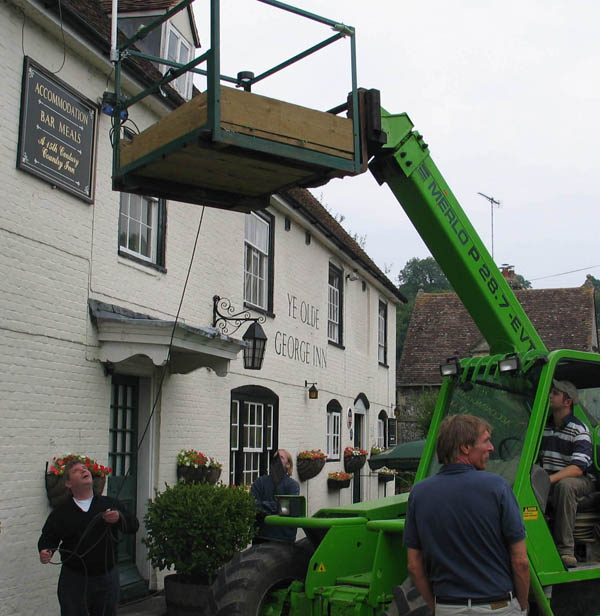
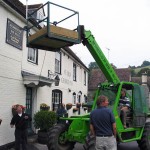
Erecting broadband aerial at Ye Olde George Inn in 2002. East Meon was the first village in Hampshire to introduce a broadband internet network.
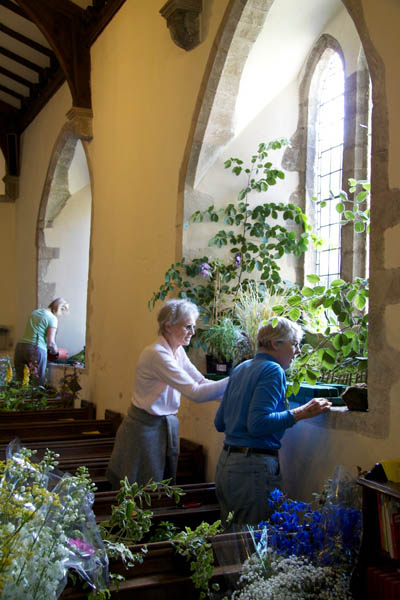
In June 2012, a Flower Festival was held in All Saints Church, organised by Clare Bartlett who has written this report.
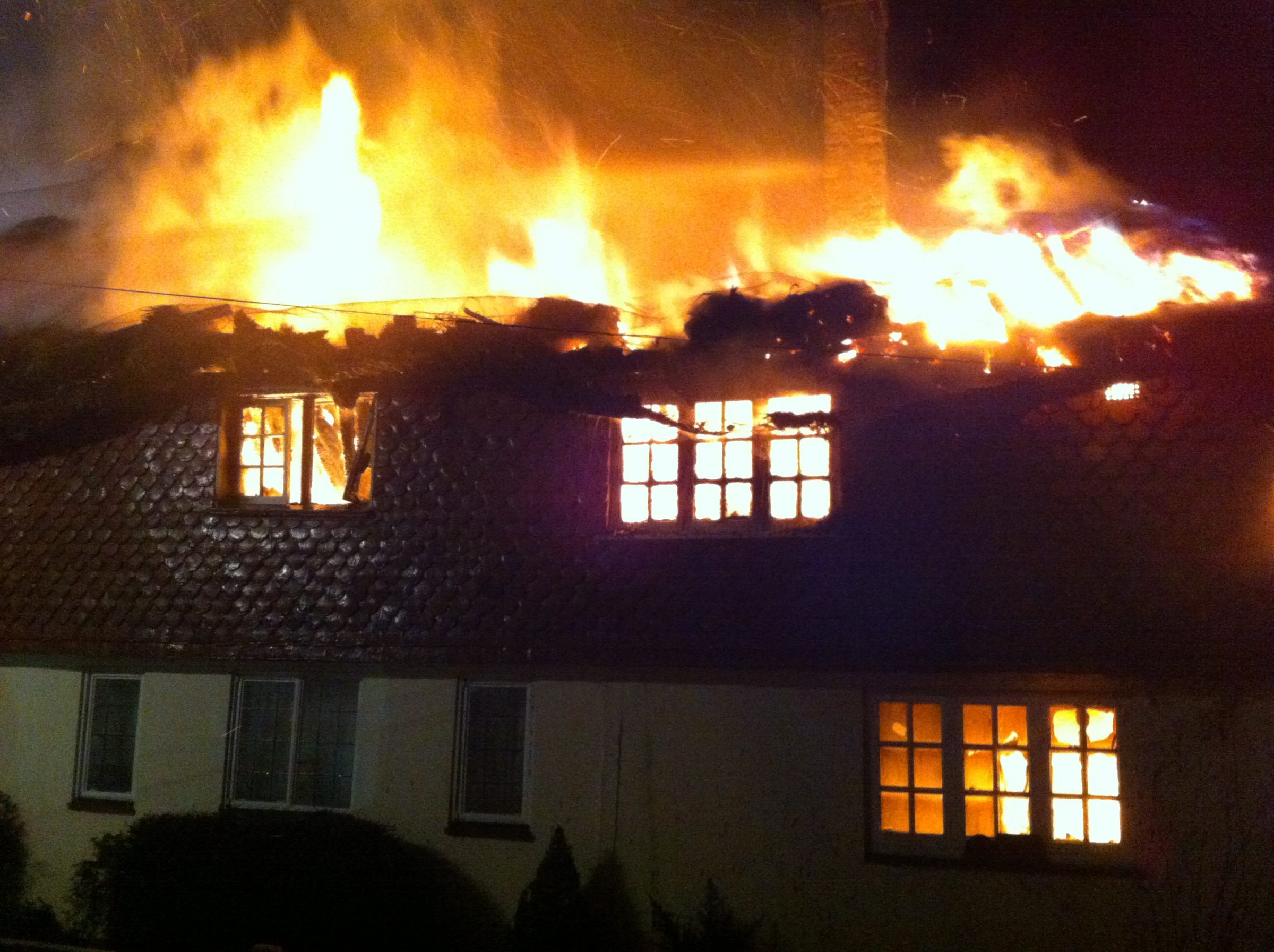
On March 28th 2013, Brook Cottages and Hockley were destroyed by fire
In 2013 and 2014, East Meon History Group has been participating in the Saxons in the Meon Valley project initiated by the Friends of Corhampton Church, surveying for early Saxon settlements. Click here for the website of the project.
This page contains excerpts from ‘Catholics in Petersfield’- A Brief History’ by Tim Concannon and Barbara Gower
The buildings which preceded The Court House (top left) and All Saints Church, from the model of East Meon at la Musee de la Tapisserie, Bayeux
At the time of the Norman conquest there were at least two and possibly three Parishes and Parish Churches in the area now covered by Petersfield Parish; however, the great jewel in the crown was the minster at East Meon.
The earliest mention of the name is when it was given as part of a christening present from King Wulfhere of Mercia to King Adelwalh of Sussex. Wulfhere reigned in Mercia from 656AD to 675, Unfortunately, Adelwalh was killed in the invasion of Sussex by forces from Wessex and thereafter the history of Meon is not clear.
The secret lies in a charter from about 970AD where the great Saxon King Edgar granted ‘that famous place which the locals have always called Aet Meon’ to his grandmother Eadgifu, the widow of King Athelstan, one of the truly great figures in Anglo Saxon history. Eadgifu wished to retire to the religious life and the Charter recites that many holy women had pleaded with the King for the privilege of Eadgifu joining them to ornament their devotions and that it had pleased the King to grant the honour to Meon with its sixty-five earth houses.
The River Meon and early dwellings, from la Musee de la Tapisserie, Bayeux
By the middle of the tenth century the monastic life of England bore little resemblance to the great medieval foundations with which we are familiar. The individual canons had their own houses but were expected to frequent the church, the refectory and the dormitory according to the rule of monastic discipline. They were expected to dispose of their houses in such a way as they did not go out of the community. There was no vow of poverty, nor yet of chastity, and it would seem likely that some of the canons were in fact lawfully married. It is interesting that there is a charter of East Meon, granted by Edgar and witnessed by Aethelwold, the Bishop of Winchester, for the purpose of providing for the retirement of the Dowager Queen Mother. It suggests that East Meon was an important foundation.
The reference to sixty-five earth houses is unusual. None of the other West Saxon charters use such a formula and it suggests that the houses themselves were connected with the monastic settlement. It would seem therefore that before the reformation by King Edgar and Bishop Aethelwold, the whole village was the monastery, or rather the monastic settlement. Rather than a conventional monastery and convent we can imagine Saxon East Meon as somewhat similar to a frontier town in the so-called Bible Belt of Middle America, a community of God-fearing folk who worshipped together and fed together but which included married couples with children. It would seem that East Meon was a monastic settlement as early at 750AD. Unfortunately, the bulk of the settlement is almost certainly under the present village, on the North bank of the river, and has never been excavated.
The Domesday Book gives us a clue as to the fate of the monastery of East Meon when it says ‘Archbishop Stigand held it before 1066 for the use of the monks; later he had it for his lifetime.’ Which suggests that the monastic foundation fell into disuse at about this time and by the Survey in 1086 it was a normal village. The Anglo Saxon Chronicle adds the gloss that the King allowed all the monasteries in England to be plundered in 1070. Perhaps East Meon was one of them. Stigand was deposed in that same year and the grant of Meon to him for life suggests he might have been forcibly retired there. It is also interesting that in the grant Edgar describes himself as ‘Edgar, by the grace of the most High, moderator of the realm of the English, and Rector and Governor of those who go about on circuit.’ These are more than fancy titles; 150 years earlier King Egbert could only make a grant of East Meon to his lieutenant Wulfeard ‘with the consent of the Bishop and Council’. Certainly East Meon remained a royal peculiar for many years for, after the Norman Conquest, William gave it to Queen Matilda, and in due course it was associated with the notorious King John. It would seem that by that date the monastic settlement had long gone and the parish would have to wait for the Reformation and the split from Rome before it would assume a centre stage in Church affairs once more.
The Civil War changed the face of East Meon, both physically, with damage done to the church of All Saints and possibly The Court Hall, and to the established order of land ownership.
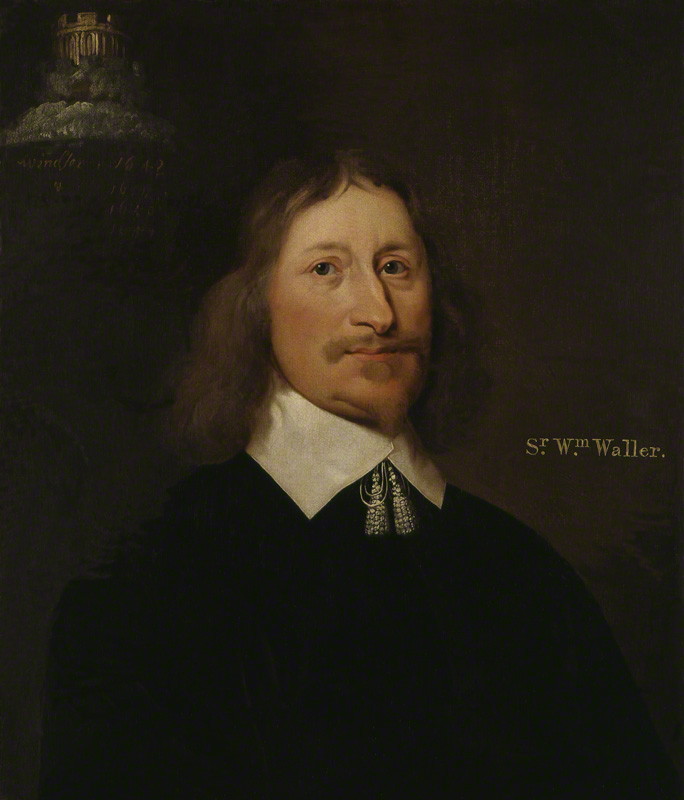
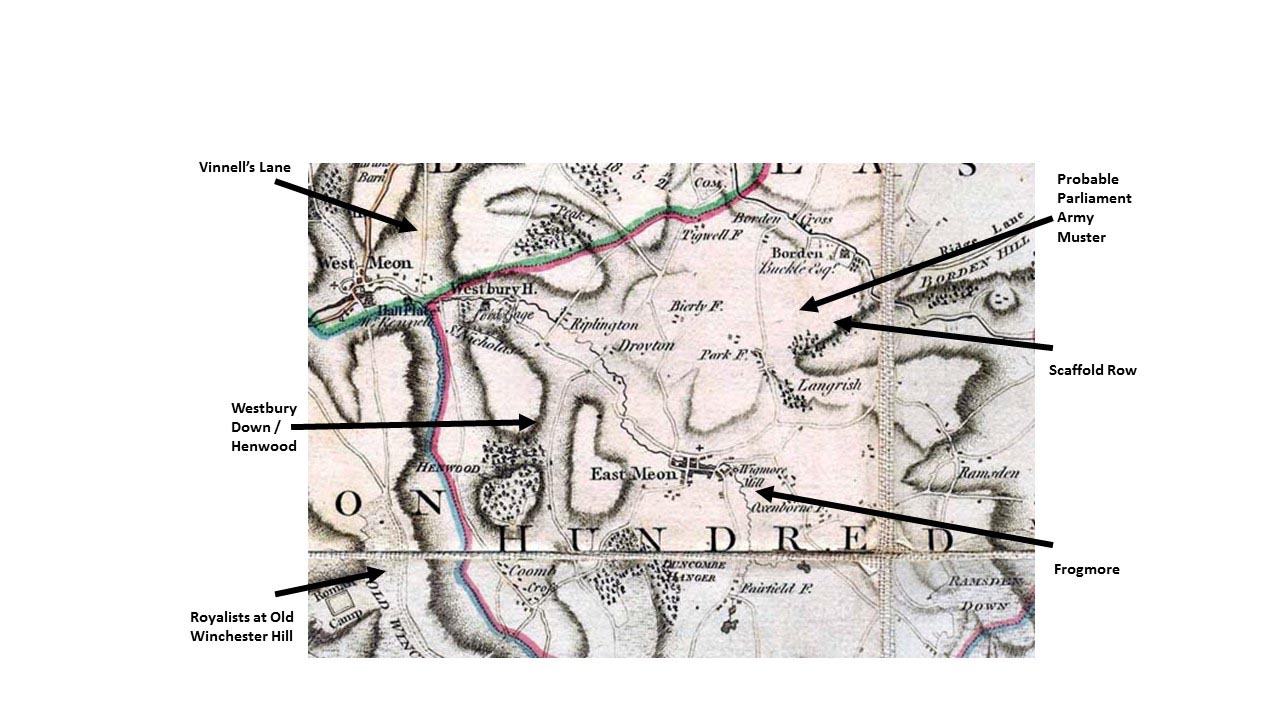
In the last week of March, 1644, the Parish of East Meon was alive with troop movements. On the 23rd March, 12,000 troops of the Parliamentary Army under Sir William Waller (pictured below) mustered above Langrish, coming from Midhurst, Liphook and Havant. Sir William Waller, Major General of the Parliamentary Army in March 1644.
The cavalry gathered in Frogmore. On the following day, the majority moved to the eastern slope of Westbury Down/Hen Hill. 6,000 Royalist horse under Sir Ralph Hopton camped on Old Winchester Hill, overlooking the Parliamentarians. There were skirmishes between rival patrols, and on the 28th, Waller slipped the net via Vinnel’s Lane in West Meon, and met the Royalists at the Battle of Cheriton on 29th. Positions and movements of Parliamentary Army, March 1644
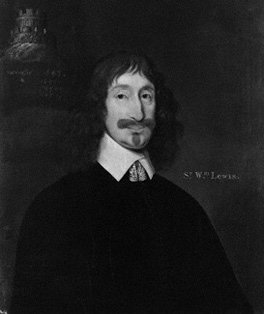
Two local dignitaries, Sir William Lewis of Bordean (pictured below) and Sir Hercules Langrish, had raised a Regiment of Foot and a Troop of Horse for Parliament, so many East Meon men would have served in that army. Sir William Lewis, 1st Baronet, of Bordean.
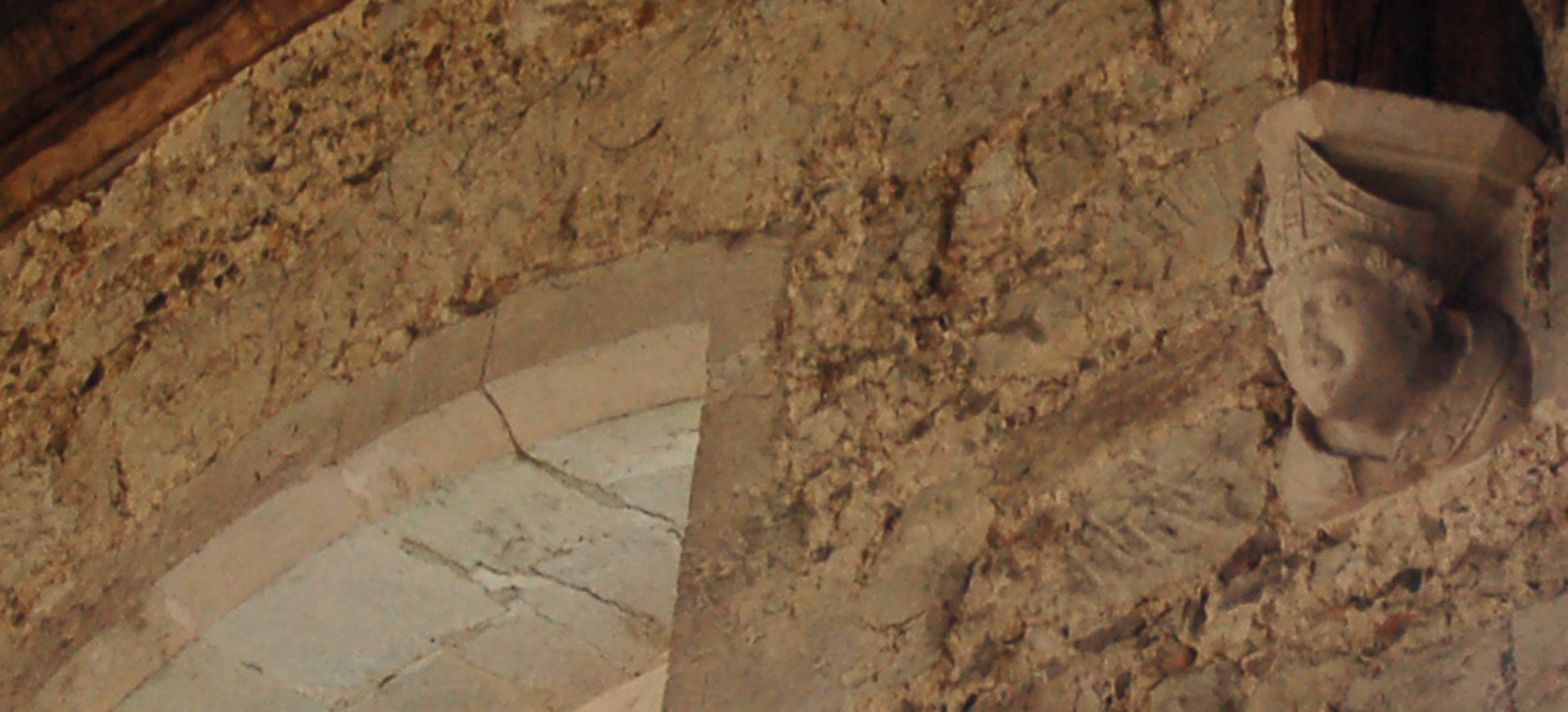
There is a grim reminder in the name of a stretch of hedge on Sir William’s Hill above Langrish which is named ‘Scaffold Row”, where it is thought that three mutinous soldiers of the Parliamentary army were executed. ‘Idolatry’ in All Saints Church was destroyed and some of the corbels in The Court Hall may have been defaced by soldiers’ pikes. Corbel of bishop, possibly William of Wykeham, damaged, possibly by roundhead soldiers.
The Civil War also changed the ownership of the parish. Until the Civil War, the Bishops of Winchester had been Lords of the Manors of East Meon and East Meon Church, and owned most of the land in East Meon – about 20,000 acres belonging to East Meon Manor, stretching from Coombe in the south to Oakshott in the north, and from Peak in the west to Stroud in the east; about 750 acres belonged to East Meon Church Manor, entirely surrounded by the land of the larger manor.
In 1646 Parliament passed the Root and Branch Bill ‘for the abolishing of Archbishops and Bishops in England and Wales and for settling their lands an possessions upon Trustees, for the use of the Commonwealth’. In East Meon, Court Farm and South Farm were sold to Nathaniel Hallowes (an existing sub-tenant) and Richard Dannald respectively. In 1649, Court Farm and the Manor including over three hundred “tenancies” were “bought” by Francis Allen, a contentious and very rich goldsmith/financier from London (who never visited East Meon). He was an MP, Army Treasurer and had made the financial arrangements for Charles 1st execution. Allen was perhaps fortunate to die in 1658, before the Restoration of Charles II, but his estate was confiscated from his heirs. Sir Stephen Fox, financier to Charles II, to whom Court Farm was granted in 1660
Upon his return to the throne in 1660, Charles II restored the Manors to the Bishop of Winchester. Court Farm (including The Court House) was leased to Sir Stephen Fox, who had managed Charles’s finances in exile and had negotiated his return to England. Fox, who became MP for his home town of Salisbury, was also an absentee landlord and sub-let the land to local farmers.
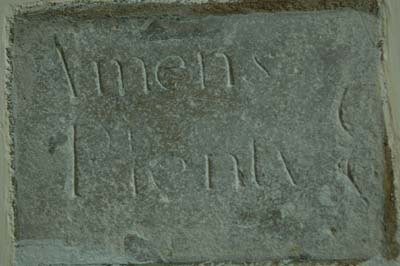
As a footnote, the famous ‘Amens Plenty’ stone is also a product of the Civil War. It originally covered the grave of four men buried upright in All Saints’ church. It may have been a parody by royalists or parliamentarians of their dead foes, or a sincere puritan burial of fallen comrades. Enthusiastic radical preachers accompanying Waller’s army (and their congregations) would have peppered their sermons with “Amens Plenty” Amens Plenty Stone in South Transept
Enclosures of farmland have had a bad press. Particularly in the 19th century, a rash of Acts of Parliament enabled landowners to enclose land by fencing in their fields, which up till then had been open spaces divided into strips of land mostly cultivated by tenant farmers.
Three official Enclosures are recorded in the parish of East Meon, enclosing land at Oxenbourne and Ramsdean Downs. The first was a formal Agreement in 1661; it is notable that most of the signatories were illiterate and marked their consent by making crosses.
Detail of the 1661 Enclosures, with three Xs marking the consent of illiterate farm tenants.
The later Enclosures were by Acts of Parliament in 1845 and 1861. The 1845 Act enclosed 612 acres, awarding 135 to a prominent local landowner, John Bonham Carter: a further 158 were distributed among members of the Weeks family and the rest divided into smaller portions. The 1861 Enclosure awarded a further 122 acres, 38 to Bonham Carter and 20 acres to another wealthy landowner, Sir William Jolliffe. In other words, the bulk of the farmland was awarded to wealthy landowners, while small farmers were confined to reduced holdings, often of poor land, or forced to give up farming altogether.
1845 Enclosure map showing division of land at Oxenbourne into large holdings for Sir John Bonham Carter and Sir William Joliffe, and smaller sections for tenant farmers. One field is set aside for ‘Poor Cottagers’.
This Victorian land grab forced many farm workers to seek new places to live and to look for work where they could find it. A lucky few ‘farm servants’, usually young men and women, still lived on the farms where they worked while ‘agricultural labourers’ were forced to find employment where they could, usually only at harvest and sowing times. Many were migrant, moving from parish to parish in search of work. By 1871, 91% of rural workers in the South East were in this category, struggling to survive.
Early East Meon censuses show how many agricultural labourers were crowded into inadequate accommodation. What are now two cottages at Barnards, for example, were subdivided into four households; the 1861 census shows one of these, No 8, High Street, housing the Sloper family of 12, four of them (including a 19-year-old girl, Jane) listed as ‘agricultural labourers’.
1920s photograph of Barnards Cottages, with four door where there are now two.
It can, however, be argued that Enclosures were inevitable and contributed relatively little to the rampant rural poverty which pervaded Hampshire in the Victorian age. Firstly, the population of England was growing astronomically – it doubled between 1801 and 1851, and again by 1911. Secondly, British farming was under intense pressure to become more efficient. The repeal of the Corn Laws in 1846 had removed the guaranteed high prices designed to protect British produce: grain imported from the Continent once again undercut local prices. New technology, including steam-powered machinery, and new farming techniques, including improved fertilisers and better irrigation, reduced the numbers of workers needed. Steam-powered ships carried cheap food from North America. In the South East of England, where farms mainly cultivated cereal crops, successive years of disastrous weather in the 1870s ruined crops.
Farming in Britain had to become more efficient to survive, and larger farms were more productive and employed fewer workers. Many migrated either to the cities, or to the colonies. Of the farm workers who remained, most had to take second jobs. In 1801, 66% of the population had been rural, by 1851 this was reduced to 46%, and by 1911, 21%.
Oxenbourne fields seen by Google Earth
As a footnote, the beauty of the Meon Valley owes a great deal to the Enclosures. Land allotted by Acts of Parliament was divided into regular field patterns and. today’s landscape, defined by fences, walls and hedges, was the result. Perhaps we should not be too hard on the Enclosures.
Many details of the East Meon Enclosure documents held in the Hampshire Records Office are available in the digital archive, click here.
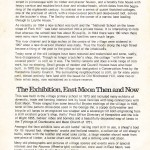
Exhibition of East Meon’s history and present, 1973
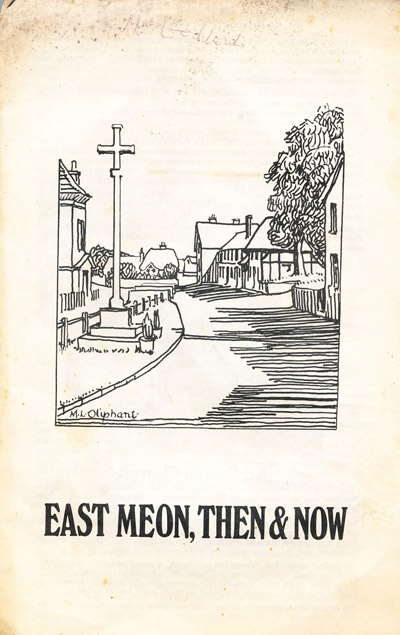
Then and Now programme cover
From article in ‘Hampshire’ magazine by Joan Grigsby
The idea of an exhibition was the brain child of Mrs Lettice Ross, the wife of a retired Naval Officer, Captain T.D.Ross who, since he is the Hampshire hon. secretary of CPRE, is quite obviously in full sympathy with his wife’s activities. But her real helpers were the people of East Meon itself who took up the idea with such enthusiasm and pleasure that when I visited it on a golden day in September I found that many of the treasures to be exhibited for two days in November were already collected together and the whole operation was taking form not only as a plan but in tangible fact.
Mr Witt, who until recently ran the main grocer’s and provision shop in the middle of the village, was Mrs Ross’ right-hand man. He has recently given up his business, owing to ill health, and the shop itself, which stands temporarily empty, proved a splendidly central assembly point for many of the larger exhibits. It was here that I met the six East Meon ‘olds and bolds’, all of whom had been brought up in the village and were to provide the team for the Talk In which, presided over by Mr Brian Blackett, will provide the highlight of the two day exhibition. Their talk will consist of entirely unscripted memories of East Meon of the pre-war (or wars) days, but since it is all to be recorded, the memories will be preserved.
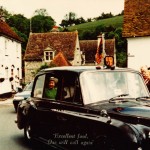
They were all there in Mr Witt’s shop, turning over fading photographs, all of which revived stories and the basis of cheerful argument. Village bands and cricket teams, village fetes and flower shows, the triumphant return of a VC from the next parish driven in a splendid pre-war Morris by a friend from East Meon.
There was Mrs Lambert and Mrs Clara Fisher and Miss Luff (who herself had lent almost enough material for a whole exhibition). There was Mr Herbert Goddard, the Chairman of the Parish Council, and Mr Ted Whitear and Mr Macdonald, whose baby clothes and binder I had seen carefully laid out in Mrs Ross’s house, together with Mrs Lambert’s beautifully embroidered christening robes. And with the Olds and Bolds, ready to give active help in the whole enterprise, where Mrs Julie Canning and Mrs Mary Crockford of a far younger generation but both brought up in the village and with children at the village school.
Together we examined the treasures they had produced, sometimes debating about the use to which they had been put. There was no doubt however about a lamb’s tailing stall or bench with a trailing iron since it is still in use on a farm in East Meon today. There was a set of sheep’s bells in graded tones, a sheep’s boot for an injured foot, a milking stool and churn and a farm worker’s stone drinking bottle, and a number of crooks and smocks all telling of the village’s (and indeed the valley’s) preoccupation with agriculture. There were sets of cobbler’s and wheelwright’s tools (the latter lent by the Curtis Museum in Alton) and a splendid collection of old bicycle lamps.
Then and Now Page 1
Then and Now page 2
Back page, East Meon in 1973, the year of the exhibition, and a description of the contents of the exhibition.
Click here for the page on Then and Now in the online archive.