Michael Blakstad is the 'publisher' of the East Meon History Group. His career was spent initially in broadcasting, in BBC TV, and both Yorkshire TV and Television South, and as in independent producer. His company Workhouse was a pioneer of interactive media. He lives in East Meon and manages the History website.
In August 2014, Meon Matters published several articles commemorating East Meon’s contributions to, and experience in, World War I, which are reproduced here.
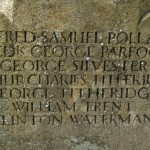
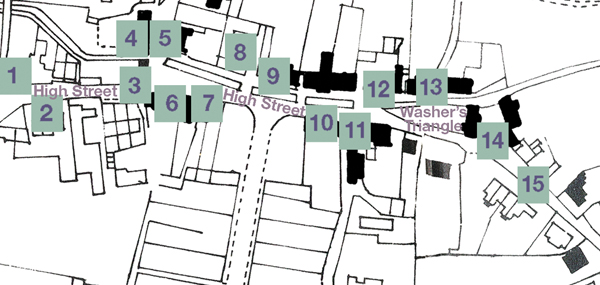
Pollard to Waterman
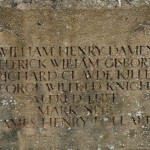
Damen to Pollard
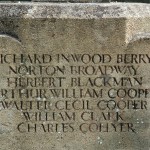
Berry to Colyier
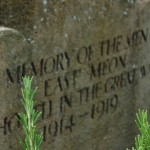
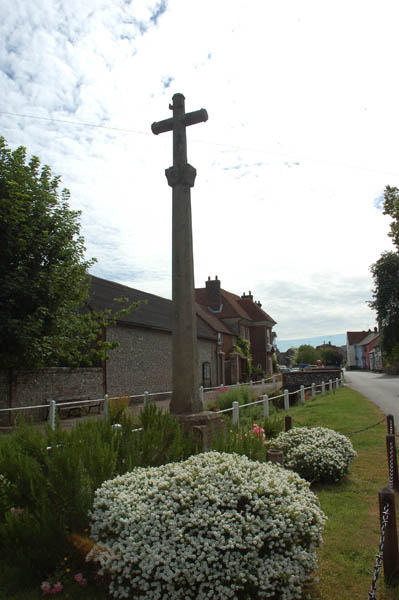
Inscription on East Meon War Memorial
Lest We Forget
Every November, we stand as a community remembering those in the village who died for their country. Simon Mortimore has looked beyond the names of the 21 East Meon men of who died in World War I, and found out more about those who walked away to war and did not return.
Their deaths were widespread. Arthur Charles Titheridge, a Royal Marine on HMS Kent, was the first villager to be killed, in the Battle of the Falklands, in December 1914. Two others died at the Battle of Jutland in May 1916, William Henry Damen on HMS Onslow, aged 17, and George Titheridge (brother of Arthur Charles?) on HMS Queen Mary. Admiral of the Fleet Lord Beatty recorded of the latter:
‘At 4.26 p.m. there was a violent explosion in Queen Mary; she was enveloped in clouds of gray smoke and disappeared. Eighteen of her officers and men were subsequently picked up by Laurel.’
Soldiers too died far from home, Arthur William Cooper in Greece in December 1915, in the retreat from Serbia, nnd Mark Neil, a gunner, who died of his wounds in Turkey in November 1916; he is commemorated on the memorial in Basra, as is George Wilford Knight, both artillerymen.
Regiments in the Great War recruited locally, and most East Meon men joined The Hampshire Regiment. The 15th Battalion, in particular, recruited local ‘pals’, and five of our dead served in it.
Their deaths track the passage of the War in northern Europe. Clinton Waterman was 18 when he died at the Battle of the Somme in July 1916; William Samuel Pollard, 24, died on 9th August. Walter Cecil Cooper, age unknown, brother of Arthur, and Frederick George Parfoot, 34, also died at the Somme, all members of the Hampshire.
The depressing tally goes on. Henry Pollard died in the Arras offensive in April 1917; Alfred Luff (a gamekeeper who lived at Nuneaton Cottage) was discharged and died later of his wounds; George Trent died in Belgium in April 1918.
Perhaps the saddest deaths occurred in the last six weeks of the war. The Allies were sweeping up through Belgium, near Ypres, when they hit fierce resistance from German machine gun nests. On one day, September 4th, three men of East Meon, all serving in the 15th Battalion, were killed in a bungled attack. The C/O’s War Diary describes how orders arrived too late for proper assembly of the troops and the barrage missed the target area.
The Battn, in spite of being much disorganised by very heavy casualties by M.G. fire & enemy snipers, succeeded in reaching the line of the light railway, but were unable to hold it owing to the accuracy and strength of the enemy’s M.G. fire and shortage of men. Casualties on this day were very heavy and included the C.O. and the acting adjutant.
A third of the 15th Battalion, 323 men, suffered casualties that day, including Norton Broadway, a farmer’s son, aged 23 years, George Silvester, again a farmers son, 19, and Charles Collyer, 18.
The last 15th Battalion man to die in action was Frederick William Gisborne died on the 21st of October 1918. He and 29 others died attacking another German machine gun nest. After that assault, the Battalion was relieved by US troops … and suffered no further casualties.
These are notes taken from Nick’s talk, with some images from the presentation he made. This talk was intended as the launch of East Meon’s participation in the Saxons in the Meon Valley project. For more information about this project, funded by the Heritage Lottery Fund, South Downs National Park and others, click here.
Introduction
Dr Nick Stoodley , Research Fellow at Winchester University, is the lead archaeologist on the project entitled ‘Saxons in the Meon Valley’. This was initiated by the Friends of Corhampton Church, of which Guy Liardet is the chair Peter O’Sullivan is the project co-ordinator.
The project is funded by a Heritage Lottery Fund grant and another from the South Downs National Park. Authority, which has enabled three surveys to be conducted in the ‘core’ territory of Corhampton, Meonstoke and Droxford. Hampshire County Council and Winchester District Councils have also subscribed.
This is a ‘community’ project, hoping to involve all towns and villages along the Meon river. Activities include a website, http://www.saxonsinthemeonvalley.org.uk, school involvement, re-creations of food and gardens, a collaborative tapestry and music.
The focus is on the first part of the Saxon era, 410 – 850AD. For the record of the Geophysical Survey conducted in East Meon in September 2014, click here.
Themes
Roman Britain becomes Saxon
Most lived in settlements
Cultural identity – Jutes or Saxons
Background
In the last years of Roman Britain there were both towns and villages. Manufacture was thriving, many could read and write. Christianity was common.
Towards the end of the 4th century, decline began, especially in towns. Buildings collapsed or disappeared, industry declined.
The Romans left c410. Soon after, tribes began to arrive from north-east Europe. According to Bede, writing in the 8th century:
• East Anglia, the Midlands and the North East were settled by Angles from Northern Germany (Schleswig Holstein).
• Southern England wassettled by Saxons from the north German plain
• Kent, the Isle of Wight and the part of Hampshire opposite the IoW were occupied by Jutes, from Jutland in Denmark.
The northern European territories from which settlers came to Britain
The early Anglo-Saxon era, 5th – 7th centuries, has been called the Dark Ages. There are very few reliable sources, and archaeology is the main source of knowledge.
Death, i.e. cemeteries, provides one form of evidence – early Anglo Saxon graves are easy to identify because of grave goods and other aspects of the rite which are characteristic of the period.
(Some of the dead were cremated, and their ashes kept in pots, but very little evidence of these in the Meon Valley.)
Buildings are hard to detect – mainly built of wood, and because they left little rubbish, only pot holes and trenches remain.
Saxons in the Meon Valley
Villages in the Meon Valley which are covered by the project.
With additional evidence from metal detectors, the Meon Valley appears to have been heavily settled in early A/S times.
Bede mentions the Meonwara, the tribe which gave its name to the Meon Valley, and says the wider area was Jutish; we assume, therefore, that the Meonware shared the same tribal identity.
The project is based on community involvement. Members are invited to learn the methods used in non-invasive archaeology and then work to discover remains.
Two types of site:
1. Community surveys
2. Expert sites (kept very secret, because of danger of unauthorised metal detectors (‘nighthawks’) who steal remains.
No excavation is involved. Three main means of non-invasive surveying:
1. Geophysics
2. Metal detecting
3. Field walking
Shavards Farm
Reconstruction of Saxon dwelling with the roof at ground level.
Diagram of Saxon dwelling with lowered floor
Reconstruction of Shavards Farm front elevation
Shavards Farm, on the A32
Shavards Farm, on the A32, was a late 4th century Roman building; its front collapsed and lay on the ground – it was possible to recreate its elevation from this evidence (see above). The excavation also revealed some post-holes of early Anglo-Saxon date and a sunken-featured building whose floor was below soil level and its roof structure above.
Geophysics
Younger members of the team undertaking magnetometry at Shavards Farm
Resistivity image of Shavards Farm
Magnetometry at Shavards Farm
NS showed magnetometer scans, which measure variations in the earth’s magnetic field. Magnetometry is based on the measurement of differences in the earth’s magnetic field. Variations in the earth’s magnetic field which are associated with archaeological features can be detected, such as brick walls, hearths, kilns and disturbed building material, as well as more ephemeral changes in soil, allowing for the location of foundation trenches, pits and ditches.
AS settlement features in relation to Roman site and field boundaries suggest that the fields were still being used. Dating of settlement to 5C supports this. Indicates old Roman landscape important in the establishment of settlements in eAS period.
NS also showed images from an expert site, highly confidential, on which some post-holes of early Anglo-Saxon date had been detected.
Resistivity survey is based on the principle that sub-surface materials conduct an electrical current passed through them: differences in the structural and chemical make-up of soils mean that there are varying degrees of resistance to an electrical current.
In general, higher resistance features are interpreted as structures which have a limited moisture content, for example walls, mounds, voids, rubble filled pits, and paved or cobbled areas. Lower resistance anomalies usually represent buried ditches, foundation trenches, pits and gullies.
Extensive surveys of Chalton have shown that people in this period lived in settlements, clusters of farms and farm buildings.
During the middle Saxon period people migrated into settlements and the process of ‘nucleation’ began.
Reconstruction of a Saxon Hall House
Each settlement would include a Saxon Hall House (Grubenhauser). It is hard to identify settlements not least because no rubbish was left. Survey of Shavards Farm shows evidence of one.
Fieldwalking
Fieldwalking picks up artefactual evidence. Settlements don’t produce much debris to pick up when fieldwalking – compared to villas with their stone walling and lots of pottery and coins. Pottery was used but it is poor quality and breaks up in the plough soil, so a handful of early Anglo Saxon pottery is considered a reliable indicator of a settlement.
Ground disturbed by ploughing often throws up evidence – and a tendency towards deeper ploughing throws up fresh materials (diagram below).
Grid mapping o fieldwalking surveyDiagrams of Saxon work area and ploughing.
Metal detecting
Archaeologists are suspicious of metal detecting because of nighthawks – who illegally detect on sites and sell their finds for profit, e.g. via eBay, Winchester University has contacts with a number of trusted and expert metal detectors who have been very helpful.
Cemeteries
Discovering a cemetery establishes the probability that a settlement was nearby. Men were often buried with weapons, women with jewellery. In 2012, the development of a housing estate to the north of West Meon revealed a sizeable Saxon cemetery. It can be inferred that there was a settlement nearby, probably where the centre of today’s village is located. (Roman and Saxon remains at Lippen Wood and Westbury House suggest other settlements in the Wast Meon area.: Click here for a report on this excavation.)
Plan of West Meon excavation.
The sources of rivers are promising territory for discovering settlements. Evidence from South and Lower Farms, by the source of the Meon, already suggests that Saxons lived there. ‘Ytedene’ (valley of the Jutes) was near East Meon.
Map showing the source of the River Meon and the village of East Meon.
Cultural Identity
The question remains, was the Meon Valley Jutish or Saxon? Many Saxon artefacts have been discovered – quoit brooches and saucer and disc brooches which suggest a Saxon identity but research by NS on dress styles suggests that a different costume in S Hants (inc Meon Valley) may differentiate those expressing a Jutish cultural identity for the surrounding Saxons.
Disc brooches
Saucer brooches
Resistivity survey is based on the principle that sub-surface materials conduct an electrical current passed through them: differences in the structural and chemical make-up of soils mean that there are varying degrees of resistance to an electrical current.
In general, higher resistance features are interpreted as structures which have a limited moisture content, for example walls, mounds, voids, rubble filled pits, and paved or cobbled areas. Lower resistance anomalies usually represent buried ditches, foundation trenches, pits and gullies.
Extensive surveys of Chalton have shown that people in this period lived in settlements, clusters of farms and farm buildings.
During the middle Saxon period people migrated into settlements and the process of ‘nucleation’ began.
Reconstruction of a Saxon Hall House
Each settlement would include a Saxon Hall House (Grubenhauser). It is hard to identify settlements not least because no rubbish was left. Survey of Shavards Farm shows evidence of one.
Fieldwalking
Fieldwalking picks up artefactual evidence. Settlements don’t produce much debris to pick up when fieldwalking – compared to villas with their stone walling and lots of pottery and coins. Pottery was used but it is poor quality and breaks up in the plough soil, so a handful of early Anglo Saxon pottery is considered a reliable indicator of a settlement.
Ground disturbed by ploughing often throws up evidence – and a tendency towards deeper ploughing throws up fresh materials (diagram below).
Exhibition of East Meon’s history and present, 1973
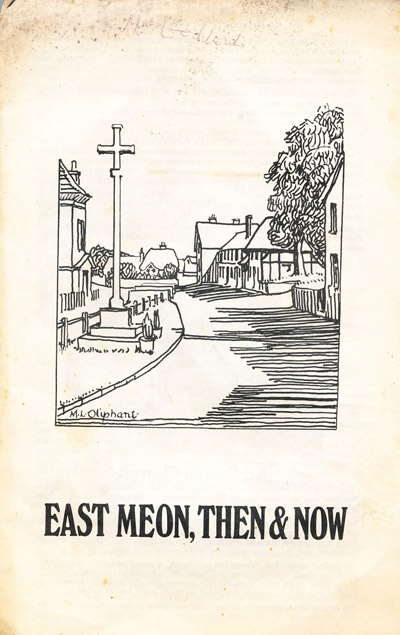
Then and Now programme cover
From article in ‘Hampshire’ magazine by Joan Grigsby
The idea of an exhibition was the brain child of Mrs Lettice Ross, the wife of a retired Naval Officer, Captain T.D.Ross who, since he is the Hampshire hon. secretary of CPRE, is quite obviously in full sympathy with his wife’s activities. But her real helpers were the people of East Meon itself who took up the idea with such enthusiasm and pleasure that when I visited it on a golden day in September I found that many of the treasures to be exhibited for two days in November were already collected together and the whole operation was taking form not only as a plan but in tangible fact.
Mr Witt, who until recently ran the main grocer’s and provision shop in the middle of the village, was Mrs Ross’ right-hand man. He has recently given up his business, owing to ill health, and the shop itself, which stands temporarily empty, proved a splendidly central assembly point for many of the larger exhibits. It was here that I met the six East Meon ‘olds and bolds’, all of whom had been brought up in the village and were to provide the team for the Talk In which, presided over by Mr Brian Blackett, will provide the highlight of the two day exhibition. Their talk will consist of entirely unscripted memories of East Meon of the pre-war (or wars) days, but since it is all to be recorded, the memories will be preserved.
They were all there in Mr Witt’s shop, turning over fading photographs, all of which revived stories and the basis of cheerful argument. Village bands and cricket teams, village fetes and flower shows, the triumphant return of a VC from the next parish driven in a splendid pre-war Morris by a friend from East Meon.
There was Mrs Lambert and Mrs Clara Fisher and Miss Luff (who herself had lent almost enough material for a whole exhibition). There was Mr Herbert Goddard, the Chairman of the Parish Council, and Mr Ted Whitear and Mr Macdonald, whose baby clothes and binder I had seen carefully laid out in Mrs Ross’s house, together with Mrs Lambert’s beautifully embroidered christening robes. And with the Olds and Bolds, ready to give active help in the whole enterprise, where Mrs Julie Canning and Mrs Mary Crockford of a far younger generation but both brought up in the village and with children at the village school.
Together we examined the treasures they had produced, sometimes debating about the use to which they had been put. There was no doubt however about a lamb’s tailing stall or bench with a trailing iron since it is still in use on a farm in East Meon today. There was a set of sheep’s bells in graded tones, a sheep’s boot for an injured foot, a milking stool and churn and a farm worker’s stone drinking bottle, and a number of crooks and smocks all telling of the village’s (and indeed the valley’s) preoccupation with agriculture. There were sets of cobbler’s and wheelwright’s tools (the latter lent by the Curtis Museum in Alton) and a splendid collection of old bicycle lamps.
Then and Now Page 1
Then and Now page 2
Back page, East Meon in 1973, the year of the exhibition, and a description of the contents of the exhibition.
Click here for the page on Then and Now in the online archive.
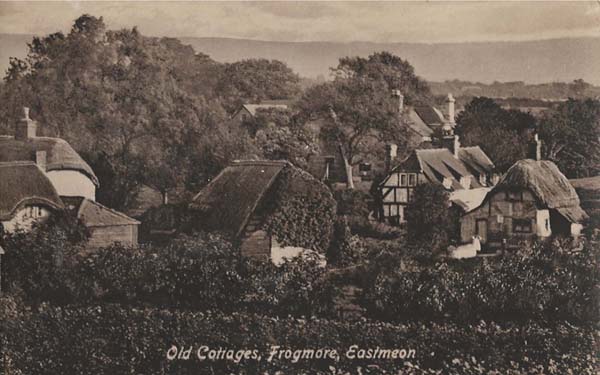
Early 20th century postcard of Frogmore “In the old days, Frogmore was looked upon as something of a slum.” Winifred Hannah Lunt, b 1885, 2 Bottle Ale Cottages.
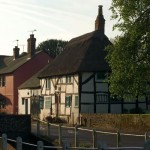
Frogmore lies at the south-eastern tip of East Meon, a small scattering of cottages and terraced housing alongside the River Meon, adjacent to the grounds of The Court House to the north and of Frogmore Mill to the south. The hamlet mainly housed agricultural and mill workers.
It was a place of water-meadows. They were frequently flooded – considered good for fertility, hay and grazing. An elaborate system of sluices related to the Mill Pond were engineered to manage this opportunity and many of the lease documents of the Mill show this as a financial asset to the estate. The sluices still partially exist.The hamlet of Frogmore today
The Civil War
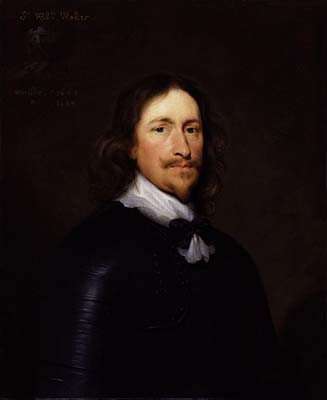
Prior to the Battle of Cheriton, in 1644, the cavalry of the Parliamentary Army was billeted for two nights at Frogmore, including the C-in-C General Sir William Waller’s own regiment. Troop commander Captain Robert Harley wrote…. “Tuesday the 26th the general rendezvous of our Horse was in the field by East Meane”. One of the first war correspondents, Elias Archer, confirmed this was Frogmore and went on to list the cavalry, 4000-5000 in number. They mustered with the infantry and guns next day on “a heath adjoining”. Sir William Waller, who commanded the Commonwealth army whose cavalry camped in Frogmore on the eve of the Battle of Cheriton
Eames Cottages
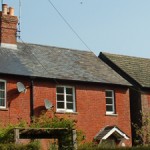
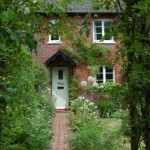
What are now known as Eames Cottages were originally a single Tudor timber-framed cottage which can be dated in the fine books as far back as 1563. It was converted into today’s five dwellings at some point after 1815 by William Eames, a village bricklayer. They would have housed agricultural labourers after the Napoleonic Wars, and provided their landlord with a tidy income. William Eames died in 1845, aged 85, and the cottages passed through successive generations until the end of the century when they were owned by Joseph Eames – and must have picked up their name from one or other of the family. (Research by Phil Gorton for Mark Vernon of No 2 Eames Cottages) Eames Cottages today.
Poverty in mid-19th century
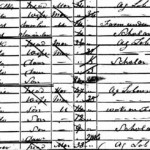
The 1851 census shows that Frogmore was inhabited by agricultural labourers or ‘scholars’, the title given to school-age children.
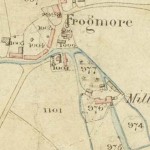
Frogmore shown in the map drawn up as part of the Tithe Apportionments,1852,
Frogmore Mill (below, right) was then owned by John Lillywhite, and included an orchard and some farmland.
No 3 New Cottages
The history of one dwelling in Frogmore provides a glimpse of the social history of the hamlet. In the Tithe Apportionments, James Weeks owned ‘cottages and gardens’, on the site. ‘New Cottages’ were built, slightly closer to the river, at some point after 1885. No 3 was rented by Arthur & George Kille and then by Annie Buncher Wilson. In 1906, William Neighbour, a grocer, bought No 3, and in 1926 another grocer, David Coles, bought numbers 3 & 4 for £350 and rented No 3 to Henry Merritt, another farm labourer, who died in 1944 aged 85.
New Cottages terrace
No 3 New Cottages
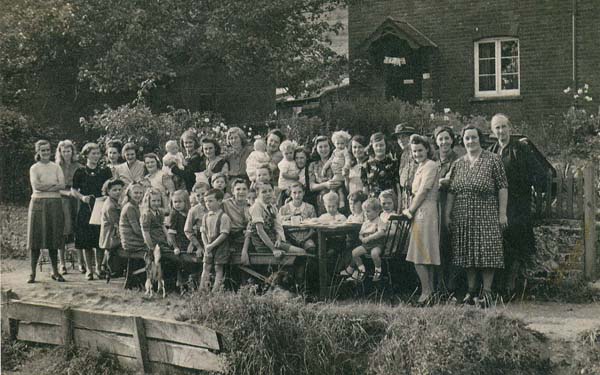
Gwen and Jack Symes, and Jack’s mother Rose, between them rented No 3 from 1950 to 1954. As a Frogmore child (she then lived in No 5 Eames Cottages) Gwen had walked through the field to the National School, but had to leave early to help her mother with the housework and look after her 10 brothers and sisters. She would shop at Parsons shop in the High Street. What is now a car park behind the cottages was then a piggery. As recently as 1950, their toilet was a shed at the bottom of the garden and a tanker lorry appeared twice a week to empty the toilet buckets. The house had two electric light bulbs but no power points – she plugged her iron into the light socket. Celebrating VE Day by the river in Frogmore, 1945
The George Inn, dates back to the 16th century, seen here with staff and customers celebrating Queen Victoria’s Golden Jubilee
Bryden engraving of The Cross. The Angel Ale House dates back to the 17th century
The Bell House, half of which was a saddlery, with the ale house next door.
The New Inn, now the Izaak Walton
Over the centuries, there have been three types of ‘pub’. Most common were ‘ale houses’ – private houses where beer was brewed and sold to customers sitting at benches in the proprietor’s living room. Towns and cities had ‘taverns’, larger establishments which served food as well as drink. On coach routes there were ‘inns’, which provided accommodation and food for travelers as well as stabling. East Meon was not on a coaching route but had its fair share of maltsters, small brewers and ale houses, two of which have survived as pubs. There was even a ‘brewery stores’, Crowley & Co Ltd .
The oldest ale houses in East Meon were The George in Church Street, which dates back to the 16h century, and The Angel in The Cross, 17th century. The building survives as Cross Cottages. The Old Bell was next door to a saddlery business. People walked in with the shoes which they wanted mending, often their only pair, and would sit drinking ale in the Bell next door, whilst waiting for their shoes to be mended.
“William Luff, licensee of The George Inn owned a wagonette and dogcart, available for journeys to places like Petersfield and West Meon, especially to meet trains.” Clara Fisher
Transport
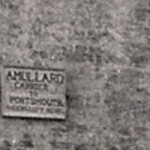
The investiture of the War Memorial in 1923. On a sign above the door of Barnards is a sign ..
which reads: ‘George Mullard carrier to Portsmouth’.
George Noble White, lived at ‘The White Cottage’, High Street and every Tuesday, Thursday and Saturday did the return journey from East Meon to Portsmouth, about 17 miles each way,.
“If full up with goods, White would only carry one passenger, who sat with him on the front seat, open to the elements. In 1921, my sister Dorothy, then 15, travelled to Portsmouth by carrier for a holiday with our aunt. The wagon left at 5.30am, arriving at its destination, the Gosport Ferry, at 12.30. It was a cold October day, and on arriving my sister was so cold and stiff she had difficulty moving.” Clara Fisher.
“The Aburrow family carried on their wheelwrights’ business where East Meon Stores now stands, and at Pond Meadow, the old parish pound. Horse-drawn vehicles were taken there to be repaired or have wheels replaced, and new wagons were built. The family owned a traction engine, used to draw timber from the woods, and when stationary, to operate a belt-driven circular saw.” Clara Fisher.
The Smithy
“The smithy stood, as it still does, at the junction of the High Street and Frogmore Lane, a hive of activity, with many horses queuing up for shoeing. Three or four farriers worked there including Jim Hobbs, the boss. It was thrilling to watch horses being shod, and iron bands put on wagon wheels, with sparks flying from the fire, and more from the anvil, as shoes were hammered into shape.” Clara Fisher
On the left, the Forge c 1909. Master blacksmith Jim Hobbs (fourth from left) is flanked by his sons Donald and Harold. Employee Walter Lambert holds the pony (extreme left) and the little old man, Jimmie Lock, retired and blind, carries a travelling blacksmith’s travelling toolbox. Right, the Forge with Forge Cottage.
In sickness and in death
“The midwife, Mrs Micklam, brought children into the world; Mrs Budd, as the village ‘Layer Out’ together with the help of Pinky Kille or Henry Coles, took care of one at the other end of life.” Margery Lambert
“Granny Fisher at the Coombe end of the village and Granny Luff, in the High Street, kept the community well oiled and ‘potioned’ with herbal advice.” Margery Lambert. In the 1990s, herbalist Tina Stapley lived in the same house, Brook Cottage; she grew herbs in the garden and published books on herbal medicine and cookery.
“There were two Undertakers. Pinky Kille, as he was known, with an unfortunate name for such a profession; he was also the village painter and carpenter. Henry Coles too was an undertaker, and had his coffin- making workshop at Chalk Dell. He laid out the bodies in part of the house known as Cross Keys, down in The Cross, and we would often peep through the cracks in the shutters to see them lying there. Henry Coles made visits to the sick when they were ill.” Margery Lambert.
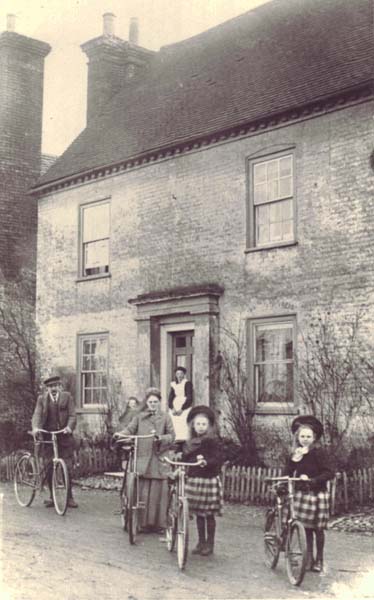
Midwife Kate Micklam with her family photographed in the early 1900s oustide Barnards
In the early 20th century, most villagers were unable to travel outside East Meon. With over 20 shops and trades, the village was virtually self-sufficient.
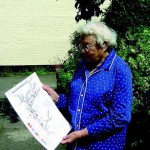
Margery Lambert with her map
Clara Fisher
In 2007, retired district nurse Margery Lambert drew a map from her memory of the stores and workshops which had served East Meon in the 1920s. Earlier, another villager, Clara Fisher, had described to village historian Freddie Standfield life in the village as she remembered it between the wars. Together with other personal memories, they provide a vivid picture of a thriving High Street in which almost every building offered goods or services. Today, East Meon has one shop and two pubs.
Provisions
“The village had four bakers, three grocers, a butchers, two mills, wheelwrights, farriers, a post office, and even a fish and chip shop, as well as visits from ‘travelling shops’ selling fish and meat. Clothes, boots and shoes could be bought at one grocery shop (Warrens).” Clara Fisher.
R.Norgett and Sons sold meat from what is now Riverside – serving it from a flap opening onto the street. The butcher slapped down a lump of meat and the trick was to pick it up before the flies settled on it. There were two other butchers, George Aylmore and Samuel Long.
“Warrens, where the Tudor House now is, was the Haberdashery and apart from groceries and household goods, sold fabrics, boots and shoes, as well as locust beans and figs out of sacks on the floor.”
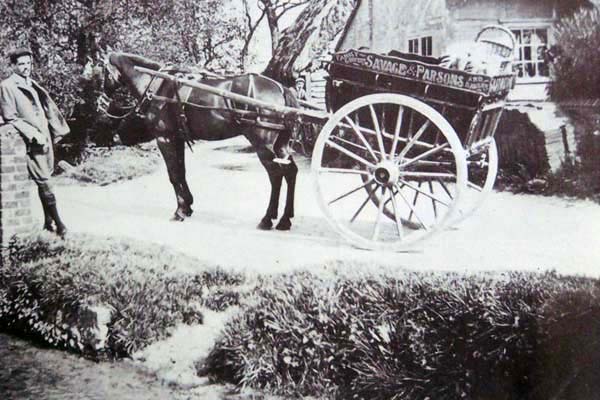
A bill dated 1899 from Thomas Adams, Family Grocer, Baker and Coal MerchantThe store was later Savage & Parsons, whose cart is seen here in Frogmore
In the 1920s it was managed by Stephen John Parsons
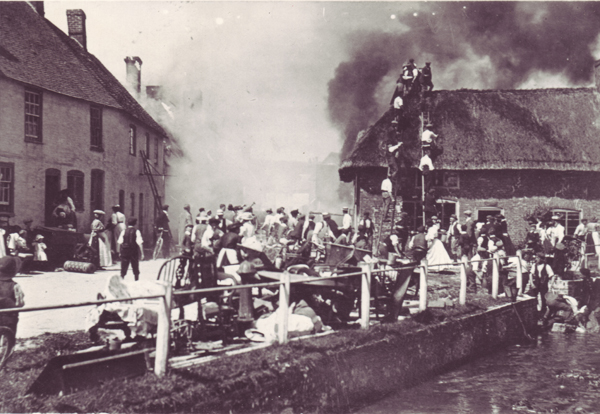
“All Groceries, excepting Smiths at the Post Office, sold Paraffin Oil, a most important requisite for the cottagers who had no electricity.” Margery Lambert. A fire in 1910 destroyed all the buildings – mostly shops – at the western end of the High Street.
Potter’s General Storehouse survived the fire; it was later taken over by HG Pink and then Mr Witt, butcher.
“David Coles was the resident of Glenthorne; the farmyard fielded a dairy. He kept a retail shop at what is now ‘The Gatehouse’ and sold sweets, milk, butter and, when he killed a pig, faggots and offal. He had about six to eight cows that grazed on the present Glenthorne Meadows housing estate.” Clara Fisher.
The Glenthorne Dairy, operated by Coles
Jane Earwaker, born in 1749, was the first to keep a grocer’s shop at
The shop at Glenthorne Hoouse. In the 1840s, John Nathaniel Atkins opened the first village post
office here, in addition to the grocery and a coal delivery business.
“Wet & Dry Fish was available twice weekly from a niche in the wall between Glenthorne shop and the dwelling attached to the Old Post Office. You can see it bricked up in the wall.” Margery Lambert.
“No larger private house had been built for at least half a century, nor has been built since.” L.H.Tyrode.
Leydene House today.
Eleanor, Dowager Countess Peel
Leydene House was built by Viscount Robert and Lady Peel in the years following the Great War. Lord Peel was a rising politician, subsequently to become Secretary of State for India under Lloyd George, Lord Privy Seal, and Chairman of the Peel Commission which recommended the partitioning of Palestine. He had married in 1899 the daughter of Lord Ashton, a multi-millionaire who had made his money from the manufacture of linoleum. Ashton settled on Eleanor the sum of £800,00 – tens of millions in today’s money.
William Robert Wellesley Peel.
Eleanor Dowager Countess Peel
Lord Peel leaving the King David Hotel, Jerusalem, during negotiations on the partitioning of Palestine.
The marriage appears to have been one of convenience – his career and her money. Although Leydene saw a succession of important house guests, including Winston Churchill (whom Lady Peel didn’t much like), Lord Peel spent most of his time in London whilst Lady Peel divided her time between Leydene and Scotland, where she fished for salmon. Unless entertaining guests, Lady Peel led a life of Spartan simplicity. She was a fresh air fanatic – her lunch was usually a bowl of soup, served in all weathers on an outdoor terrace. She went out of her way to avoid social contact and dressed ‘like a tramp’ in ankle-length shabby black clothes. She preferred the company of her pedigree Saddleback pigs to that of people, and although she had a son and a daughter, had little liking for children, her own or other people’s.
Construction
Starting in 1913, the Peels bought over 10,000 acres of land to the south of East Meon and, in the spring of 1914, started building Leydene house at the top of Hyden Hill. Work began, using local labour to level the land and lay foundations. Lord and Lady Peel took over a farmhouse at Coombe Cross to supervise the building. Work ceased with the outbreak of the First World War.
The magnificent double-spiral staircase designed by the Hooydonk Brothers
The garden bed planted in the pattern of Lord Ashton’s best-selling linoleum
Map showing layout of the grounds before WWII
After the war, work resumed, with a large body of artisans and workmen, steam tractors and lorries, moving chalk and fetching supplies. Belgian limestone was landed at Littlehampton, brought by train to Havant, and thence by lorry. Bricks were made by the Rowlands Brick Works.
Lady Peel had engaged Hooydonk Brothers to design Leydene; described as ‘Decorative Artists, they had created elaborate interior schemes for the moneyed classes. Their most notable contribution was the double-spiral staircase in the spacious entrance hall; this was constructed by a firm in Gosport. As an acknowledgment of the source of the money which made the project possible, the rose garden was laid in the design of Lord Ashton’s best-selling linoleum.
Lord Peel died in 1937, after which Lady Peel spent most of her time at Hendersdyke Park, near Kelso in the lowlands of Scotland, where she indulged her passion for salmon fishing. She died in 1949; both are buried in East Meon.
HMS Mercury
The insignia of HMS Mercury
Aerial photograph of the site, with Leydene House lower right
Aerial shot showing officers’ housing at the southern rim of the Mercury site
Junior ratings in the dining hall
In 1941, Leydene House and 100 acres were occupied by the Royal Navy; its Signal School in Portsmouth had been heavily bombed. A Wardroom annex, ‘Siberia Block’, was built to the south of the main house. In 1943, a large nissen hut was built as a cinema, theatre and assembly hall. A full account of the period during which the Navy operated HMS Mercury was commissioned by RJD Technology of Rowlands Castle; a copy is in the East Meon archive.
Break-up of the estate
In May 1953, the remainder of the Leydene Estate was sold by auction in 51 lots, many of which were gratefully acquired by sitting tenant farmers. In the 1990s, the house and its mews was divided into ten dwellings; the medical centre and senior rates mess were converted into a Sustainability Centre, and houses were build on the rest of the site south of the road. The land to the north has subsequently been purchased for development and the remaining naval buildings nave been demolished.
Cover of the catalogue listing the elements of the estate which were auctioned in 1953
For source material on Leydene House, in the online archive, click here.
Westbury House is located at the extreme west of the Parish of East Meon.
Easrly history
The Ulnod of Edward the Confessor is recorded as an early owner of Westbury (also known in mediaeval times as Wesberie, Westburia and Westbyrie). It was assessed at 3 hides then, and in the Domesday survey.
Westbury had a colourful history, with a succession of owners rising and falling in the favour of different kings. Robert le Ewer, the yeoman of King Edward II, was given permission to fortify the house; he held Odiham Castle ‘during the king’s pleasure’, fell out with the king, and was subsequently restored to favour. During the sixteenth and seventeenth centuries Westbury was owned by the Fawconer family.
The Irish connection
The magnificent Palladian house build in the 18th century.
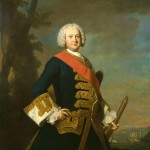
Admiral Sir Peter Warren, who built the original Westbury House
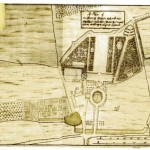
Charles Bridgeman’s design of the gardens and grounds.
In 1722, Westbury was purchased by an Irishman, Sir Peter Warren, who in 1745 captured Louisburg on behalf of the New England colonies and was promoted to rear admiral of the blue. He captured three French ships worth £1,000,000 – a fortune. In 1747 he won a great naval victory off Cape Finestere and was made a Knight of the Bath. He married a fabulously rich American lady, Susanna daughter of Stephen de Lancey. The combined wealth enabled them to build a fine Palladian house at Westbury, and to commission the celebrated early 18th century landscape gardener Charles Bridgeman to design the grounds..
The approach to the house was along a tree-lined drive off the road between the villages of East Meon and West Meon. The drive looped into an oval on the north side of the house, and on the south side were pleasure grounds. Surrounding the house and gardens was a working estate with a farmyard, barns and stables, fields and timber plantations.
In the early 19th century, Westbury passed to Warren’s grand-daughter, Suzannah Maria, who had married her first cousin, Viscount Gage. (The first Baron Gage of Castlebar and Viscount Gage of Castle Island, had been ennobled in 1720, under the Irish Peerage.) The Gage family was based in Firle, West Sussex, and the couple divided their time between there and Westbury.
Thomas William, fourth Viscount Gage
The 1851 census lists Westbury as occupied by the fourth Viscount, Thomas William Gage, and the Tithe Apportionments show that most of the parish land to the west of the main village was owned, and much of it farmed, by him. This included Riplington, Drayton, Peake, Coombe and parts of Hyden.
The Sartoris family
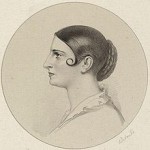
The 1861 census shows that Westbury was then occupied by tenants, the Sartoris family. They were distant relatives of the Gages and well-known in London’s artistic circles. May’s mother was Adelaide Kemble, one of the most famous opera singers of the period, and a member of a prominent theatrical family. She was a renowned hostess and friend of great literary and artistic figures, including Robert Browning and Sir Frederic Leighton.
May Sartoris.
Portrait of May Sartoris by Frederic Leighton
Adelaide Kemble, famous opera singer and friend of Leighton
Frederic Leighton, famous Victorian painter
This portrait of May Sartoris was painted at Westbury in the early 1860s. For the full story of the painting and its location, click here.
The great fire
Westbury was bought from the Gage family in 1866 by John Delaware Lewis. In 1904, the Times of London reported the heroism of his son, Colonel Le Roy Lewis, in saving the lives of some of his domestic staff from a devastating fire which destroyed the Palladian mansion:
‘The escape of the occupants was most exciting. The French governess, who occupied a bedroom at the rear of the main part of the house, raised the alarm at about 3am. Her cries were heard by Colonel Le Roy-Lewis, who immediately did what he could to rouse the family. Rushing out of his bedroom he found the staircase burning and the corridors filled with smoke, and all means of escape cut off. His first impulse was to save his five children, and he ran through the flames to the children’s wing and found that that part of the house was safe. Getting out of a window, he scrambled along a narrow ledge to a stack pipe, down which he slid to the ground, a distance of about 40 ft. He rushed to the stables, and with some difficulty roused the stablemen, and with the aid of three of them tried to raise a heavy ladder to the French governess’ window, but it fell and broke.’
‘Owing to the efforts of Colonel Le Roy-Lewis himself, no lives were lost by fire, but the housekeeper, an elderly woman named Jane Henley, who had been in the service of the family for many years, died on the roof from shock and fright before she could be rescued.’
‘The mansion itself is an old one, standing in a well-wooded park of 500 acres, and is in the Queen Anne style. It contained many fine pictures and some rich carving by Gibbons. Most of the rooms were wainscotted in oak, and there was a fine library. All these have been destroyed, only a few articles of furniture being saved. The family lost all their personal belongings.’
The ruins of Westbury Houses after the fire of 1904The Westbury cricket team, with Colonel Le Roy Lewis and his wife and son
The gallant Colonel lost no time in rebuilding the mansion, regardless of cost. Ground-floor rooms included a ‘saloon or lounge’ (45ft by 27ft), with oak-panelled walls and housing a ‘three-manual organ, electrically blown’, an elegant drawing room (72ft by 21ft), fitted with mahogany glazed bookcases of Chippendale design, a dining room (32ft by 21ft), with painted panel walls; plus a study, boudoir and billiards room…. and so it went on, three floors of Edwardian comfort, including a passenger lift and central heating.
Break-up of the estate
The estate was broken up in 1924, when Westbury House became a well-known and successful preparatory school, a use that continued for many years, until the 1980s when it was converted into a nursing home.
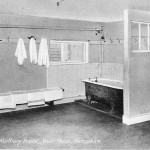
A Bathroom at Westbury House School
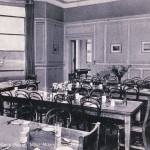
Dining Hall at Westbury House School
View of the school buildings from the park at Westbury
Desks in the magnificent library
Schoolroom within Westbury House
For source material on Westbury House, in the online archive, click here.
In 2011 Richard Pink made contact through the village website, enquiring of the History Group about his family, who had lived in East Meon for several generations (although there is no remaining Pink in the village). Richard had already done a great deal of research, but the Group, and in particular David Hopkins, was able to help him add to his knowledge. We met him when he came to the Flower Festival in June 2012 and visited the House Histories exhibition; since when he has written a full report on his researches.For the source materials, including this account, on the online archive, click here
Richard Pink, with wife Scarlet and son James,
The Sunderland connection
Richard was born and still lives in Middlesbrough, now thought of as an industrial town but with a history which reaches back a long way. Richard discovered, through Reverend Terry Louden’s history of the early church in East Meon (click here), that Christianity may have been brought to this village by St Wilfrid, Bishop of Northumberland in the 7th century. Wilfrid’s monastery, St Peter’s, was founded in Monkwearmouth in Sunderland where, by chance, a James Pink was married in 1836. Bear in mind that families tended to repeat the same Christian names time and again ….
Middlesborough Iron Works, blast furnace, 1840s
The Sunderland connection – the Pink family.
St Peter’s Church, Monkwearmouth
This James Pink’s occupation was variously given as a mariner, shipwright and carpenter. In the 19th century, Sunderland was one of the biggest shipbuilding centres in Britain and it attracted workers from far and wide – including, it would appear, from Hampshire. Of his eight children, the eldest son, Edward Pink, was born in 1838 and was a shoemaker; he appears in the census of 1881, with his wife and 3 of his children, plying his trade in Alton, Hampshire. Also on the 1881 census, Edward’s eldest son, James William Pink is recorded as a Royal Marine, who was in the Royal Naval Hospital, Haslar, Alverstoke, Hampshire. So this branch of the Pink family had a Hampshire connection.
It was the fourth child of James and Margaret, Samuel George Pink, who moved from Monkwearmouth to Middlesbrough, around 1878, with his wife and 5 children, where they had a further 7 children. Samuel George Pink was Richard’s great great grandfather. His occupation was carpenter and shipwright.
Hampshire Pinks
All Saints Church, Hinton Ampner, where James Pink of Bramdean married Elizabeth Brier in 1817
All Saints Church, East Meon
However, Richard has tracked down another James Pink, who was married in Hinton Ampner in Hampshire in June 1817 to Elizabeth Brier, who subsequently had several children. However, there is still further confusion surrounding the name James Pink. From the Parish Registers of All Saints, East Meon, Richard discovered another James Pink, this one baptised in East Meon in 1816. The reason he had not found this James Pink previously was because he was illegitimate and was listed in the database under his mother’s name, Elizabeth Tull. The baptism entry reads:
25th August 1816 James Pink son of illegitimate Elizabeth Tull of East Meon, pauper, F Dunderdale officiating minister.
It was not until the following year that his parents were married:
21st January 1817 James Pink and Elizabeth Tull married by Banns by Dunderdale Curate in presence of Robert Smith and Sarah Chace.
This couple also had children: Jane, born around 1820, Samuel, born around 1826, Henry, born around 1828, Mary, born around 1832, and Eliza, born around 1835. A baptism entry reads:
6th March 1825 William son of James & Elizabeth Pink, East Meon, Maltster. Spencer Rodney Drummond officiating Minister.
Why two of the children were baptised at All Saints Church and the others were not, may have something to do with the religion of their parents. A James Pink of East Meon applied for a dissenter’s meeting house certificate on 16th February 1828 (also Robert Pink of East Meon applied for his house to be used as a dissenting meeting house in 1844). An illegitimate girl was baptised at the East Meon Church in this year:
16th September 1828 Ellen dr of James Pink East Meon Maltster and Ann Abburrow Hambledon.
Therefore, there were two James and Elizabeth Pink families in Hampshire at this time. Both couples were married in 1817 and both had sons named James and William. In order to verify his findings, it was necessary for Richard to examine both families and try to trace both family histories.
William Pink, surgeon
The James Pink who married Elizabeth Tull was the son of William and Sarah Pink, the father’s occupation being surgeon. (The confusion does not end there; there was another William and Sarah Pink who lived in East Meon in the latter part of the eighteenth century. This William Pink was a farmer and his marriage produced at least ten children, the last one, also a James Pink, died only a few months old in 1784.) Our William Pink, the surgeon, had his second child, Sarah, baptised in East Meon on 26th September 1785.
There is a reference in the Hampshire Directory of 1784, to a William Pink in Alresford recorded as a “Surgeon and Man-midwife”. From the East Meon Memorial transcriptions online:
To the memory of William Pink who departed this life 15 Sept 1819 age 59, also Sarah his Wife who departed this life 23 Oct 1830 age 74, also 3 of their children, Sarah, eldest daughter, Jane 2nd daughter & William their infant son.
It seems likely that William Pink practised as a surgeon in Alresford and had his first child there, before moving to East Meon. There is a possible reference to William in the late eighteenth century from the Star, from Wednesday 24th October 1798:
Finchdean Volunteers. William Pink, Gent. to be surgeon.
William Pink died in 1819 and his wife Sarah died in 1830, aged about 70. William Pink’s death was reported in the Hampshire Telegraph and Sussex Chronicle on 20th September 1819:
Died, on Wednesday, suddenly, Mr Pink, Surgeon, of East Meon.
The family in trouble
After his death, the Pink family appear to have suffered financial difficulties, land was sold and surrendered, as the following newspaper extracts show: Hampshire Telegraph and Sussex Chronicle, 31st May 1824. To be SOLD by AUCTION… Lot 5.-Six Acres (more or less) of capital ARABLE LAND, and one acre (more or less) of PASTURE, situate near the village of Eastmeon, in the occupation of Messrs. . Barnard and Pink.
James Pink’s partner in these transactions is probably one of the Barnard family that was linked to the Barnards Cottages on East Meon High Street.
Hampshire Telegraph and Sussex Chronicle, 14th February 1825. EAST MEON,-HANTS. FOR SALE by PRIVATE CONTRACT… Lot 3.- Two Closes of Arable and Pasture LAND, containing about seven Acres, situate near the Village of Eastmeon, in the occupation of Messrs. Barnard and Pink, Copyhold of Inheritance of the same Manor. For particulars apply to Messrs. T. A. and W. Minchin, Portsea and Gosport.
William Pink owned Duncomb Farm, but after his death, this, too, had to be sold. Perhaps James Pink was unsuccessful as a maltster and this meant that he had to sell off the land he had inherited. At around this time, James and his family moved from East Meon to Ramsdean, and James’ occupation changed to agricultural labourer.
William Pink’s will from 11th May 1813 names three executors, including a James Andrews Minchin of Petersfield. The History Group helped Richard establish that William Pink had married Sarah Minchin in Portsea on 24th April 1781, and that the witnesses to the will were cousins of Sarah’s, Thomas Andrews Minchin, an Attorney and Banker, and Thomas Minchin, who had a successful career in the Navy. James Andrews Minchin was a notable figure in the area. The Minchins had returned from Ireland, where they had acquired land as a result of service in Cromwell’s Army.
George Pink
Unlike his brother James, William Pink’s second surviving son George (1794-1886) appears to have prospered. He was a surgeon in East Meon from at least 1841 until the 1870s. (It took about seven years to qualify as a surgeon and it must have cost William a lot of money to pay for George’s apprenticeship.)
White’s History, Gazetteer and Directory of Hampshire 1878 includes a reference to George Pink who was still active as the “surgeon and medical officer” for East Meon. He was recorded on the 1881 census as a retired surgeon. The census records also show that he was a member of the Royal College of Surgeons, a licensed apothecary and a GP.
The house, in the middle, now known as Brooklyn, photographed in 1914
The tithe apportionments for 1852/53, supplied by the History Group, show that George Pink owned land and property in East Meon and Frogmore, including the substantial house in which he lived, now known as “Brooklyn”, next to Glenthorne House on the High Street.
George Pink had married Ann Guy at All Saints, East Meon on 4th August 1832. The Guys were a prominent and well-to-do East Meon family. George and Ann had six children, three of whom died in infancy. Ann died young, at the age of 38, and her passing was recorded in the Hampshire Telegraph and Sussex Chronicle on 23rd February 1850:
DIED. Pink – On Tuesday last, Ann, wife of George Pink, Esq., Surgeon, of Eastmeon, much regretted by her family and a large circle of friends.
George Pink’s brother-in-law, George Guy, was also a surgeon at East Meon, but he died in 1846 at the age of 29. Since George Pink had only one son who died in infancy, it may be that George Guy was apprenticed to him.
That George Pink continued to own land in East Meon is confirmed by a list of property owners in the Petersfield area from the Hampshire Telegraph of 1876. This lists all the landowners in East Meon, including a Richard Pink.
Bridge Cottage, as it is called today – probably Bridge House in the 19th century.
Bottle Ale Cottages in Frogmore today, probably Bottle Ale House in the 18th century.
The tithe apportionments further show that George Pink let a cottage in Frogmore to William Weeks Jr, who was an executor of William Pink’s will in 1813, and that he let Bridge House in Frogmore to William Kille. The tithe apportionments also list Samuel Kille as letting a cottage to “Henry Pink and others”.
George Pink appears to have had a close association with the Kille family of East Meon. From the census records, Allan G Kille was his groom in 1861 and Walter Kille (aged 5) is recorded as a visitor on the 1871 census. Towards the end of his life, in the 1881 census, George Pink is recorded as lodging with the Kille family:
Village Caleb Kille 42 Carpenter East Meon
Hephzibah Kille 39 East Meon
Walter Kille 15 Carpenter East Meon
Nun Kille 11 Scholar East Meon
Ernest Kille 9 Scholar East Meon
Clement Kille 7 Scholar East Meon
George Kille 5 Scholar East Meon
Arthur Kille 13 Carpenter East Meon George Pink 86 Retired Surgeon East Meon
Earlier Pinks
There were other Pinks of East Meon, such as Richard Pink the miller, Robert Pink from the Isle of Wight, or Henry Pink and his family in Frogmore – and there have been Pinks living in East Meon for several hundred years. For instance, Nicholas Pynke, “yeoman of Oxenbourne”, died in 1570. Glenthorne House, one of the largest in the village was owned in 1729 by Robert Pink,, in 1757, by his son Thomas Pink, then in 1779, by his son Thomas Pink, who surrendered it that year to John Hawkins …”
Hampshire Record Office holds an enormous amount of information on property ownership and transactions relating to the Pink family going back to the mid-seventeenth century. It is possible that the family had been engaged in the Malt trade previously. A 1728 gift by the Pink family of “le Malthouse” for the use of the poor is documented:
Tourn of Hock, 1 Geo II. Admission of Robert Pincke, Stephen Steele Stephen Woodman, William Baker, Robert Stale, John Silvester, Joseph Terrell and Stephen Tulett to a close containing an acre now or late an orchard called Backclose with a cottage built thereon lying on the east of Duncombe Lane and also a house called le Malthouse, for the use of the poor of the parish of East Meon in the tithing of Meon Manor/ except and reserved to Thomas Pinke his heirs and assigns a tenement lying on the west of le Malthouse now in the occupation of John Long, and the use of a well pertaining to a cottage and house called le Malthouse by surrender of Thomas Pinke.
The book of court rolls extracts shows that the Bottle Ale House in East Meon was in the possession of Richard Pink in 1764. Since this house was owned by George Pink in 1852, it may show a connection between Richard’s branch of the Pink family and the Pinks of East Meon that dates to before William Pink the surgeon.
Work in progress
It would appear that the only way to sort out the confusion of surrounding the various Pink families with any certainty is to map all the Pinks who were either born in East Meon or lived there. Richard is only in the early stages of this task, starting with the nineteenth century. One interesting fact that has already emerged is that Sir William Pink of Shrover Hall, Cosham, who was Mayor of Portsmouth five times between 1875 and 1891, had a connection to East Meon. He was born on 15th December 1829 at Durley, near Botley, in Hampshire, the son of a farmer, Thomas Pink. Thomas Pink was born in East Meon in 1785 and, although he lived at Durley from about 1812 to 1841, producing thirteen children with his wife Sarah, the 1851 census shows that he lived at Oakshott, Froxfield, farming 120 acres and employing two men. One of his other sons, Richard Pink, was a miller at East Meon, appearing on the census records at Upper (or South) Mill in 1881 and 1891. In the biography of Sir William Pink on the History in Portsmouth website, it is noted that: “The Pinks were a notable Hampshire family having their family seat, for over 300 years, at Kempshott Park near Basingstoke.” (Pictured, below – Jane Austen was a visitor to this house.)
Kempshott Park
As for the James and Elizabeth Pink who married at Hinton Ampner in 1817, they eventually moved to Froxfield, where they appear on the 1841 and 1851 census. By 1861, Elizabeth, now widowed, was still living at Froxfield, with her grandson John Pink. Two of their sons, James and William, appear to have married sisters, Naomi and Mary Jane Hunt respectively. William and Mary Jane married in Portsea in 1856 and James and Naomi were married there in 1860. On the 1871 census, the two couples and their families were living a few doors away from each other on Sinah Lane, South Hayling. The occupation of the two brothers is given as agricultural labourer.
GH Pink hardware store, which occupied a prominent position in East Meon from the 1920s to the 1950s.
Middlesbrough Iron Works blast furnace iron-making plant in the1840s We were contacted by Richard Pink, the descendant of a prominent East Meon family who lives in Middlesborough. Richard had already conducted research into his family’s genealogy and we were able to help him with some details. This is his full report, starting in Sunderland.
The Sunderland connection
It is probably best to start this account with a bit of background information on Middlesbrough, the town where I was born and have lived all my life. Middlesbrough is a fairly large town in the north east of England, at the mouth of the river Tees. Although it is surrounded by, and, as it expanded, has swallowed up several ancient villages, ones that are mentioned in the Domesday Book and whose histories stretch back to the Saxons and beyond, Middlesbrough itself has an elusive, history. There is a theory that the high ground where the old part of the town started was once the site of a Roman signal station, safeguarding a crossing of the Tees that linked York to Hadrian’s Wall. Another theory is that a Saxon church stood on the site from the seventh century. However there is no concrete evidence for either theory. A monks’ cell was established here in the twelfth century whose ownership was disputed by the Augustinian Priory at Guisborough and the Benedictine Abbey at Whitby. Unlike its near neighbour and rival on the other side of the Tees, Stockton, the population of Middlesbrough remained small and static, up until the nineteenth century. In 1801, Middlesbrough was a hamlet with a population of just 25, living in four farmhouses. In 1829, the population was still only 40 and yet by the end of the century, it had grown rapidly to become a large industrial town of 91,000 inhabitants. The period of growth started in the 1840s, first as a port for exporting coal from the Durham collieries and then the iron and steel industry dominated the town’s economy. Therefore the family history of most people in Middlesbrough reflects this rapid influx of migrant workers who arrived in the town from the mid to late nineteenth century. I have Scottish and Irish ancestors, as well as Yorkshire and Hampshire ancestors, via Sunderland.
The name Pink is an unusual one in the north east. One family theory was that we were descended from Cornish tin miners, who had come to the area to cash in on the boom in the iron industry. It was a fact that miners did travel from all over Britain, Europe and further afield, to work on Teesside. There were certainly people from Cornwall living and working in Middlesbrough and some of them can be found recorded on the 1881 census, which was about the time the Pinks moved to Middlesbrough. However I have not, as yet, found any Cornish miners working in the Teesside iron industry. It was not until later that I found out that Cornwall is one of the top three counties in England for having the highest concentration of inhabitants named Pink. The other two are Kent and Hampshire.
I was fortunate when I started to do my family history that someone had already made a start on it and had made their research available on the internet. Therefore in tracing my family name of Pink, it was largely a case of verifying what had already been done.
St Peter’s Church, Monkwearmouth, where James Pink of Hampshire was married to Margaret Charlton in 1836
From this I soon found out that I was related to a James Pink of Hampshire, who was married to Margaret Charlton at St Peter’s Church, Monkwearmouth (Sunderland) on 5th January 1836. Although I live in Middlesbrough, I had visited this church prior to finding out any family connection. It is the site of a famous Saxon monastery founded in 674, the one where the Venerable Bede grew up and is twinned with the more famous St Paul’s Monastery in Jarrow, where Bede spent his adulthood and wrote his famous historical and theological works. St Peter’s still retains a lot of Saxon stonework, particularly in the Church tower, and recently put in a joint bid with St Paul’s for World Heritage status. However, in the 1830’s a lot of the churchyard had been covered by a huge mound of ships’ ballast that was dumped there by passing traffic on the River Wear. This had been going on since the Middle Ages and St Peter’s, which once stood on a hillock, became surrounded by sand hills and the west end of the church and the lower part of the tower were hidden from view. It was not until the 1860s, when the church was restored, that the sand was removed and the Saxon features were revealed. The ballast hills were sometimes built upon and James Pink’s brother William lived on one, Lookout Hill, in 1851.
Sunderland shipbuilding in the 19th century
It was interesting to read on the East Meon History Group website the essay by the Vicar of All Saints, East Meon, Rev. Terry Louden, on the history of Christianity in East Meon. This looks at the role of Wilfrid of Northumbria in spreading Christianity to southern England in the seventh century. Wilfrid was Bishop of Northumbria from 668 to 677, the time when St Peter’s Monastery was founded at Monkwearmouth. Then from about 678-686, he was based at Selsey, spreading the Christian message to Southern England, including Hampshire.
The Lambert Barnard mural of St. Wilfrid commissioned by Bishop Sherburne c 1508-1536 in the North Transept of Chichester Cathedral.
James Pink’s occupation is variously given as: mariner, shipwright and carpenter. On the 1841 census he was living at Wreath Quay on Monkwearmouth Shore. At this time, Sunderland was one of the biggest shipbuilding centres in Britain and it attracted workers from far and wide. He was living with is wife Margaret and young son, also James, and a William Pink, probably James’ brother, aged 15 (this is an approximate age, as ages on the 1841 census were rounded to the nearest 5) and his occupation was a ship’s blacksmith (“ship smith ap”).
James and Margaret had 8 children, before James died in 1859. These mainly lived and worked in the north east, although the eldest son, Edward Pink, born in 1838 (who is not listed with his family in Sunderland on the 1841 census and who appears to be missing altogether from this census), was a shoemaker, who worked in Sunderland, Newcastle and Hartlepool. This was apart from a period around 1881, where he appears on the census with his wife and 3 of his children, plying his trade in Alton, Hampshire. Also on the 1881 census, Edward’s eldest son, James William Pink is recorded as a Royal Marine, who was in the Royal Naval Hospital, Haslar, Alverstoke, Hampshire.
It was the fourth child of James and Margaret, Samuel George Pink, who moved to Middlesbrough, around 1878, with his wife and 5 children, where they had a further 7 children. Samuel George Pink was my great great grandfather. His occupation was carpenter and shipwright. He married Dorothy Ann Sanderson of Southwick (“Suddick”), Sunderland at the Independent Chapel in Dundas Street, Sunderland in 1866. Dorothy eventually became a midwife in Middlesbrough. Samuel’s mother Margaret also ended up in Middlesbrough, first living with her daughter in North Ormesby and ending her days in the workhouse.
The Hampshire Connection
All Saints Church, Hinton Ampner, where James Pink of Bramdean married Elizabeth Brier in 1817
One problem I have had is in making the leap from the era of birth registration and the census, to the early part of the nineteenth century and from the north east of England to Hampshire. This is because the person who did my family tree linked the James Pink who was married in Monkwearmouth to a James and Elizabeth Pink who were married in Hinton Ampner in Hampshire in 1817. James Pink of Bramdean married Elizabeth Brier of Hinton Ampner at All Saints Church, Hinton Ampner on 18th June 1817. They had several children, the first being Francis Pink, baptised at St Simon & St Jude Church, Bramdean on 11th August 1817. Their second child was James Pink, baptised at Hinton Ampner on 11th July 1819. Two more sons, George and John Pink were baptised at Hinton Ampner on 18th March 1824 and William Pink was baptised at All Saints, East Meon on 6th March 1825.
I have not been able to contact the person who did my family tree in order to ask him what evidence he has for claiming that the James Pink of Monkwearmouth was born in Hinton Ampner. From the CD ROM produced by the Hampshire Genealogical Society (HGS) of Church of England baptisms, the Hinton Ampner James Pink is the only one returned when searching on that name that could fit with being married in 1836. However, this would make him either 15 or 16 when he got married, which, although not impossible, would seem unlikely. It is possible that he was born before 1819 and then baptised later, which was common practise at the time. However, the fact that Francis Pink was baptised in 1817 would make this unlikely.
From the census records of 1841 for Monkwearmouth, James Pink gives his age as 25 and he was born out of the county of Durham. On the 1851 census, he gives his age as 35 and his place of birth as Eastmere, Hampshire. Living with James in 1841 is William Pink, presumably a younger brother. This census records his age as 15 and his birthplace as being out of the county. By 1851, William was married and making his way in the world separate from his brother. This census records his age as 27 and his birthplace as East Meon, Hampshire. On the 1861 census he records his birthplace as Petersfield and, for 1871 and 1881, he again gives East Meon as his place of birth. It may be that James Pink was confused about his birthplace. His family did appear to move around the Bramdean, Hinton Ampner and East Meon area quite a lot. Somehow though, this did not ring true with me and I always suspected there was something wrong with the Hinton Ampner connection.
The East Meon connection
It was not until fairly recently that I did a free text search on some search results I had downloaded from the baptism CD ROM and discovered a James Pink baptised in East Meon on 25th August 1816. The reason I had not found him previously was because he was illegitimate and was listed in the database under his mother’s name, Elizabeth Tull. The baptism entry for James Pink reads:
25th August 1816 James Pink son of illegitimate Elizabeth Tull of East Meon, pauper, F Dunderdale officiating minister.
It was not until the following year that his parents were married:
21st January 1817 James Pink and Elizabeth Tull married by Banns by Dunderdale Curate in presence of Robert Smith and Sarah Chace.
This couple had children: Jane, born around 1820, Samuel, born around 1826, Henry, born around 1828, Mary, born around 1832, and Eliza, born around 1835. I have not been able to find baptism records for these children and have taken their details from census records. It now also seems likely that the William Pink baptised in 1825 at East Meon was their son and not from the Pink family married in Hinton Ampner. The entry reads:
6th March 1825 William son of James & Elizabeth Pink, East Meon, Maltster. Spencer Rodney Drummond officiating Minister.
[Incidentally, Francis Pink, mentioned earlier, married Ellen Blackman from East Meon and lived there for a short time around 1850 (at “Berely Lodge” according to the 1851 census). Ellen Blackman’s mother was Hannah Tull, who was the younger sister of Elizabeth Tull and so the two Pink families were distantly related through marriage.]
All Saints Church, East Meon
Why two of the children were baptised at All Saints Church and the others were not, may have something to do with the religion of their parents. A James Pink of East Meon applied for a dissenter’s meeting house certificate on 16th February 1828 (also Robert Pink of East Meon applied for his house to be used as a dissenting meeting house in 1844). An illegitimate girl was also baptised at the East Meon Church in this year:
16th September 1828 Ellen dr of James Pink East Meon Maltster and Ann Abburrow Hambledon.
Although James Pink is referred to as a maltster in this record and on William Pink’s baptism entry in 1825 and on a surrender of land document also in 1825, on the 1841 and 1851 census, he is referred to as an agricultural labourer. By this time, the family had moved to Ramsdean.
Therefore, there were two James and Elizabeth Pink families in Hampshire at this time. Both couples were married in 1817 and both had sons named James and William. It would appear that the genealogist who looked at my family tree got these two families confused, mixing the Hinton Ampner Pinks with those in East Meon. In order to verify any findings I came up with, it was necessary to examine both families and try to trace both family histories.
The James Pink who married Elizabeth Tull was baptised at All Saints, East Meon on 25th January 1790. He was the son of William and Sarah Pink, the father’s occupation being surgeon. Making things harder from a research point of view, there was another William and Sarah Pink who lived in East Meon in the latter part of the eighteenth century. This William Pink was a farmer and his marriage produced at least ten children, the last one, also a James Pink, died only a few months old in 1784. William Pink the surgeon had his second child, Sarah, baptised in East Meon on 26th September 1785. It is at this point in the register that William Pink is noted as a surgeon, to distinguish him from the other William Pink in East Meon.
There is a reference in the Hampshire Directory of 1784, to a William Pink in Alresford recorded as a “Surgeon and Man-midwife”. According to the HGS cd rom of Hampshire baptisms, William son of William and Sarah Pink was baptised on 25th July 1783, at New Alresford. From the East Meon Memorial transcriptions online:
To the memory of William Pink who departed this life 15 Sept 1819 age 59, also Sarah his Wife who departed this life 23 Oct 1830 age 74, also 3 of their children, Sarah, eldest daughter, Jane 2nd daughter & William their infant son.
The burial records for East Meon, show that “William Pink inf.” was buried on 27th Feb 1785. The only William Pink in the East Meon records prior to this was baptised in 1774. Therefore, it seems likely that William Pink practised as a surgeon in Alresford and had his first child there, before moving to East Meon.
There is a possible reference to William in the late eighteenth century from the Star, from Wednesday 24th October 1798:
Finchdean Volunteers.
William Pink, Gent. to be surgeon.
William Pink’s will from 11th May 1813 names three executors:
…my Brother in law James Andrews Minchin of Petersfield in the said County of Southampton Gentleman my Son James Pink and my friend William Weeks junior of Oxenbourne in the said Parish of Eastmeon yeoman…
It was not until I contacted the East Meon History Group that I found out that William Pink had married Sarah Minchin in Portsea on 24th April 1781. I was also informed that the witnesses to the will were cousins of Sarah’s, Thomas Andrews Minchin, an Attorney and Banker, and Thomas Minchin, who had a successful career in the Navy. From the information I was provided with, it became clear that James Andrews Minchin was a notable figure in the area. The Minchins were ‘returnees’ from Ireland, where they had acquired land as a result of service in Cromwell’s Army. Their main occupation was carpentry, James Minchin was a Master Carpenter, involved in the furniture and carriage making trades and as a timber merchant, who employed apprentices throughout his career. He was also very politically active, campaigning for political reform in the area, prior to the 1832 Reform Act. The Minchins provide an opportunity for work in carpentry and the Navy, which may have benefited James Pink’s sons, James and William.
William Pink’s death was reported in the Hampshire Telegraph and Sussex Chronicle on 20th September 1819:
Died, on Wednesday, suddenly, Mr Pink, Surgeon, of East Meon.
At this time, the Pink family appear to have suffered financial difficulties, land was sold and surrendered, as the following newspaper extracts show:
Hampshire Telegraph and Sussex Chronicle, 31st May 1824.
To be SOLD by AUCTION…
Lot 5.-Six Acres (more or less) of capital ARABLE LAND, and one acre (more or less) of PASTURE, situate near the village of Eastmeon, in the occupation of Messrs. Barnard and Pink.
Hampshire Telegraph and Sussex Chronicle, 14th February 1825.
EAST MEON,-HANTS.
FOR SALE by PRIVATE CONTRACT…
Lot 3.- Two Closes of Arable and Pasture LAND, containing about seven Acres, situate near the Village of Eastmeon, in the occupation of Messrs. Barnard and Pink, Copyhold of Inheritance of the same Manor.
For particulars apply to Messrs. T. A. and W. Minchin, Portsea and Gosport.
James Pink’s partner in these transactions is probably one of the Barnard family that was linked to the Barnards Cottages on East Meon High Street.
I also found this reference to a land transaction in the Hampshire Records Office, which shows the surrender of land in East Meon by all three executors of the will of William Pink:
New Alresford, Bishops Sutton etc deeds – Date 21st April 1825.
Record: 583 of 1199
Finding No 26M77/E/T25
Title Admission and surrenders, with regards to land in East Meon
Description A toft and 10a in Meon Manor called Mould’s, a toft and 10a in Meon Manor called Gentleman’s and a close of bondland in Oxenborne Field, 1a called Harbords parcel of Potters now or late called Bonham Paddock. Admission of Thomas Andrews Minchin, gent and John Small the younger, devisees of James Andrews Minchin, gent, deceased on the surrender of William Pink, gent, deceased by forfeit on non payment of mortgage of £450. Surrender to James Pink of East Meon, maltster and William Weeks the younger, yeoman, survivors of James Andrew Minchin and surrender by all 4 parties ie Thomas Andrews Minchin, John Small the younger, James Pink and William Weeks the younger to Samuel Newton Humphreys of Petersfield, gent.
William Pink died in 1819 and his wife Sarah died in 1830, aged about 70. I believe that William Pink owned Duncomb Farm in East Meon because of a reference to Sarah Pink in the Hampshire Telegraph from 1825:
Hampshire Telegraph and Sussex Chronicle, 12th September 1825.
Farm to let – Eastmeon
To be LET by AUCTION, at the George Inn, Eastmeon, on Thursday the 22d day of September inst. At twelve at noon, upon a Lease for Fourteen Years, determinable on the life of Mrs. Sarah Pink, widow, of the age of 67, subject to such conditions as will be then produced, All that FARM called DUNCOMB, containing 60 Customary Acres (more or less), with the Barn, Carthouse, Stable, and Gateroom thereto belonging, situate in the Parish of Eastmeon._ For particulars, apply to Messrs. Minchin, Solicitors, Gosport and Portsea.
This perhaps shows that the sudden death of William Pink could have been the trigger for financial troubles. William Pink owned Duncomb Farm, but after his death, this, along with other plots of land, had to be sold. Perhaps James Pink was unsuccessful as a maltster and this meant that he had to sell off the land he had inherited. It is also around this time that James and his family moved from East Meon to Ramsdean, and James’ occupation changed to agricultural labourer.
William Pink’s second surviving son, George Pink (1794-1886) was a surgeon at East Meon from at least 1841 until the 1870s. From the History Group’s website, there is an old Freddie Standfield article from Meon Matters which has details of White’s History, Gazetteer and Directory of Hampshire 1878. This includes George Pink who was still active as the “surgeon and medical officer” for East Meon. However, he was recorded on the 1881 census as a retired surgeon. The census records also show that he was a member of the Royal College of Surgeons, a licensed apothecary and a GP.
George Pink had married Ann Guy at All Saints, East Meon on 4th August 1832. The Guys were a prominent and well-to-do East Meon family. George and Ann had six children, three of whom died in infancy. Ann died young, at the age of 38, and her passing was recorded in the Hampshire Telegraph and Sussex Chronicle on 23rd February 1850:
DIED.
Pink – On Tuesday last, Ann, wife of George Pink, Esq., Surgeon, of Eastmeon, much regretted by her family and a large circle of friends.
George Pink’s brother-in-law, George Guy, was also a surgeon at East Meon, but he died in 1846 at the age of 29. Since George Pink had only one son who died in infancy, it may be that George Guy was apprenticed to him.
I knew that George Pink owned land in East Meon because of a list of property owners in the Petersfield area from the Hampshire Telegraph of 1876. This also lists all the landowners in East Meon, including a Richard Pink. Presumably this is the same Richard Pink I found mentioned in Standfield’s notes:
Documents in the possession of George Kille of East Meon: 24/10/1888 – Surrender by Richard Pink of East Meon Miller of a cottage late in the occupation of Arthur Prouting but now of Nun Kille consideration £15.
Brooklyn, the home of George Pink GP, is the middle house of the row.
Details of the tithe apportionment map for East Meon of 1852/53, supplied by the East Meon History Group, show that George Pink owned land and property in East Meon and Frogmore, including the house that became known as “Brooklyn”, next to Glenthorne House on East Meon High Street. Since I was informed by the History Group that the current owners lived in America, I had assumed that this was why the house had its present name. However, I noticed that it is referred to as “Brooklyn” on the 1901 census, so it would be interesting to find out when and how it acquired this name.
Bridge Cottage, as it is called today – probably Bridge House in the 19th century.
Further information from the tithe apportionment map shows that George Pink rented a cottage in Frogmore to William Weeks Jr, who was an executor of William Pink’s will in 1813. A Bridge House was rented to William Kille. From the 1841 census, William Kill (or Kille) was a miller and close neighbour of George Pink. William’s brother Samuel Kille was a butcher and another neighbour of George Pink. The tithe apportionment map shows that Samuel was renting a cottage to Henry Pink and others in 1853. This Henry Pink was from a different Pink family to the one I am related to and not to be confused with James Pink’s son, Henry, who was working as a servant in George Pink’s household at around this time.
George Pink appears to have had a close association with the Kille family of East Meon. From the census records, Allan G Kille was his groom in 1861 and Walter Kille (aged 5) is recorded as a visitor on the 1871 census. He also must have had close links with the Strugnell family of Cheriton. Mary Strugnell was his servant in 1851, Hephzibah Strugnell in 1861 and Alice Strugnell in 1871. Hephzibah Strugnell married Caleb Kille, the father of Walter Kille and cousin of Allan G Kille, and George Pink was recorded as lodging with this family on the 1881 census:
Village Caleb Kille 42 Carpenter East Meon
Hephzibah Kille 39 East Meon
Walter Kille 15 Carpenter East Meon
Nun Kille 11 Scholar East Meon
Ernest Kille 9 Scholar East Meon
Clement Kille 7 Scholar East Meon
George Kille 5 Scholar East Meon
Arthur Kille 13 Carpenter East Meon George Pink 86 Retired Surgeon East Meon
It is difficult from the census to tell exactly where in East Meon they were living, but it does not appear to be at Brooklyn. From a comparison with the residents on the 1871 census and using proximity to the New Inn (now the Isaac Walton) as a guide, George Pink’s successor as GP, Edward Noott, and his younger brother, Frank Noott, a student of medicine, from Dudley, Worcestershire, were living at Brooklyn. Doing a similar comparison on the 1891 census, it would appear that, after Dr Noott, this house was owned by Luke Merritt, a cattle dealer, who had married Lucy Pink of East Meon in 1876. Lucy was the daughter of Robert Pink, who was born on the Isle of Wight around 1796 and married Sarah Ratty of East Meon in 1823. It is only on the 1901 census that the building is named as “Brooklyn” and Lucy Merritt, now widowed, was still living there. It is tempting to think that Lucy Pink’s family must have had some connection to George Pink, but it is probably just a coincidence.
Despite the early death of his wife, George Pink lived a long life and had a long career as a GP. His older brother, James, did not fare as well and his fortunes appear to go into decline in the 1820’s, shortly after the death of his father. Although land and property are not included in the will of William Pink the surgeon, it would appear that his two surviving sons inherited various plots of land in and around East Meon. George Pink married into a well-to-do family and had a long and stable career. However, James Pink appears to have failed as a maltster and Duncomb Farm and other land he had a share in had to be sold. He then moved from East Meon to Ramsdean, becoming an agricultural labourer.
The fact that William and George Pink were surgeons and James Pink was a maltster and that they owned land, implies that they were from the middle class. It took about seven years to qualify as a surgeon and only wealthy families would have been able to afford the apprenticeship. The Pink family did have a certain amount of property, but the different branches of the family had mixed fortunes. It could be that William and his son George learnt their trade in the Navy, although so far I have not been able to find any details from naval Records or the Royal College of Surgeons. (The close proximity of Portsmouth may also explain the later James and William Pinks’ involvement in shipbuilding.) What is intriguing is the apparent difference in character between the two brothers, James and George, and the resulting difference in their fortunes.
I have not yet been able to determine whether there were any family connections between George Pink and the other Pinks of East Meon, such as Richard Pink the miller, Robert Pink from the Isle of Wight, or Henry Pink and his family in Frogmore. I know from Standfield’s History of East Meon that there have been Pinks living in East Meon for several hundred years. For example, he mentions Nicholas Pynke, “yeoman of Oxenbourne”, who died in 1570, amongst others. From information supplied by the History Group, it seems that in the mid-eighteenth century, Glenthorne House, next to Brooklyn on the High Street was owned by Pinks.
(From the list of owners of Glenthorne House: “1729 Robert Pink, 1757, his son Thomas Pink, then in 1779, his son Thomas Pink, who surrendered it that year to
1779 John Hawkins …”
There are also various records kept at Hampshire Records Office, which detail the Pinks activities in East Meon, going back several hundred years. One of the most useful of these is:
23M76/11: Volume containing manuscript extracts from court rolls of the manors of Hambledon (1648-1814) and East Meon (1647-1805) relating to the Pink family.
This contains an enormous amount of information on property ownership and transactions relating to the Pink family going back to the mid-seventeenth century. Here are a few examples, the first documents a gift by the Pink family of “le Malthouse” for the use of the poor:
Tourn of Hock, 1 Geo II
AD 1728
Admission of Robert Pincke, Stephen Steele Stephen Woodman, William Baker, Robert Stale, John Silvester, Joseph Terrell and Stephen Tulett to a close containing an acre now or late an orchard called Backclose with a cottage built thereon lying on the east of Duncombe Lane and also a house called le Malthouse, for the use of the poor of the parish of East Meon in the tithing of Meon Manor/ except and reserved to Thomas Pinke his heirs and assigns a tenement lying on the west of le Malthouse now in the occupation of John Long, and the use of a well pertaining to a cottage and house called le Malthouse by surrender of Thomas Pinke.
The second documents the transaction of a piece of land called “Bunney”, which appears to have been in the possession of various members of the Pink family for many years:
Tourn of St Martin, 11 Geo. II
AD 1737 [in margin: widow of John formerly Jane Locke]
Admission of Chadwick Parsons the younger and Jane his wife late Jane Pink widow, of an “acremen” of land called Bunney in the tithing of Meon Manor by surrender of the said Jane when sole. To hold to the said Chadwick and Jane with remainder to the heirs of the said Jane.
From another Freddie Standfield article available on the History Group’s website on Tithes, it notes that the small meadow fronting Clanfield Road and adjoining “Pastures” was called “Bunny Meadow”. This information is taken from the terrier (the schedule or inventory of land) that accompanied the tithe apportionment map. Bottle Ale Cottages in Frogmore today, probably Bottle Ale House in the 18th century.
The book of court rolls extracts shows that the Bottle Ale House in East Meon was in the possession of Richard Pink in 1764. Since this house was owned by George Pink in 1852, it may show a connection between my branch of the Pink family and the Pinks of East Meon that dates to before William Pink the surgeon.
It would appear that the only way to sort out the confusion of surrounding the various Pink families with any certainty is to map all the Pinks who were either born in East Meon or lived there. I am only in the early stages of this task, starting with the nineteenth century and the information that is available from census and registration records. The next step will be to move back in time through the parish records and the court rolls information. (Click here for slides showing Richard’s geneaological charts of the different branches of the Pink family)
So far one interesting fact that has emerged is that Sir William Pink of Shrover Hall, Cosham, who was Mayor of Portsmouth five times between 1875 and 1891, had a connection to East Meon. He was born on 15th December 1829 at Durley, near Botley, in Hampshire, the son of a farmer, Thomas Pink. Thomas Pink was born in East Meon in 1785 and, although he lived at Durley from about 1812 to 1841, producing thirteen children with his wife Sarah, the 1851 census shows that he lived at Oakshott, Froxfield, farming 120 acres and employing two men. One of his other sons, Richard Pink, was a miller at East Meon, appearing on the census records at Upper (or South) Mill in 1881 and 1891. In the biography of Sir William Pink on the History in Portsmouth website, it is noted that: “The Pinks were a notable Hampshire family having their family seat, for over 300 years, at Kempshott Park near Basingstoke.”
As for the James and Elizabeth Pink who married at Hinton Ampner in 1817, they eventually moved to Froxfield, where they appear on the 1841 and 1851 census. By 1861, Elizabeth, now widowed, was still living at Froxfield, with her grandson John Pink. Two of their sons, James and William, appear to have married sisters, Naomi and Mary Jane Hunt respectively. William and Mary Jane married in Portsea in 1856 and James and Naomi were married there in 1860. On the 1871 census, the two couples and their families were living a few doors away from each other on Sinah Lane, South Hayling. The occupation of the two brothers is given as agricultural labourer.
From Margery Lambert’s recollection of shops in East Meon in the 1920s, “1 Hardware Store (Pinks) supplied the village with hardware.” From recollections of World War !! “When he came home, he’d stand on the bridge at Pink’s corner and play marbles with the children.”