Michael Blakstad is the 'publisher' of the East Meon History Group. His career was spent initially in broadcasting, in BBC TV, and both Yorkshire TV and Television South, and as in independent producer. His company Workhouse was a pioneer of interactive media. He lives in East Meon and manages the History website.
A memorial service was held for Peter on May 19th – a blustery day at the start of the wretched summer weather. Suitably, those who came ranged from villagers and fellow ex- cricketers from Steep to erstwhile BBC colleagues and Peter’s brother-in-law Simon Brett, broadcaster and writer of radio and TV comedies, who gave the main address.
In it, Simon chronicled Peter’s ‘global’ career, starting as a true son of East Meon – his parents were Geoff and Eileen Brook who ran a wonderful High Street general store in the days when we had as many as six shops in the village. Peter went to New Zealand in his twenties, visiting Eileen’s family and finding work where he could. His glorious voice and English accent found favour with local radio stations so that is where he got his first experience behind a microphone.
Peter decided to return home at a time when the New Zealand government was anxious to attract more residents and offered citizenship in return for completing a single form, so Peter became a Kiwi as well as a Brit. He came back to Hampshire, joined the BBC as a continuity announcer (the out-of-vision voice which takes viewers seamlessly from one programme to another), met Mirabel and married her. Simon told tales of the aplomb with which Peter would switch from snoozing or listening to cricket commentaries, to fully alert conduct of the broadcast omnibus even in times of crisis.
Peter and Mirabel moved to Lythe House and started a tripartite working pattern which would have left most of us gasping. They developed outhouses as luxury self-catering apartments (and later added the Martello tower further down the Buriton road) while Peter made a business out of his passion for wine by starting Hampshire Wine Shippers, a cornucopia of well-chosen French varieties which led to many an addiction among other villagers – ours was for Chateau Pierrail.
The Brooks earned a paragraph in the history books by being the first British couple to adopt three children, Alexi, Anton and Anna, direct from a Moscow orphanage. Their lives were heavily influenced by the needs of these three and when they decide to go to New Zealand it was partly to provide a liberal and caring environment for them. Peter and Mirabel bought a ‘batch’ – a plot of land near Havelock North in the Hawke’s Bay area. They then found a suitable house which was transported on low-loaders to Cape South. Another house was later added as part of a small colony of wonderful self-catering cottages – Tricia and I enjoyed a glorious stay there and unreservedly recommend it to other Limeys seeking a luxury break in New Zealand.
It was the worst possible blow for the family that they no sooner had Cape South in shape and visitors starting to arrive than Peter was diagnosed with an aggressive cancer. He had superb care especially in the hospice in Havelock North to which donations at the Memorial Service were made. Peter and Mirabel came to Europe in September last year to meet friend and family in the near-certain knowledge that this would be Peter’s last visit and to visit their favourite holiday home in Cyprus. Peter said firmly that he also wanted to attend the 2012 Olympics …. an unquenchable spirit and a redoubtable son of East Meon.
Margery holding the map she prepared showing shops and trades in East Meon in the early 1920s
Margery Lambert at 18, at the start of her nursing career
Obituary, February 20th 2007, by Reverend Terry Louden
Marjorie Lambert was recently described to me as ‘the nearest thing to a saint’. She would have disagreed very firmly with that assessment, pointing out her personal shortcomings, and saying that in whatever she did she was only doing her Christian duty.
Duty is today a very unfashionable word. The trend in society is to be more concerned with rights rather than with responsibilities and duties. Duty carries the hint of obligation, of doing things because you have to rather then because you want to. But duty really means giving other people their due (God included) and duty embraces ideas and concepts like honour, respect and love. Throughout her long life, Marjorie gave others – patients, colleagues, family, friends, neighbours – their proper due.
Marjorie died six weeks short of her 90th birthday. She was born in Westbrook Cottages, the only child of a tenant farmer, who was one of three brothers who worked Duncombe Farm. She never forgot her family background, and although she spent nearly 40 years working in London, she was always tuned in to the cycle of the agricultural year, and those who worked on the land, including her own family, who were always close to her heart. Typically, she insisted that she did not want to die during lambing, as she did not want those making arrangements to be put to extra trouble. Her wish was granted.
A week or so before she died, at her bedside in the Royal Hampshire County Hospital in Winchester, Marjorie reminded me that it was in the same hospital, over 70 years before, that she had started her nursing training. By the outbreak of the Second World War, she was a Staff Nurse, earning £90 per annum. In 1940, Marjorie went to Guy’s Hospital in London to begin midwifery training, taking a substantial pay cut in the process. I don’t know why she decided to specialise in mums and babies, but it was certainly highly appropriate for someone born on the 25th of March, the Feast of the Annunciation, nine months to the day before Christmas. Some of her work in London was as a district midwife, out on a bicycle in the Blitz, helping to bring new life into a world of war. In 1943 she was sufficiently experienced to become a teacher and trainer of midwives in the Bermondsey and Southwark areas. By 1946, she was back on the maternity ward at Guy’s, and the following year she was promoted to Sister, often on duty at night.
In 1948, Marjorie was appointed Superintendent Midwife of the South London Hospital for Women, in charge of a unit of 50 beds and a district midwifery service covering Clapham, Balham, Battersea and Brixton, as well as teaching and training 50 pupils every year. In 1957, she was joined in this work by Eileen Alston, who is here today.
In 1962, Marjorie moved a little further out into the south London suburbs when she was appointed Superintendent Midwife of Mayday Hospital, Croydon. Mayday’s maternity unit was large, with 150 beds. Marjorie continued teaching and examining in the midwifery training school. The 60s and 70s were an era of great change for midwives, with new job titles (Senior Nursing Officer) and suits rather than frilly caps. Marjorie admitted that the last ten years of her career were difficult, with a very demanding job, and family responsibilities for her mother and her aunt, both of whom were in poor health. Marjorie retired in 1977, when she was awarded the Queen’s Jubilee Medal for services to midwifery. The MBE, which she would have said she didn’t deserve, but of which I think she was quietly and properly proud, was awarded some years later.
So in 1977, she returned to the village where she had been born and brought up. Marjorie had not neglected East Meon during her London years. Indeed, she had been known to cycle here from Croydon to visit her mother. It has been East Meon’s privilege to have her living at the centre of the village for the past 30 years.
Those 30 years were years of much activity. There was the regular Saturday visit to the family at Stoneylands Farm. There was the Lunch Club, where Marjorie, as she used to joke, was eventually older than most of the members. At Lunch Club we all observed Marjorie’s attention to detail – the flower arrangements, the menus written in that wonderful hand, the cards sent to the unwell and the housebound. There were all the village activities, the Country Fair and the Fetes, and the human fruit machine. Marjorie, though a single woman, was a strong supporter of the village school and its children. There was this Church. Marjorie was the most faithful of communicants. If Marjorie was not in church on Sunday, or at weekday services, it was because she was not in the village or she was unwell. Her Christian faith was a foundation of her life. For many years she looked after the church’s linen and vestments. If we wanted to know what she was like as a trainer of midwives, we need look no further than the thorough, precise and painstaking instructions, complete with diagrams, that she gave to those preparing and setting up for church services. She prepared for this service, of course, by choosing the bible reading and the hymns. For years she was a sidesman at church funerals and memorial services like this, welcoming and gently consoling the bereaved. There was Marjorie’s hospitality. How many cups of tea and coffee and biscuits have been offered and served in Woodford House over the years – always with a good-humoured smile and even sometimes a raised eyebrow and naughty glint in the eye, always with a genuine interest in the visitor, a funny story to relate and a bit of wisdom to be dispensed. Marjorie was a keen and gifted photographer, and her photos, which we often saw at the Garden Club Show, illustrated the range of her interests, and especially her love of the outdoors.
There was also a great deal of unseen and unsung activity on Marjorie’s part – regular visits to the housebound and the unwell – meals prepared, shopping done, errands run – often for those who were not Marjorie’s closest friends and acquaintances. I remember an occasion only last summer, when Marjorie herself was not at all well, when she went by bus to the hospital in Winchester and back to visit someone, because she knew that person was not having many visitors. That was a typical example of her generosity of time and spirit, a mark of her Christian love and what she would have regarded as her Christian duty. In Marjorie we saw an old fashioned virtue called constancy – a faithfulness and a reliability which made her so attractive as a sharer of personal joys and sorrows.
Marjorie had her own idiosyncracies, just like us all. She had likes – flowers, especially garden flowers, chocolate éclairs (I think) and she had dislikes, of which untidiness was certainly one. We have made sure that the linen altar cloths are straight today. She had firm opinions, but they were always expressed with politeness and graciousness, which made you respect her even more. She had a strong element of stoicism, perhaps as a result of things she had seen and been part of in her working life, and in recent years you sometimes wished she would actually admit to the pain and discomfort she was in. She gave so much to others, but she would not always allow others to help her, because she felt that was not important. With those who knew her well though, she did enjoy ‘an hug’ now and again.
Marjorie’s funeral was on 27th February, the day in the Christian year when the Church remembers a man called George Herbert. George Herbert lived about 400 years ago. He was a poet and a hymn-writer and a Church of England vicar. There is even an East Meon connection. Most of what we know about George Herbert’s life is because of his first biographer, the man who wrote his life story. That man was called Izaak Walton.
I mention Herbert today because so much of what he believed about the Christian faith and Christian love can be seen in Marjorie Lambert’s life.
Take some words from the hymn ‘Teach me my God and King’.
Teach me, my God and King,
in all things thee to see;
and what I do in anything
to do it as for thee.
All may of thee partake;
nothing can be so mean
which, with this tincture, “for thy sake,”
will not grow bright and clean.
A servant with this clause
makes drudgery divine;
who sweeps a room, as for thy laws,
makes that and the action fine.
I think that sums up Marjorie so well. Her strong Christian faith was the background to her long life of practical service, both as a midwife and trainer of midwives, and for all that she has done in the past thirty years living in East Meon for family, friends, and neighbours. Even those of us who knew Marjorie well know only a fraction of what she did on behalf of others – the many generous kindnesses, unsought and unlooked for. She would do anything for anyone, if she could. Nothing was too mean for her, to quote Herbert’s words.
Today we mourn the loss of a relative – cousin, auntie, dear friend. We are sad, and there will be a huge space in our lives, and in the life of the village, because Marjorie has died. But we are also immensely privileged that we knew her, that she was our companion and friend, and that she was a shining example throughout her life of what it means to be a follower of Jesus and to be a channel of his love and care and peace. And if that is what a saint is, then Marjorie is to numbered among that great cloud of witnesses by whom we are surrounded, and by whose prayers and Christian example we are inspired.
Tribute by Denys and Rosemary Ryder, from Meon Matters, April 2007
To try to emulate the address (reported elsewhere in this edition) given by the Vicar, Cannon Terry Louden, at the Memorial Service held on Saturday 10th March, for Margery Lambert, would be an insult to his words. However I would like to add my own thoughts to the many that I have heard people express about her over the last few days.
I was so pleased to be able, in the last issue of Meon Matters, to be able to tell the story of Margery’s Grandfather who was one of the village Postmen at the turn of the last century. Since Margery returned to the village in 1977 after over 40 years of acting as a nurse and midwife, that, whenever we met, she was always ready to talk about my family, and in particular our children how were they getting on, and about what they were doing. Rarely would she talk about herself. On occasions I would enquire about her life and what she had done during her career, and she would tend to say “ Oh, I’m of no interest to the village, other people around the village have had far more interesting lives than me”. That of course was the essence of Margery. She didn’t only ‘have time’ for people, she ‘made’ time for people and was always thinking about others never about herself.
Her life had been dedicated to her chosen profession and her nearest relations Joan and Winifred Walther from Stonilands Farm have given me permission to reproduce here, a photograph of Margery taken when she was 18. Of the many that Margery had in her photo album going back to her Great, Great Grandmother Gladys Moorman in 1831, together, Joan, Winny and I chose one taken in 1935 of Margery in her nurses uniform when she was 18 and starting her career at the Eye and Ear Hospital Portsmouth. To me it shows that one lasting memory of Margery that I so admired, her lovely smile, which was her hallmark whenever you met her. Although slightly less upright in her later years than in the picture, she would always greet one with her head tilted to one side and that lovely open face and impeccable dress sense that she had, as can be seen in the picture of her.
It was reported in an article produced in 1977, that her friends and relatives were not in favour of her choice of career. “They told me it was not the thing for a girl like me. They said: ‘You’ll never stand it’.” She recalled. “So I stuck it”. Sticking to it meant that she was given the Queen’s Silver Jubilee Medal for more than 40 years service. “When the medal came through the letterbox in its official envelope, I thought it was something to do with pensions” Margery said at the time, “ When I found out, I kept quiet about it. I think it was for my services to Midwifery”.
That was typical of Margery and her attitude to her achievements in life. However in 2006 I was so very pleased to get a call from Margery at the time I was arranging a display about East Meon to be shown in the Petersfield Museum, to say she had drawn a map, with coloured crayons, of East Meon as she remembered it during the 1920s, when she was growing up. Would I like it for the exhibition? I quickly recognised that her work was a priceless visual record of life in East Meon at that time. The map, which is on A3 size paper, shows where the Midwife, Doctor, the persons able to offer Herbal Advice, the Layer-Outer and Undertaker lived as well as the Grocers, Butcher, Fishmonger, and Dairyman. Saddler, Chimney Sweep, Cobbler, Wheelwright, Blacksmith and Carrier all are shown on the map, as well as the Pubs, Post Office, Churches and Chapels. All written in her beautiful handwriting. Margery’s relatives have also given me permission to have a limited number of copes made of this unique map for sale to those people who would like to have a copy. They will cost £10 unframed and £20 framed with all funds going towards Margery’s chosen Charity, All Saints Church, East Meon. Anyone wishing to have a copy made in memory of Margery should contact me (01730 823 271) by the end of April 2007 and they will be ready for collection a week later. They can also see a copy of the map on the village notice board out side the shop.
In the opening lines of Terry Louden’s address at her Memorial Service, he said “ Margery Lambert was recently described to me as ‘ the nearest thing to a saint’”.
Well even people who are ‘the nearest thing to a saint’ have their faults. If there is one thing that can be levelled at Margery it is that she had a rather poor sense of direction when coming to draw maps. She drew the road leaving the village for Petersfield as going straight north through Park Hill. If that Margery is all we can find at fault during your life then all the people you have served during your working life and those many friends you have made in the village of East Meon during your retirement are so lucky and privileged to have known you. Her map will hang on a wall in my study as a reminder of Margery and all that she meant to our family. We, as a family, shall miss her. I’m sure many in the village will do so as well.
Click here to see Margery Lambert’s map and Denys Ryder’s notes on the contents.
The Whitear family, standing outside the Izaak Walton pub.
Detail of family group. John is in the middle at the back., Nobby is next to him with dark glasses and white sideburns, and John’s son Ian on the left, with Nobby’s son Justin behind them. Left to right in front. Caroline (wife of Ian), Vera (deceased wife of John), Casey (daughter of Nobby & Jeanette), Karen (Daughter of John) and Michaela (daughter of Nobby & Jeanette).
By Denys Ryder, from Meon Matters 2006
Continuing the theme of ‘Portraits of a Villager’ in Meon Matters had me thinking who next? No need to worry as a chance meeting with the eldest member of a family who was born in the village and had spent most of their lives here, brought out the remark, “Our family have been in the village more than 100 years”.
John Whitear is well known to many of the more elderly people in the village as a man who talks straight and speaks his mind. John, who lives in Chidden Close, is the eldest of two sons born to Harold Edward Whitear (Ted) at Hockham Cottage on the Coombe Road. Ted, (John’s father), was born in 1907 and was one of five brothers and three sisters and were the result of the union between Walter William Whitear (nicknamed Shep) and Ellen Goddard (Aunt to Herbie Goddard the former Chairman of he Parish Council and affectionately known as the ‘Mayor of East Meon’). He was a shepherd by trade, but as John put it, “also a part-time Poacher/Gamekeeper”. He worked for the Nicholson Estate at Bereleigh, and can be seen in the picture.
The other well-known member of the Whitear family to live in the village is Harold (Nobby) Whitear, whose father was Jack. Jack was born in the parish at Bordean Cross in 1903. Nobby is John’s cousin and he has a sister Doreen, married to Pat Lanham who worked for the Wrens of Riplington Farm in his younger days. I asked how Nobby came by his name, “Ah”, said Doreen, “when he was born the birth was attended by Doctor Clifford”, (the red haired doctor, who many of us remember, who had an artificial leg and who resided at ‘Doctor’s Corner’, where The Redpath family now live). “When Nobby arrived ‘Doc Cliff’ said to Jack, his father as he came out of the ‘birthing’ room, “You’ve got a really Nobby lad there” and it has stuck all these years. The brothers, Jack and Ted, both worked on the farm. Nobby, Jack’s son, left school at the age of 15 and went to work, like his father, on the farm, first for the Jones’s of Hillhampton Farm, then for the Brian Blacker of Garston Farm, and finally for Michael Atkinson at South Farm, for 38 years.
In his time he was one of the stalwarts of the East Meon Tug-of-War team. A stroke in 2002 brought to an end his active life on the farm. However, he has now thankfully, almost recovered and he and Jeanette his wife live in Coombe Road and can be seen attending their allotment in the village, which he enjoys very much. He struck me as a very contented man, and when asked what he liked about East Meon he replied, “It’s tranquility”.
John, on the other hand is a very different character, and at the age of 68, has mellowed considerably from his younger days. He went to school in Chapel Street, Petersfield and then onto the Secondary Modern. Leaving school at the age of 15, he first worked for George Bailey’s Nursery before entering the Grenadier Guards as a Guardsman. After an eventful few years, that included a tour of duty to Suez in Egypt, he was promoted to Sergeant and sent to guard Windsor Castle. “That was an easy job”, said John. When he came out of the Guards he spent two years at HMS. Mercury before joining the Electricity Board for 14 years. That was enough of being employed by others, and he turned his hand to window cleaning, chimney sweeping and gardening. He became self-employed and has been that ever since. He spent eight years as a Parish Councillor, and also as a School Governor, whilst his children were growing up, and did his fair share as a member of the Village Hall Committee. He was Standard Bearer for the British Legion (men’s section) and the bearer when the standard was finally laid up in the Church, a few years ago. I asked John what he liked or disliked about the village. Unlike his cousin Nobby who said it in two words, I would need another article to do justice to his words. Best left till then. Eh?
Neither of the families has moved far from East Meon, and today most members of both families live within 10 miles of the village. There are too many children and grandchildren of John and Nobby to mention them all, but the two eldest boys of each family still live in the village, Ian (John’s) works for Rogate Renault and Justin (Nobby’s) works for Graham Tosdevine on the farm. The other children, Karen, (John’s), who is a Management Accountant for a large motor group in West Sussex, are Michaela and Casey, (Nobby’s) and all live in East Meon.
The last word must come from Nobby. When asked where the photo of all the family should be taken, he said “Outside the Isaac”. “Why” I asked. “Because my father played darts there and he and I drank there and I still do with my son Justin”. Let’s hope they may all continue to do so into the future.
During the Flower Festival, held in late June 2012, members of the History Group led groups around a number of the houses which had been researched for the Historic Buildings exhibition.
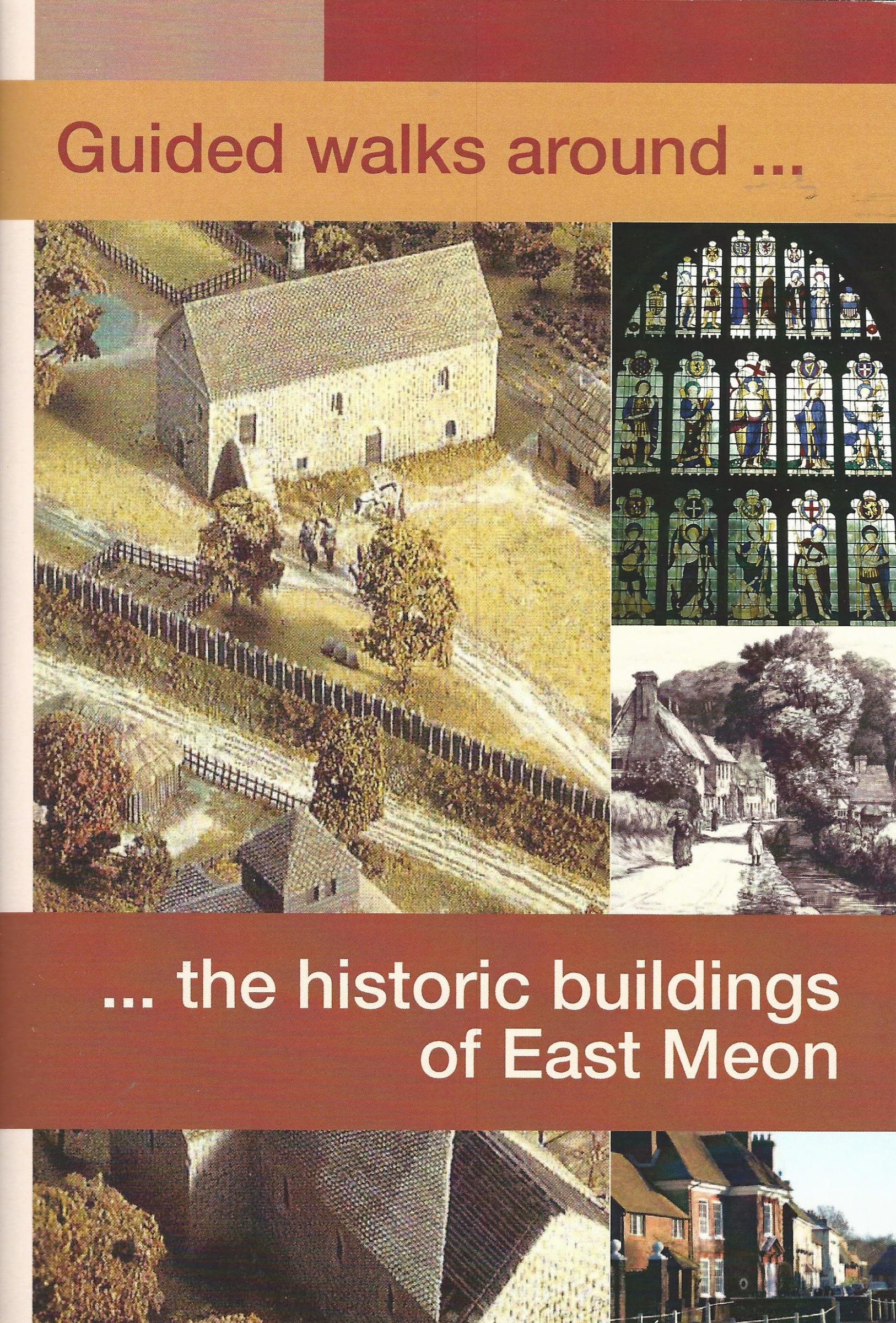
Guided walk around the historic buildings of East Meon
A guide book has since been published (£4 at East Meon Village Stores or at Petersfield Museum.)
Each property has been time time-lined where ever the records found to-date allow.
The records for the 1861 and 1871 census have yet to be searched for East Meon Kill/Kille’s.
Other records have been found but the locations given are “village”, “East Meon” or not defined.
Where the family member is known to be “in service” at a property, it has not been included.
1841 Frogmore – Nicholas and Grace Kille and family of six. Agr Labourer. (census)
1842 – Louis Kille (from burial record).
1851 – Nicholas and Grace and family of four. (census)
1859 – Nicholas Kille ( from burial record).
1861 – Nicholas and Jane and family of three, Thatcher/Agr Labourer. (census)
1878 – Ellen Kille (from burial record).
1881 – Nicholas and Jane Kille. Thatcher. (census)
1895 – Jane Kille (from burial record).
1906 – Nicholas Kille (from burial record).
1929 – Emily Kille (from burial record).
1861 Also Frogmore Mill, William and Ellen Kill and family of two. Farmer of 15 Acres and Carpenter. (census).
1841 Oxenbourne – James and Ann Kille and family of three. Agr Labourer. (census)
1851 – James and Ann and family of two. (census)
1841 High Street – Benjamin and Elizabeth Kille and family of four. Carpenter (census)
1841 High Street – William and Ellen Kille and family of two. Miller (census)
1841 High Street – Samuel and Sarah Kill and family of three. Builder. (census)
1841 Alley of Temple Lane – Joseph and Sarah Kill and family of six.Bricklayer. (census)
1861 17 Alley Street – Joseph and Sarah and family of three. Bricklayer. (census).
1845 East part of cottage lying on the west part of Heycrofte in the tithing of Meon Manor.
George Kille Carpenter on the surrender of Thomas Chase.
1863 To Frances Hiard widow on the surrender of George Kille.
1878 To Caleb Kille glazier, devisee of Frances Hiard Widow,late of East Meon.
1893 Surrender by Caleb Kille builder to Geroge Kille bricklayer on £100 mortgage.
1902 Admittance of Dorcas Kille of Bath spinster, saving the mortgage rights of George Kille.
1904 Conveyance of Rose Cottage, The Square, East Meon, formerly described as the east part
of a Cottage on the west part of Heycrofte in the tything of Meon Manor.(detail to yet to be examined).
1849 Court roll, Manor of East Meon: Admission of Samuel Kille builder of East Meon and William Alderslade yeoman of East Meon to a cottage, built upon 1 acre of land, and a garden in Riplington after the death of Robert Aburrow.
1856 Court roll, Manor of East Meon: Surrender of a cottage as above, by Samuel Kille and William Alderslade, to the use of Henry Hall Viscount Gage.
1851 Crop Street – James and Anne Kille and family of two. Agr Labourer. (census)
1851 Crop Lane – Benjamin and Elizabeth Kille and family of six. Carpenter/Joiner. (census)
1851 Holly Street Joseph and Sarah Kille and family of five. Bricklayer Journeyman. (census)
1851 Holly Street George and Lydia Kille. Carpenter Journeyman. (census)
1851 Holly Street Nicholas and Jane Kill. Thatcher / Agr Labourer. (census)
1851 Church Street Samuel and Annie Kill. Carpenter Journeyman. (census)
1861 3 Church Street – Samuel and Annie Kille and one child. Carpenter (census)
1851 Church Street – Stephen and Harriett Kill. Agr Labourer. (census)
1861 6 Church Street Benjamin and Elizabeth Killand family of four. Carpenter/Joiner
Elizabeth school mistress. (census)
1861 1 Little West Street – George and Lydia Kille, two nieces and Thomas Warren father in law
Carpenter and Grocer. (census)
1874 Spring Holes William Albert Kille (from burial record).
1881 Spring Holes Alfred and Mary Kille and family of four. Agr Labourer. (census)
1881 Providence Villa – Elizabeth Kille, Retd.School Mistress, Elizabeth Kille (daur), School Mistress and William Kille (bro) Agr. Labourer. (census)
1891 – Elizabeth Kille. Retd. School Mistress. (census)
1881 Rookham Lodge –Walter and Sarah Kille and family of six. Agr Labourer (census)
1891 – Walter and Sarah Kille and Family of four. Thatcher (census)
1911 The Hyde – Walter and Harriet Kille and one child. (census)
1914 Chapel Street – Walter Kille ( from burial record).
1986 Glencross, Chaple street – George Stanley Kille (from burial record).
1921 The Square – Arthur Kille (from burial record).
1922 A cottage in The Square, East Meon lately in the occupation of Mrs A. Kille, for sale by auction on 26th April 1922.
1924 Templars Brow – Dorothy Charlotte Kille (from burial record).
1927 High Street – Samuel Gilbert Kille ( from burial record)
Engraving of The Court House, taken from the Victoria County History.
The Court House and garden, late 1970s
Eastern aspect of the Hall
The interior of the Hall roof.
This brief history of The Court Hall was written to accompany an exhibition of the Winchester Pipe Rolls held in April 2011. Click here for the House History panel featuring The Court Hall
East Meon was the largest of the Bishop of Winchester’s manors in Hampshire, and the Pipe Rolls record the amount spent each year on maintenance and building works at the manor house, The Court House. About 20 years ago the architectural historian Edward Roberts identified the Pipe Rolls (those for 1395-6 and 1396-7) which record the building of the present house. From these building accounts we know where the materials used in its construction came from and how much they cost and the names of those who did the work and how much they were paid.
At the south end (where the present fireplace is) the hall was built on to a wing of the earlier building containing the bishop’s chamber and chapel. The doorway at the south-west corner, now blocked up, gave access to a staircase leading up to the chamber. The hall itself is 48 feet long and 26 feet wide and is over 40 feet up to the peak of the roof, which was covered with 35,500 tiles. There would have been an open fire in the middle, with the smoke finding its way upwards to louvres in the roof, as the blackened timbers of the roof show.
The walls are 4 feet thick and 20 feet high and are constructed mainly of white malmstone from Langrish and flints from the downs above the village. The roof, an independent structure that sits on the walls, was constructed during the very same months as the great roof of Westminster Hall. The great tie beams came from Durford Wood to the east of Petersfield. The corbels, the heads of bishops and kings, were carved in Winchester, and those of the bishops are probably a portrait of William of Wykeham, then in his 70s.
The windows were originally unglazed, but with shutters, the hinges of which remain. Glass, from Guildford, was inserted in 1440 by Cardinal Beaufort, Wykeham’s successor as bishop, who also remodelled (and possibly rebuilt) the wing at the end of the hall. The wing was demolished, probably in the early 17th century when the timber framed farmhouse wing that still stands on the east of the hall was built. The fireplace now in the hall is almost certainly that from Cardinal Beaufort’s new chamber.
There would have been a dais at the south end of the hall with a high table of beechwood that the accounts record as having been made for the new building along with trestle tables for the body of the hall. The bases of the present tables were made in 1736 out of Baltic oak for Middle Temple Hall in London, where they remained until 2000, when they were brought here and new tops were added to them.
At the opposite, north, end of the hall from the fireplace two doors lead into, respectively, the buttery (or bouteillerie, where drink was prepared) and the pantry (or painterie, where food was prepared). The lath and plaster division between these rooms has long since disappeared, but its location can be seen. The kitchen would, because of the fire hazard, have been a freestanding building to the east.
Above the buttery and pantry is the great chamber, 30 feet by 15, with a good, honey-coloured timber roof of similar construction to that of the great hall, and a fine fireplace. Access is by a staircase, with original wood block stairs, through a door on the outside of the great hall. Off the great chamber is a small room, formerly the garde-robe, with a drop down to a latrine below.
The names of those who constructed the building of 1395-7 are commemorated on a board in the great hall. The building itself has survived virtually unaltered through 6 centuries of low-key existence. It was sensitively restored by the architect Morley Horder in the first half of the 20th century. He added a north wing joining the house to the 18th century thatched cottage on the roadside and, between the hall and the early 18th century thatched barn, on what had become a farmyard, he laid out a garden with lawns and borders divided by low stone walls and yew hedges.
Click herefor source materials in the online archive.
On May 6th, 1985, the Sunday Times Colour Supplement published a feature entitled Domesday, The Conqueror Who Shaped England. The article described in great detail the state of England under William the Conqueror and the publication of the Domesday Book. It announced a Sunday Times exhibition in Winchester’s Great Hall, and included three photographic panels of East Meon, as ‘The Domesday Village’. These are photographs of the panel, with the text below.
First , “The Rev Peter Wadsworth in front of the Norman All Saints Church, East Meon.
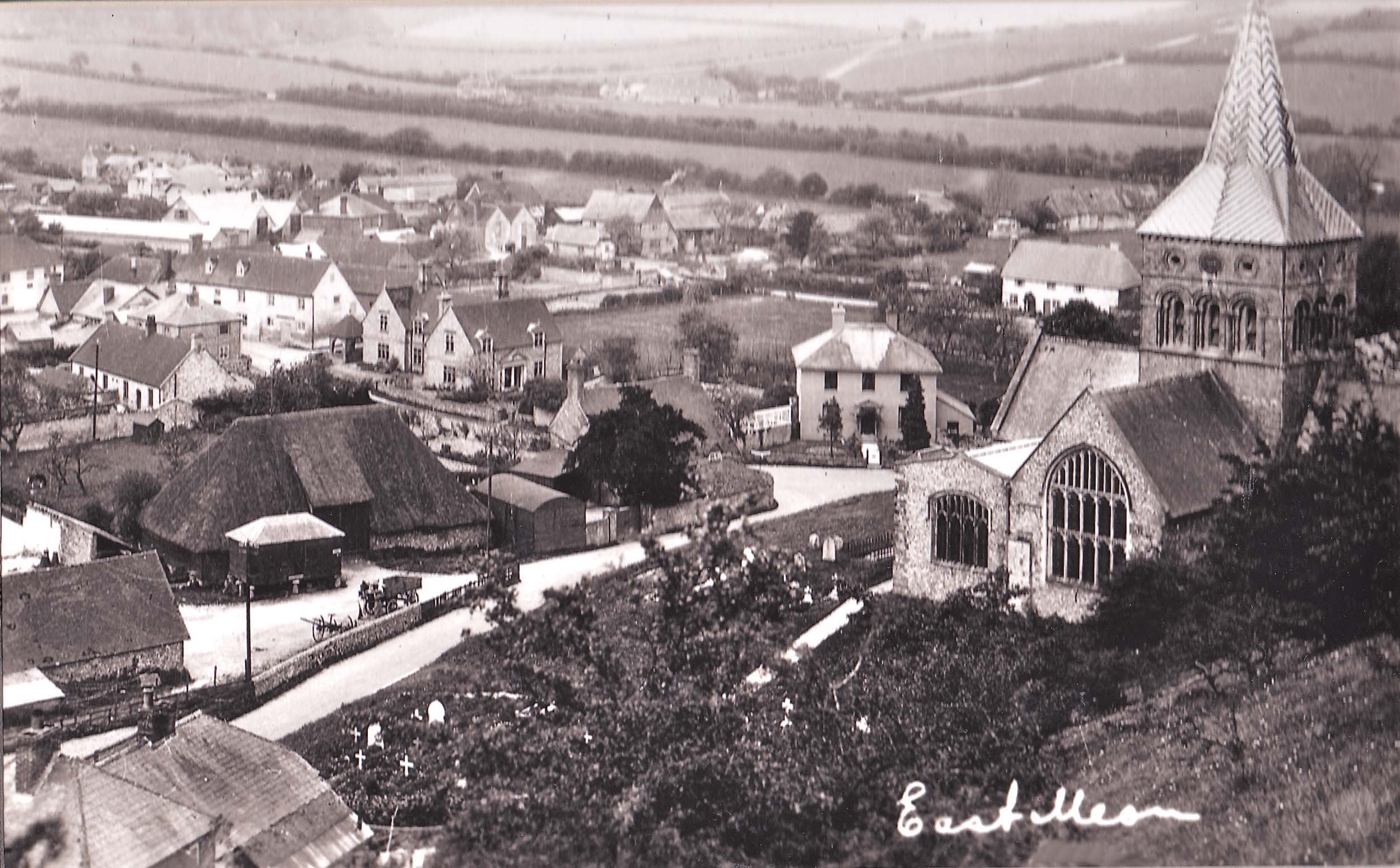
Second, “The Domesday Heritage. The Hampshire village of East Meon, target for The Sunday Times Domesday project, spreads itself beyond its Norman church under soaring hills which once formed a medieval deer park. Though only five miles west of bustling Petersfield, the village retains an ancient calm such as existed during the reign of William the Conqueror. Above left, the gable of a 14th-century manor house testifies to the site of an earlier manor held in Harold’s day by Stigand, Archbishop of Canterbury before the Conqueror replaced the Anglo-Saxon with a Norman priest. Where the village ends abruptly at its southeast corner (above right) the farming fields begin: now modern allotments, they were worked in the 11th century on a field strip system by the villagers for their lord and themselves.”
Note that in this note and the subsequent one, the paper has mis-identified the site of the Court Hall – its photographs are of The Tudor House.
Third, “Landmarks in Time. Two fine old Hampshire houses stand at the site of an ancient bridge over the River Meon. On the left, Forge Sound, a rare 14th-century aisled building, faces a second timber-framed cottage of the 1300s, with a 16th century extension. The Domesday Book records ’70 villagers and 32 smallholders’ living in this village, that might have looked much like these dwellings, though smaller. Right, a handsome 17th-century house with a mediaeval core. Such a building in William’s day might have housed the steward of the lord’s estate. The River Meon (left) runs through the village. It was diverted in the past to feed the six mills recorded in the Domesday Boook. The river, which reaches the Solent above Gosport, acted as a lifestream to villagers in the 11th century, providing them with fish and flooding their meadow-land. Researchers are now worming their way back through ancient maps and bishops’ accounts to produce a picture of Domesday East Meon, just as this summer thousands of schools all over Britain will be turning back the clock in the search for their Domesday origins.”
It is more likely that there was a ford, not a bridge, at Forge Sound.
Click here For a report on the village’s experience as ‘The Domesday Village’ in 1986.
The memorial was unveiled by General J S Nicholson MP, and dedicated by the Bishop of Lewes, in 1921
Designed by Sir John Ninian Comper (1864-1960), executed by stone-mason Andrew Perryman. Stone.
The memorial has a tall chamfered shaft with projecting moulded cap and bevelled cross. The cap of the shaft is decorated with a shield motif, and the top of the cross-head has a scroll across one face. The shaft rests on a plinth on top of a base. The plinth has an inscription reading ‘In memory of the men of East Meon who fell in the Great War 1914-1919’, and bears the names of those fallen. The plinth also carries a bronze plaque in the form of an open book with the inscription ‘1939-1945’ and a list of names of the fallen in World War II.
For information about the names from World War I, click here.
Before the present Village Hall was built in 1974, the social hub of East Meon had been the Parish Institute. Michael Blakstad has researched the minutes of the Management Committee of the Institute and wrote this article for Meon Matters, June 2014.
Before the Village Hall
Today’s Village Hall is a comparatively recent building, opened in January 1975; it plays a vital part in the community life of East Meon, providing a venue for meetings and indoor sports, organised by village societies, and for private social events such as weddings and funeral receptions. The Village Hall Committee works hard to maintain the building and schedule bookings, and to organise the Country Fair each May. But its predecessor was a more vibrant social centre, and demanded more its unpaid Committee.
I have been digging deep into the history of The Institute, the ramshackle building which was located opposite where East Meon Stores now stands. You may have seen the plaque in the foyer of today’s Hall which commemorates the building of the ‘Reading room, Library, Recreation and Coffee room …. legally secured through private beneficence …. in 1887, the year of the Jubilee of Queen Victoria’. It was donated by its benefactors to ‘the Parish of East Meon’, the church not the Parish Council.
The buildings were the cheapest available, mainly corrugated and galvanised iron sheeting. In 1885 it was listed as the ‘Working Men’s Reading Room and Library’, and its Librarian was William S Tregear, then master of the National School. In 1915 it was listed as the ‘East Meon Church Institute’, and ‘Institute’ became the name by which it was known.
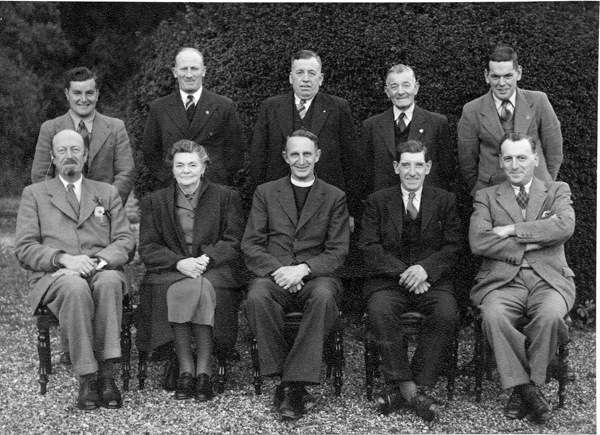
As part of his parish responsibilities, the Vicar of All Saints always chaired the Management Committee, until as recently as May 1968, when the legendary Herbie Goddard was elected to be the first regular lay chairman. Below is a photograph of a Management Committee in the late 1940s, with a commentary by Denys Ryder.
In the days before radio, and long before television, the Institute was a vital source of entertainment and social life in East Meon. In the 19th and early 20th centuries, there was a plethora of village music groups including a fife and drum band, a glee club, jazz and swing bands and a folk group. They all performed at the Institute.
Sports facilities included a billiards table, a boxing ring, and even a rifle range (where Park Vista is now located) all organised by the Committee, who also laid on regular dances. Village societies such as the British Legion also held events (the WI held cookery demonstrations). The National School, located on the West Meon road, used the Library and held overspill classes there. Vicars gave magic lantern shows. In the minutes of January 1931, it is recorded that ‘Mr Talbot Ponsonby was to give a play in aid of Institute funds’.
The rifle range is the long, light roof at the top left of this postcard.
Next to the Institute was the caretaker’s house, and the incumbent was responsible not only for maintenance of the facilities, but for taking bookings, collecting the money and supervising behaviour. Several of the entries in the minutes record damage done ‘by younger members’ at dances and unruly sports events.
The most depressing theme pervading the minutes was the constant need to refurbish and repair the buildings, reflecting the skimpy materials from which they were built.
Group of women and men, probably British Legion, in the old Institute.
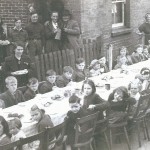
Dinner in the Institute, early ’50s
Children’s tea outside the Institute,
By Denys Ryder (from Meon Matters)
Running the Village Hall in the late 1940s was the domain of the men of the Village. Even so, Lady Margaret Nicholson, the last of the Nicholson ‘Gin’ family to live at Bereleigh, (sitting second left) was reported to be a very strong lady in her own right, could get her own way, and saw that the Village Institute & Library, as it was then know, was well run. Other characters were, (from left to right back row), W (Weary) Blackman from Drayton who worked at Bereleigh Estate on the farm side, Herbert (Herby) Goddard ran the garage and petrol pump from the yard of Glenthorne House. Jack Porter was the caretaker and Librarian and worked for the Ministry of Defence at Liphook. He was brother-in-law to Iris Porter. Frank Collyer, leader of the Home Guard and father of Margaret Tosdevine. He was a wood turner by trade. Finally, standing at the end of the row Reece Porter (husband to Iris). He was a Postman and assisted his brother looking after the Village Hall.
Sitting to the right of Lady Margaret Nicholson is Doc. Clifford, who ‘sported’ a ginger goatee beard and had one artificial leg. His surgery was in the Glebe House. The Church was represented by the Reverend Watkins. Harry Wynn was the local contractor who had a lorry and lived at Pidham Farm. He had a wood business and helped maintain the Church Yard. To complete the picture George Wilson Atkinson, father to Wilson and Mary Caines, represented the farming interests, as did his son Wilson for many years in the 1980/90s.
For records of the Institute in the online archive, click here
Persistent thefts of lead, from Meon Matters, 2011
A Question I am Frequently Asked. ‘What is happening about replacing the lead on the Lady Chapel roof ‘?
Well …. we clearly cannot afford to go on having the lead stolen as the insurance will only cover up to £5000 per year to replace stolen lead and we claimed most of that on the first theft. The second, and therefore uninsured loss, was nearly double that.
We have asked for and been given permission to replace the lead on the Lady Chapel roof with another material which will look almost identical from a distance to the lead, but be much less attractive to thieves. We are also installing a ”state of the art” security system, which will cover the whole of the roof in the hope that we will prevent any further attacks on our beautiful church.
We hope that this work will be done fairly soon as at the moment the Lady Chapel has tarpaulin over it and Terry is suffering from a severe lack of sleep on wet and windy nights for fear of the state of the Lady Chapel when he unlocks the church in the morning!!
Olivia Hickling – Church Warden
Report from Village Policeman, PC David Baker, on the first theft, 2009
Information from a local farmer, relating to suspicious vans and persons seen in the area of the old HMS Mercury, has led to a number of arrests and convictions for theft of lead and copper from the buildings on that site. Another area suffering thefts of metals is an industrial premises in Langrish. CCTV showed three offenders bolt cropping their way into locked compounds to steal metal cabling. Unfortunately the index number of their van is not visible, but it is a quite distinctive white Mercedes Sprinter fitted with a row of three spotlights on a roof bar above the cab. This has been circulated through police channels but if any resident happens to see a van fitting this description I would welcome the registration number. The value of scrap metal has seen thefts of these sorts increasing, many public buildings now mark their lead roof with smart water, which allows identification of the stolen lead. As a result of the recent success with All Saints Church, future police spot checks will be carried out on scrap lead stocks at Hampshire recycling yards.