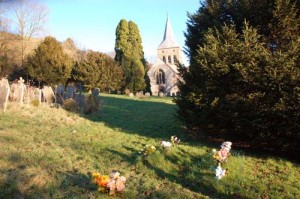
The memorial was unveiled by General J S Nicholson MP, and dedicated by the Bishop of Lewes, in 1921
Designed by Sir John Ninian Comper (1864-1960), executed by stone-mason Andrew Perryman. Stone.
The memorial has a tall chamfered shaft with projecting moulded cap and bevelled cross. The cap of the shaft is decorated with a shield motif, and the top of the cross-head has a scroll across one face. The shaft rests on a plinth on top of a base. The plinth has an inscription reading ‘In memory of the men of East Meon who fell in the Great War 1914-1919’, and bears the names of those fallen. The plinth also carries a bronze plaque in the form of an open book with the inscription ‘1939-1945’ and a list of names of the fallen in World War II.
For information about the names from World War I, click here.
Persistent thefts of lead, from Meon Matters, 2011
A Question I am Frequently Asked. ‘What is happening about replacing the lead on the Lady Chapel roof ‘?
Well …. we clearly cannot afford to go on having the lead stolen as the insurance will only cover up to £5000 per year to replace stolen lead and we claimed most of that on the first theft. The second, and therefore uninsured loss, was nearly double that.
We have asked for and been given permission to replace the lead on the Lady Chapel roof with another material which will look almost identical from a distance to the lead, but be much less attractive to thieves. We are also installing a ”state of the art” security system, which will cover the whole of the roof in the hope that we will prevent any further attacks on our beautiful church.
We hope that this work will be done fairly soon as at the moment the Lady Chapel has tarpaulin over it and Terry is suffering from a severe lack of sleep on wet and windy nights for fear of the state of the Lady Chapel when he unlocks the church in the morning!!
Olivia Hickling – Church Warden
Report from Village Policeman, PC David Baker, on the first theft, 2009
Information from a local farmer, relating to suspicious vans and persons seen in the area of the old HMS Mercury, has led to a number of arrests and convictions for theft of lead and copper from the buildings on that site. Another area suffering thefts of metals is an industrial premises in Langrish. CCTV showed three offenders bolt cropping their way into locked compounds to steal metal cabling. Unfortunately the index number of their van is not visible, but it is a quite distinctive white Mercedes Sprinter fitted with a row of three spotlights on a roof bar above the cab. This has been circulated through police channels but if any resident happens to see a van fitting this description I would welcome the registration number. The value of scrap metal has seen thefts of these sorts increasing, many public buildings now mark their lead roof with smart water, which allows identification of the stolen lead. As a result of the recent success with All Saints Church, future police spot checks will be carried out on scrap lead stocks at Hampshire recycling yards.
The East Window of All Saints Church – East Meon’s other War Memorial
Next month, precisely at 11 am on Sunday 13th November, many readers will be standing in East Meon’s main street, in front of the war memorial by the bridge at the George. Traffic will be halted and in respectful silence after the wreaths are laid on the steps below the cross, the words of Laurence Binyon “….. they shall not grow old…” will rise above the sounds of the valley. We treasure our memorial, it is a twofold record of war and the community. The names on it represent some of the families who in the last century were the backbone of East Meon; they energised the village – the shops, the pub, the garage, the smithy and also provided the individual tradesmen who made a living in the parish.
Although we cherish our stone cross by the river, in the Hampshire list of war memorials, it is not a spectacular affair and there are many similar stone crosses mounted on three stepped bases, against which red-poppy wreaths are laid year after year. The irony of this is that less than two hundred paces from this spot beside the river, East Meon has another unique and visually stunning war memorial, which is largely unnoticed and under- celebrated. It stands nearly thirty feet high, glittering with colour each morning behind the altar in the Church.
The east window of All Saints Church is perhaps unnoticed because the caption “in memoriam 1914-1919”, which is the vital clue to its theme and reason for being there, is obscured from the congregation by the top edge of the altar screen.
From a distant seat in the pews, all you can see is the familiar shapes of a church window, stained glass saints in rows framed in perpendicular stone. Move closer and the details reveal a rather mysterious and secular work by the great British architect and designer Sir Ninian Comper, which has more to do with war and grand political alliances than God. The saints and the countries they represent, which you can identify by the national coat of arms above them, are the victorious side in the First World War, not a parable from the Bible. Saints Vladimir, Methodius and Adrian are for Russia, Serbia and Romania, they stand alongside the more familiar patron saints of England, Scotland, Ireland, Wales, Belgium, France and Italy. On the top row in smaller scale are the Royal arms of UK (left) and the seal of the President of the United States (right)
Three unexplained saints on the bottom row are (centre) St Nicholas for the Royal Navy, right of him St George for the Army and left St Michael (with the wings) the patron saint of the newly created Royal Air Force.
From a closer position directly below the window there is much to admire, Comper’s design has clarity, elegance, rich colours and some great detail. Symbols help to identify each saintly figure – St Catherine holds a lily, St Joan stands ambitiously looking upwards in her armoured leggings, St Adrian carries an anvil and a hammer.
The figures are graceful, the drawing is tremendous, but Comper’s overall message is obscure. Without reading the terms of his commission, it is hard to understand what this huge window is trying to say. Except for peaceful St Catherine with her lily, the saints are mostly armed, swords, spears, lances, pikes thrust in every direction. Two dragons are being killed violently and a lion has been subdued. Is this a celebration of allied victory, good over evil, peace after war? All of these post war issues were certainly raging in the public debate of the early 1920s. But perhaps the unresolved theme gives the window another dimension, compels us to keep looking, thinking and even returning for another look.
The east window may be an undervalued memorial because, unlike the stone cross beside the river, it seems to stand aloof from the village, physically by its position in the church and socially because its content seems to relate more to grand strategy and moral debate than to the people of East Meon. But this was not the intent of Sir Ninian or the Nicholson family who were instrumental in its commission. In the 1920 planning request the then vicar, Reverend T.H. Masters∗. emphasised that these things “are being done in memory of East Meon men who fell in the Great War”. To make his point a stone tablet was also carved (you will find it below the HMS Mercury bell) to connect the window to the people of the village. But by a misfortune of positioning the tablet is too far from the window to make this connection in a compelling manner. The window and the tablet face in different directions and it is hard to relate them.
Nevertheless the east window is by national, perhaps even international standards, an interesting memorial and certainly worth turning from your path to see at close quarters. So three cheers for Sir Ninian and three more for the Nicholsons and Reverend JH Master and the East Meon team who between them, nearly a hundred years ago had the vision and generosity to create this work of art that we continue to enjoy in the 21st Century.
∗ In World War 1 Reverend T.H. Masters had served as a Red Cross Ambulance Driver and then as a chaplain in France (including the Somme), was twice mentioned in dispatches and appointed CBE subsequently Vicar of Petersfield and Provost of Portsmouth Cathedral. He. He is buried against the west wall of the churchyard alongside Frank Partridge, second Bishop of Portsmouth.
For the page on the stone War Memorial by the River Meon, click here. For more about Rev Masters, click here.
We were having a natter, my daughter and I, at the bus stop – the one beside the lych gate, where the path leads up to the church. The sun was shining, the daffodils were fading, but the daisies and the wild flowers were appearing all over the place; everything looked great, it was just the sort of day you wish people to come and see our village. And sure enough at that moment a group of visitors approached, each one earnestly clutching a green coloured guidebook.
“What are you looking for?” we asked, “the Tournai font” they replied.
“The Tournai what?” whispered my university educated daughter. “Font!” I said. “Sounds a bit Belgian – I didn’t know we had a new font”.
“Not new, we got it about 850 years ago, and as a matter of fact you were baptised in it.”
It used to be said that to be a true East Meoner you had to have fallen in the river, I mean completely in – so that you had to go home to change. But perhaps being christened in the Tournai font would make a better test. After all any wedding guest or casual visitor leaving the pub might fall completely into the river, but you need to have been connected to the village from birth to be christened here. And the problem is that when you are being christened you tend not to remember much about the details of the font – or anything at all really.
At a modest rate of twenty or so christenings a year, since 1150 there must have been about seventeen to twenty thousand babies christened in our Tournai font, and if you are one of them I suggest you come back and take a look at it. It’s a truly remarkable stone. It was carved from the hardest blue-black marble from the banks of the river Scheldt by the local sculptors of Tournai in Flanders for a grandson of William the Conqueror who was then the lord of the manor in East Meon Court House. When it was finished it was transported by rafts and sailing boats across the Channel and along the south coast of England and finished its journey to East Meon on an ox cart.
Because it was carved in Tournai, not Hampshire, and almost 500 years before Gallileo got into to trouble with the Inquisition, it presents a strange and barely recognisable version of the world.
This gallery follows the construction of the Frame and Vestry, made by Steve Lamont. To view the process of creating the Millennium Embroidery, click here.
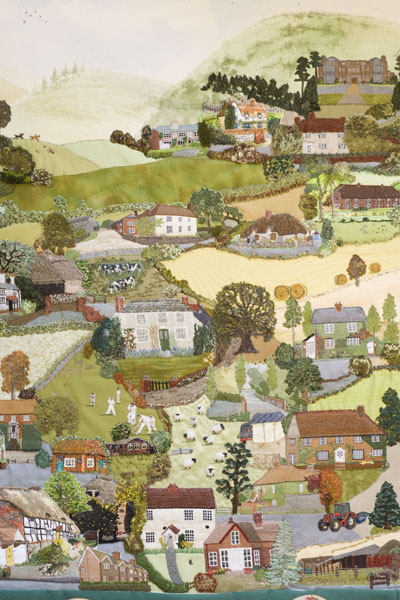
November 2008 saw the culmination of almost a decade of work by a dedicated team of embroiderers, who had sewn this embroidery representing the village.
The group got together to plan the embroidery in January 2000, in the sitting room of The Tudor House. In this picture, L to R, Jean Rockett, Tiggy Greenwood, Sue Barrett, Jane Sims, (kneeling) Cathy Clayson
The group decides the likely layout of the embroidery, on the dining room table at the Tudor House.
At this stage the project was in effect a cottage industry, with individuals and families working on their own sections of the embroidery in their own homes.
Jane with the keystone Millennium oval.
Some men contributed to the embroidery. Here is Adrian Pelly, since sadly deceased, with a bird he had sewn.
Charles Clayson doing close work.The project could have ground to a halt when, in 2003, Charles and Cathy Clayson decided to realise their long-held dream of buying a house in the Mediterranean and moved their home to Mallorca. Although they sold their house in East Meon they kept an English base near Chichester and the monthly progress meetings continued as regular as clockwork.
Detail of top border. There follow some other details of the embroidery round the border. The work continued for five years with Cathy returning to East Meon every third Tuesday and Wednesday when they were in the UK, and with Maggie Marks, Ann Hutchings or Jane Brown deputising for them when they were in the Mediterranean.
Detail – Badger & Primroses
Chaffinch & Blue Tit
And details from the embroidery proper. The Court Hall.
Almshouses
Glenthorne-House
Detail showing the centre of the village, including All Saints Church
Detail including Horses in field and, in foreground, Forge Sound and Riverside Cottages.
Originally, no figures were planned but Ann Hutchings is a particularly talented embroiderer and was particularly good at doing figures, so a few villagers were depicted, as well as a wedding carriage drawn by horses at the church gate (above). A few notable buildings outside East Meon – Bereleigh, Leydene and Drayton – were depicted on the fringes.
Detail from the ‘East End’ of the embroidery, showing a game of cricket on the Recreation ground.
Syvia Brindley and Jolene, working at one of the monthly sewing sessions held in the Church Hall. The work continued for six years, with Cathy and Charles Clayson attending these monthly meetings when they were in England.
Cathy Clayson stretching the canvas.Just before they moved out of the village, Charles built the wooden frame onto which the calico was stretched by hand. The frame wouldn’t fit in their roof-rack so it had to be manually carried to the Hall. The calico was stretched by hand and stapled in place – with several attempts required before the weave was sufficiently well-aligned and under the correct tension.
Stretching the canvas on to the oak frame. With the embroidery in position, it was time to prepare the canvas to be mounted in its oak cabinet. At this stage the project had to move from being a cottage industry to the business of assembling the individual elements onto the calico.
Charles Clayson transfers the panel to the oak frame.
With the frame now mounted in the Church Room, the embroiderers began to sew the individual elements onto the canvas. In the purple cardigan, Jane Sims; in the blue, Anne Huthcings – two of the most skilled needlewomen in the team.
The vicar, the Rev Terry Louden, takes a look at the embroidery coming together.
The sky and the hills surrounding the village were painted on to form a background and as other individual pieces were embroidered they were pinned onto the calico.
Sewers came in all ages and sizes……… The sky and the hills surrounding the village were painted on to form a background and as other individual pieces were embroidered they were pinned onto the calico.
Alexa takes a turn at the back
At this stage the project had to move from being a cottage industry – with individual elements being stitched all around East Meon – to the business of assembling the individual elements onto the calico. The sky and the hills surrounding the village were painted on to form a background and as other individual pieces were embroidered they were pinned onto the calico.
On September 4th, 2008, a small reception was held in the Church Hall to thank those who had helped in the creation of the Millennium Embroidery project.
The vicar of All Saints, the Rev Terry Louden, thanked Cathy and her co-workers. He praised the magnificent result and stressed that this is a village project to which the church has provided house room. The Parochial Church Council had commissioned a mighty oak frame in the North aisle, created by villager Steve Lamont
At the party, all those who had been involved were invited to sign the back of the Embroidery – here, Tricia Blakstad, with Susan Hull behind her.
The Parochial Church Council had commissioned a mighty oak frame to be placed in the North aisle, created by Steve Lamont , a carpenter then living in the village. For a record of its construction, go to the Embroidery Frame gallery. he embroidery is protected by a laminated glass window and illuminated by 66 optical fibres (Charles Clayson researched the best technology to achieve the delicate balance between making the tapestry visible but not fading the colours).
The Millennium Embroidery and the Vestry unit were dedicated by the Archdeacon of the Meon, the Venerable Peter Hancock, at a service in All Saints on 2nd November 2008. Left to right, Steve Lamont, Charles and Cathy Clayson and Archdeacon Hancock.
Archdeacon Peter Hancock spoke about the work involved in creating the Embroidery
The Tournai font, one of only seven, the gift of Henry of Blois
Amens Plenty stone in All Saints church
Sir Ninian Comper
The Church Hall was dedicated in November 2000
Detail from the 'East End' of the embroidery, showing a game of cricket on the Recreation ground.
The size and majesty of this Norman church reflects the importance in mediaeval times of East Meon parish. At the foot of this page is a PDF of a talk given by Michael Blakstad on its history, whilst a brief version is given on the web pages in this section.
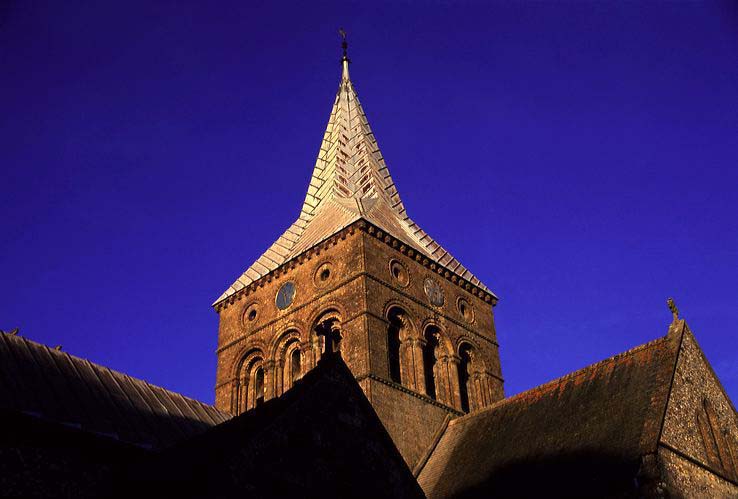
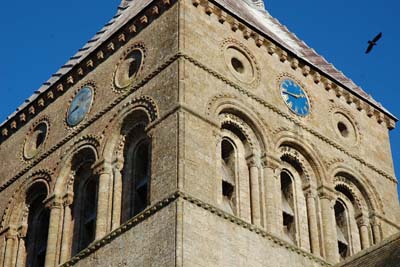
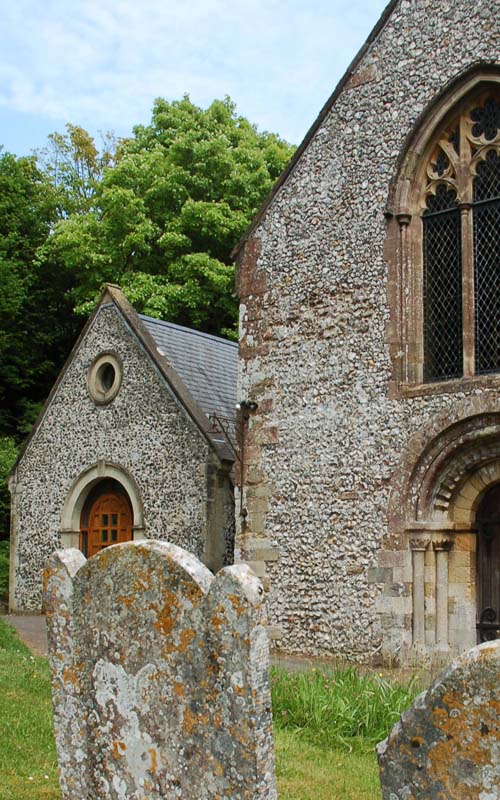
The church of All Saints was completed in about 1150. The original church was cruciform in shape, consisting of nave, chancel, and transepts, and the original work is clearly identifiable in the round-topped arches typical of Norman or Romanesque style, and in the West and South doorways. The only major addition to the church subsequently was made in about 1230, when the South Aisle and Lady Chapel were added, in the new Early English style, with its pointed arches and larger windows. The spire was probably added at this time too.
Tournai Font
Among the church’s most important treasures is the black marble Tournai font dating from the church’s completion and one of only seven in the country. The font was probably a gift from the Bishop of Winchester, Henry of Blois, grandson of the Conqueror. The carvings on the four sides are illustrations from the opening chapters of Genesis, executed in a Romanesque style.
The Victorians
In 1869-1870, there was a major internal and external restoration. The vicar, William Brodie, enlisted the help of the well-known Victorian architect, Ewen Christian (1814- 1895). The obvious external signs of this restoration are gutters and down pipes. Christian worked on the roofs, especially the Lady Chapel, chancel and transepts, and also on the spire. The three-faced clock came at this time. Internally, the box pews and gallery were removed, and were replaced by the pews as we have them today. Christian’s restoration also uncovered the remains of the four soldiers from the Civil War period who were curiously buried upright, and whose remains are marked by the ‘Amens Plenty’ stone now in the South Transept.
Sir Ninian Comper
The church internally owes its greatest debt to the work of the distinguished church architect, Sir Ninian Comper (1864 -1960) Comper was much influenced by the Arts and Crafts movement associated with William Morris, and had an interest not just in architecture, but also in church fabric and furnishings. Comper was employed here by Thomas Heywood Masters, vicar from 1902-1921. He was responsible for the two altars in the Sanctuary and the Lady Chapel, the reredos behind the Lady Chapel altar and the timber screens surrounding the Lady Chapel. This work expressed Comper’s emphasis, as an Anglo-Catholic, that the primary purpose of a church as a place of worship is for the celebration of the Eucharist.
After the First World War, Comper designed the great East window depicting the coats of arms and patron saints of those countries who formed the alliance which defeated Germany and its allies. The window was dedicated in 1921.
Church Hall
The building of the Church Hall, completed in 2000, and designed to be in sympathy with the Norman church, speaks of a desire to serve community needs, which is both modern and also as old as the Middle Ages.
Millennium Embroidery
Visitors now come to admire the magnificent Millennium Embroidery, illuminated in its huge oak display case, which depicts the village in the year 2000 and was the work of a team of forty skilled needleworkers over several years before its installation in 2008.
The memorials in the Lady Chapel merit inspection. In the 18th and 19th century it became de rigueur, perhaps through the increased interest in classical times when these things were also fashionable, to erect monuments in churches to the great and good. Their florid language is very attractive, though the cynic may wonder whether there is not sometimes an element of hyperbole and exaggeration. The Bonham memorial in the churchyard, erected in about 1800, and a Grade II listed structure, was also part of this fashion.
The repositioning of organ and choir and the installing of the nave altar reflect changes in liturgical style in the second half of the 20th century. The building of the Church Hall, completed in 2000, and so designed so as to be in sympathy with the Norman church, testify of a desire to serve community needs, which is both modern and also as old as the Middle Ages.
The churchyard has grown in size over the years. The last addition was at the east end about a hundred years ago. To conclude: externally, the building remains fundamentally as it always has been, and it is a significant and unchanging landmark in this area. Internally, it has seen a process of change, driven by the changing contexts of politics, religion and society. The Normans would not easily recognise the church’s interior, so different now from the 12th century. And I suspect that if we were able to return here in a few hundred years time, whilst the shell of the building would remain (provided our successors have the resources for upkeep), internally another process of change would have taken place. And for a living church, that is absolutely right.
This section of the website contains a variety of records, including the history of All Saints Church, research into some of the village’s more historic buildings, profiles of notable residents, and a selection of recent events – part of East Meon’s ‘living history’.
‘Lost and Found’ features research carried out in response to queries by people from all over the world whose ancestors may have lived here or, in one case, by the curator of a museum in Texas enquiring about a painting in his collection.
‘Farms and Farmers’ contains a number of reports, mostly taken from the parish magazine ‘Meon Matters’, on agriculture past and present.
The Tounai font, one of only seven, the gift of Henry of Blois.