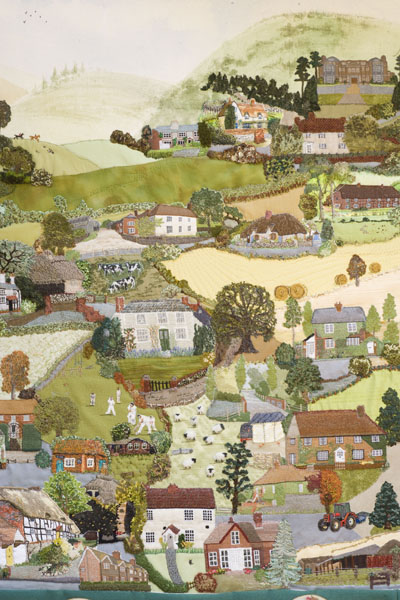
November 2008 saw the culmination of almost a decade of work by a dedicated team of embroiderers, who had sewn this embroidery representing the village.
The group got together to plan the embroidery in January 2000, in the sitting room of The Tudor House. In this picture, L to R, Jean Rockett, Tiggy Greenwood, Sue Barrett, Jane Sims, (kneeling) Cathy Clayson
The group decides the likely layout of the embroidery, on the dining room table at the Tudor House.
At this stage the project was in effect a cottage industry, with individuals and families working on their own sections of the embroidery in their own homes.
Jane with the keystone Millennium oval.
Some men contributed to the embroidery. Here is Adrian Pelly, since sadly deceased, with a bird he had sewn.
Charles Clayson doing close work.The project could have ground to a halt when, in 2003, Charles and Cathy Clayson decided to realise their long-held dream of buying a house in the Mediterranean and moved their home to Mallorca. Although they sold their house in East Meon they kept an English base near Chichester and the monthly progress meetings continued as regular as clockwork.
Detail of top border. There follow some other details of the embroidery round the border. The work continued for five years with Cathy returning to East Meon every third Tuesday and Wednesday when they were in the UK, and with Maggie Marks, Ann Hutchings or Jane Brown deputising for them when they were in the Mediterranean.
Detail – Badger & Primroses
Chaffinch & Blue Tit
And details from the embroidery proper. The Court Hall.
Almshouses
Glenthorne-House
Detail showing the centre of the village, including All Saints Church
Detail including Horses in field and, in foreground, Forge Sound and Riverside Cottages.
Originally, no figures were planned but Ann Hutchings is a particularly talented embroiderer and was particularly good at doing figures, so a few villagers were depicted, as well as a wedding carriage drawn by horses at the church gate (above). A few notable buildings outside East Meon – Bereleigh, Leydene and Drayton – were depicted on the fringes.
Detail from the ‘East End’ of the embroidery, showing a game of cricket on the Recreation ground.
Syvia Brindley and Jolene, working at one of the monthly sewing sessions held in the Church Hall. The work continued for six years, with Cathy and Charles Clayson attending these monthly meetings when they were in England.
Cathy Clayson stretching the canvas.Just before they moved out of the village, Charles built the wooden frame onto which the calico was stretched by hand. The frame wouldn’t fit in their roof-rack so it had to be manually carried to the Hall. The calico was stretched by hand and stapled in place – with several attempts required before the weave was sufficiently well-aligned and under the correct tension.
Stretching the canvas on to the oak frame. With the embroidery in position, it was time to prepare the canvas to be mounted in its oak cabinet. At this stage the project had to move from being a cottage industry to the business of assembling the individual elements onto the calico.
Charles Clayson transfers the panel to the oak frame.
With the frame now mounted in the Church Room, the embroiderers began to sew the individual elements onto the canvas. In the purple cardigan, Jane Sims; in the blue, Anne Huthcings – two of the most skilled needlewomen in the team.
The vicar, the Rev Terry Louden, takes a look at the embroidery coming together.
The sky and the hills surrounding the village were painted on to form a background and as other individual pieces were embroidered they were pinned onto the calico.
Sewers came in all ages and sizes……… The sky and the hills surrounding the village were painted on to form a background and as other individual pieces were embroidered they were pinned onto the calico.
Alexa takes a turn at the back
At this stage the project had to move from being a cottage industry – with individual elements being stitched all around East Meon – to the business of assembling the individual elements onto the calico. The sky and the hills surrounding the village were painted on to form a background and as other individual pieces were embroidered they were pinned onto the calico.
On September 4th, 2008, a small reception was held in the Church Hall to thank those who had helped in the creation of the Millennium Embroidery project.
The vicar of All Saints, the Rev Terry Louden, thanked Cathy and her co-workers. He praised the magnificent result and stressed that this is a village project to which the church has provided house room. The Parochial Church Council had commissioned a mighty oak frame in the North aisle, created by villager Steve Lamont
At the party, all those who had been involved were invited to sign the back of the Embroidery – here, Tricia Blakstad, with Susan Hull behind her.
The Parochial Church Council had commissioned a mighty oak frame to be placed in the North aisle, created by Steve Lamont , a carpenter then living in the village. For a record of its construction, go to the Embroidery Frame gallery. he embroidery is protected by a laminated glass window and illuminated by 66 optical fibres (Charles Clayson researched the best technology to achieve the delicate balance between making the tapestry visible but not fading the colours).
The Millennium Embroidery and the Vestry unit were dedicated by the Archdeacon of the Meon, the Venerable Peter Hancock, at a service in All Saints on 2nd November 2008. Left to right, Steve Lamont, Charles and Cathy Clayson and Archdeacon Hancock.
Archdeacon Peter Hancock spoke about the work involved in creating the Embroidery